


Page 1869 - Hematology_ Basic Principles and Practice ( PDFDrive )
P. 1869
Chapter 108  Graft-Versus-Host Disease and Graft-Versus-Leukemia Responses  1661


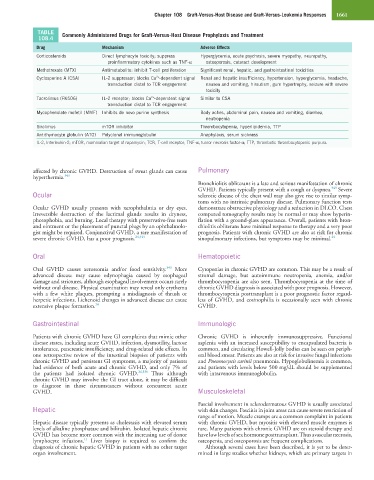
             TABLE   Commonly Administered Drugs for Graft-Versus-Host Disease Prophylaxis and Treatment
              108.4
             Drug                 Mechanism                        Adverse Effects
             Corticosteroids      Direct lymphocyte toxicity; suppress   Hyperglycemia, acute psychosis, severe myopathy, neuropathy,
                                    proinflammatory cytokines such as TNF-α  osteoporosis, cataract development
             Methotrexate (MTX)   Antimetabolite: inhibit T-cell proliferation  Significant renal, hepatic, and gastrointestinal toxicities
                                                    2+
             Cyclosporine A (CSA)  IL-2 suppressor; blocks Ca -dependent signal  Renal and hepatic insufficiency, hypertension, hyperglycemia, headache,
                                    transduction distal to TCR engagement  nausea and vomiting, hirsutism, gum hypertrophy, seizure with severe
                                                                    toxicity
             Tacrolimus (FK506)   IL-2 receptor; blocks Ca -dependent signal   Similar to CSA
                                                  2+
                                    transduction distal to TCR engagement
             Mycophenolate mofetil (MMF)  Inhibits de novo purine synthesis  Body aches, abdominal pain, nausea and vomiting, diarrhea,
                                                                    neutropenia
             Sirolimus            mTOR inhibitor                   Thrombocytopenia, hyperlipidemia, TTP
             Antithymocyte globulin (ATG)  Polyclonal immunoglobulin  Anaphylaxis, serum sickness
             IL-2, Interleukin-2; mTOR, mammalian target of rapamycin; TCR, T-cell receptor; TNF-α, tumor necrosis factor-α; TTP, thrombotic thrombocytopenic purpura.


            affected by chronic GVHD. Destruction of sweat glands can cause   Pulmonary
            hyperthermia. 343
                                                                  Bronchiolitis obliterans is a late and serious manifestation of chronic
                                                                                                             343
                                                                  GVHD. Patients typically present with a cough or dyspnea.  Severe
            Ocular                                                sclerotic disease of the chest wall may also give rise to similar symp-
                                                                  toms with no intrinsic pulmonary disease. Pulmonary function tests
            Ocular  GVHD  usually  presents  with  xerophthalmia  or  dry  eyes.   demonstrate obstructive physiology and a reduction in DLCO. Chest
            Irreversible  destruction  of  the  lacrimal  glands  results  in  dryness,   computed tomography results may be normal or may show hyperin-
            photophobia, and burning. Local therapy with preservative-free tears   flation with a ground-glass appearance. Overall, patients with bron-
            and ointment or the placement of punctal plugs by an ophthalmolo-  chiolitis obliterans have minimal response to therapy and a very poor
            gist might be required. Conjunctival GVHD, a rare manifestation of   prognosis. Patients with chronic GVHD are also at risk for chronic
            severe chronic GVHD, has a poor prognosis. 24,343     sinopulmonary infections, but symptoms may be minimal. 24

            Oral                                                  Hematopoietic

                                                       343
            Oral  GVHD  causes  xerostomia  and/or  food  sensitivity.   More   Cytopenias in chronic GVHD are common. This may be a result of
            advanced  disease  may  cause  odynophagia  caused  by  esophageal   stromal  damage,  but  autoimmune  neutropenia,  anemia,  and/or
            damage and strictures, although esophageal involvement occurs rarely   thrombocytopenia are also seen. Thrombocytopenia at the time of
            without oral disease. Physical examination may reveal only erythema   chronic GVHD diagnosis is associated with poor prognosis. However,
            with  a  few  white  plaques,  prompting  a  misdiagnosis  of  thrush  or   thrombocytopenia posttransplant is a poor prognostic factor regard-
            herpetic infections. Lichenoid changes in advanced disease can cause   less  of  GVHD,  and  eosinophilia  is  occasionally  seen  with  chronic
            extensive plaque formation. 24                        GVHD.

            Gastrointestinal                                      Immunologic

            Patients with chronic GVHD have GI complaints that mimic other   Chronic  GVHD  is  inherently  immunosuppressive.  Functional
            disease states, including acute GVHD, infection, dysmotility, lactose   asplenia with an increased susceptibility to encapsulated bacteria is
            intolerance, pancreatic insufficiency, and drug-related side effects. In   common, and circulating Howell-Jolly bodies can be seen on periph-
            one  retrospective  review  of  the  intestinal  biopsies  of  patients  with   eral blood smear. Patients are also at risk for invasive fungal infections
            chronic GVHD and persistent GI symptoms, a majority of patients   and Pneumocystis carinii pneumonia. Hypoglobulinemia is common,
            had evidence of both acute and chronic GVHD, and only 7% of   and patients with levels below 500 mg/dL should be supplemented
            the  patients  had  isolated  chronic  GVHD. 24,336   Thus  although   with intravenous immunoglobulin.
            chronic GVHD may involve the GI tract alone, it may be difficult
            to  diagnose  in  those  circumstances  without  concurrent  acute
            GVHD.                                                 Musculoskeletal

                                                                  Fascial involvement in sclerodermatous GVHD is usually associated
            Hepatic                                               with skin changes. Fasciitis in joint areas can cause severe restriction of
                                                                  range of motion. Muscle cramps are a common complaint in patients
            Hepatic disease typically presents as cholestasis with elevated serum   with chronic GVHD, but myositis with elevated muscle enzymes is
            levels of alkaline phosphatase and bilirubin. Isolated hepatic chronic   rare. Many patients with chronic GVHD are on steroid therapy and
            GVHD has become more common with the increasing use of donor   have low levels of sex hormone posttransplant. Thus avascular necrosis,
                             11
            lymphocyte  infusions.   Liver  biopsy  is  required  to  confirm  the   osteopenia, and osteoporosis are frequent complications.
            diagnosis of chronic hepatic GVHD in patients with no other target   Although several cases have been described, it is yet to be deter-
            organ involvement.                                    mined in large studies whether kidneys, which are primary targets in

