


Page 1871 - Hematology_ Basic Principles and Practice ( PDFDrive )
P. 1871
Chapter 108  Graft-Versus-Host Disease and Graft-Versus-Leukemia Responses  1663


            (sCD13); sBAFF and anti-dsDNA also may be elevated in patients   However, in patients classified as high-risk on the basis of platelet
            with  late-onset  chronic  GVHD,  but  these  biomarkers  need  to     counts below 100,000/µL, treatment with prednisone alone resulted
            be validated in much larger cohorts before definitive conclusions can   in only 26% 5-year survival. When a similar group of patients was
            be drawn.                                             treated  with  alternating-day  CSA  and  prednisone,  5-year  survival
                                                                             367
                                                                  exceeded  50%.   A  randomized  study  of  patients  with  extensive
                                                                  GVHD found no difference when prednisone alone was compared
            THERAPY FOR CHRONIC GRAFT-VERSUS-HOST DISEASE         with prednisone plus CSA.  For chronic GVHD that recurs or fails
                                                                                      24
                                                                  to respond to initial therapy, there is no standard treatment. A small
            Chronic GVHD has a major impact on both quality of life and sur-  recent study has shown that an 8 week administration of low dose,
            vival, frequently involves multiple organs, and necessitates prolonged   subcutaneous  IL-2  ameliorated  several  manifestations  of  chronic
                                 360
            immunosuppressive therapy.  One report noted that 15% of cancer-  GVHD that was resistant to steroids, particularly in the skin. 9,368  This
            free patients were still receiving immunosuppressive therapy after 7   improvement was associated with an increase in Tregs. This increase
                361
            years.  The more severe forms of chronic GVHD are clearly associ-  was caused by enhanced, proliferation, thymic export and resistance
            ated with a lower disease-free survival. Thus the potential benefit of a   to  apoptosis. 10,171   Randomized  clinical  trials  of  this  approach  are
            GVL effect is shadowed by significant treatment-related mortality. 361  currently  being  conducted.  Other  experimental  therapies  include
              Current therapies for chronic GVHD are of limited efficacy, and   psoralen plus ultraviolet light A, MMF, thalidomide, total lymphoid
            there is no long-term satisfactory regimen for patients who do not   irradiation, Plaquenil, extracorporeal photopheresis, pentostatin, and
                                                                         338
            respond to front-line steroid-based therapy. Indeed, no medication   acetretin.  (see Table 108.4, for list of the commonly used GVHD
            has been approved by the Food and Drug Administration for use in   drugs and their side effects.)
            chronic GVHD. The lack of standardized response criteria to measure
            therapeutic efficacy poses a major obstacle to pursuing therapeutic
            trials in chronic GVHD. Overall survival and/or discontinuation of   Transfusion-Associated Graft-Versus-Host Disease
            systemic  immunosuppression  are  accepted  long-term  endpoints  in
            chronic GVHD trials. The recent NIH-sponsored consensus project   Most blood products administered to immunocompromised patients
            provided, for the first time, a set of standardized measures and defini-  are now irradiated or at least leukocyte-depleted to avoid the transfu-
            tions to use as response criteria in chronic GVHD. 341,342  Nonetheless,   sion  of  viable  alloreactive  T  cells.  With  most  homologous  blood
            these recommendations are yet to be tested and validated in prospec-  products,  the  MHC  incompatibility  between  donor  and  recipient
            tive  studies. The  NIH  consensus  conference  has  defined  response   results  in  rapid  clearance  of  transfused  T  cells  by  the  recipient’s
            measures that are classified in two main groups: clinician-assessed and   immune  system.  However,  occasionally,  transfusions  from  donors
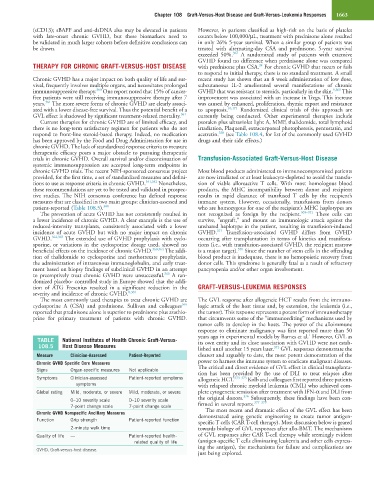
            patient-reported (Table 108.5). 348                   who are homozygous for one of the recipient’s MHC haplotypes are
              The prevention of acute GVHD has not consistently resulted in   not  recognized  as  foreign  by  the  recipient. 369–371   These  cells  can
            a lower incidence of chronic GVHD. A clear example is the use of   survive,  “engraft,”  and  mount  an  immunologic  attack  against  the
            reduced-intensity  transplants,  consistently  associated  with  a  lower   unshared haplotype in the patient, resulting in transfusion-induced
                                                                        371
            incidence  of  acute  GVHD  but  with  no  major  impact  on  chronic   GVHD.   Transfusion-associated  GVHD  differs  from  GVHD
            GVHD. 362,363  The extended use of GVHD prophylaxis with cyclo-  occurring after transplantation in terms of kinetics and manifesta-
            sporine,  or  variations  in  the  cyclosporine  dosage  used,  showed  no   tions (i.e., with transfusion-associated GVHD, the recipient marrow
                                                                               370
            beneficial effects on the incidence of chronic GVHD. 360,364  The addi-  is a major target).  Since the number of stem cells in the offending
            tion of thalidomide to cyclosporine and methotrexate prophylaxis,   blood product is inadequate, there is no hemopoietic recovery from
            the administration of intravenous immunoglobulin, and early treat-  donor cells. This syndrome is generally fatal as a result of refractory
            ment based on biopsy findings of subclinical GVHD in an attempt   pancytopenia and/or other organ involvement.
                                                       360
            to  preemptively  treat  chronic  GVHD  were  unsuccessful.   A  ran-
            domized placebo- controlled study in Europe showed that the addi-
            tion  of  ATG  Fresenius  resulted  in  a  significant  reduction  in  the   GRAFT-VERSUS-LEUKEMIA RESPONSES
            severity and incidence of chronic GVHD. 8,365
              The most commonly used therapies to treat chronic GVHD are   The GVL response after allogeneic HCT results from the immuno-
                                                            366
            cyclosporine  A  (CSA)  and  prednisone.  Sullivan  and  colleagues    logic attack of the host tissue and, by extension, the leukemia (i.e.,
            reported that prednisone alone is superior to prednisone plus azathio-  the tumor). This response represents a potent form of immunotherapy
            prine  for  primary  treatment  of  patients  with  chronic  GVHD.   that circumvents some of the “immunoediting” mechanisms used by
                                                                  tumor cells to develop in the hosts. The power of the alloimmune
                                                                  response to eliminate malignancy was first reported more than 50
                                                                                                      1
                                                                  years ago in experimental models by Barnes et al.  However, GVL as
             TABLE   National Institutes of Health Chronic Graft-Versus-  its own entity and its close association with GVHD were not estab-
              108.5   Host Disease Measures                       lished until another 15 years later.  GVL responses demonstrate the
                                                                                           372
             Measure    Clinician-Assessed  Patient-Reported      clearest and arguably to date, the most potent demonstration of the
             Chronic GVHD Specific Core Measures                  power to harness the immune system to eradicate malignant diseases.
             Signs      Organ-specific measures  Not applicable   The critical and direct evidence of GVL effect in clinical transplanta-
                                                                  tion  has  been  provided  by  the  use  of  DLI  to  treat  relapses  after
             Symptoms   Clinician-assessed   Patient-reported symptoms  allogeneic HCT. 373–375  Kolb and colleagues first reported three patients
                          symptoms                                with relapsed chronic myeloid leukemia (CML) who achieved com-
             Global rating  Mild, moderate, or severe  Mild, moderate, or severe  plete cytogenetic remission after treatment with IFN-α and DLI from
                                                                                 376
                        0–10 severity scale  0–10 severity scale  the original donors.  Subsequently, these findings have been con-
                                                                                    377–379
                        7-point change scale  7-point change scale  firmed in several reports.
                                                                    The most recent and dramatic effect of the GVL effect has been
             Chronic GVHD Nonspecific Ancillary Measures          demonstrated  using  genetic  engineering  to  create  tumor  antigen-
             Function   Grip strength      Patient-reported function
                                                                  specific T cells (CAR T-cell therapy). Most discussion below is geared
                        2-minute walk time                        towards biology of GVL responses after allo-BMT. The mechanisms
             Quality of life  —            Patient-reported health-  of GVL responses after CAR T-cell therapy while seemingly evident
                                             related quality of life  (antigen-specific T cells eliminating leukemia and other cells express-
             GVHD, Graft-versus-host disease.                     ing the antigen), the mechanisms for failure and complications are
                                                                  just being explored.

