


Page 1888 - Hematology_ Basic Principles and Practice ( PDFDrive )
P. 1888
1670   Part X  Transplantation


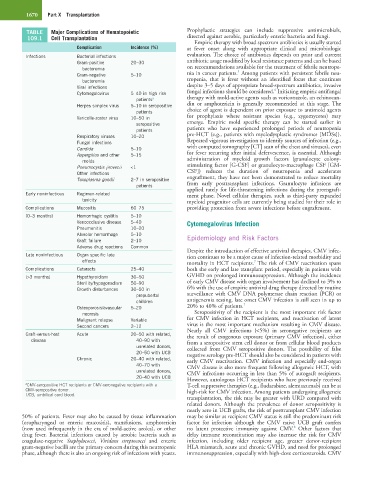
          TABLE   Major Complications of Hematopoietic        Prophylactic  strategies  can  include  suppressive  antimicrobials,
          109.1   Cell Transplantation                        directed against aerobic, particularly enteric bacteria and fungi.
                                                                 Empiric therapy with broad spectrum antibiotics is usually started
                          Complication      Incidence (%)     at  fever  onset  along  with  appropriate  clinical  and  microbiologic
         Infections       Bacterial infections                evaluation. The choice of antibiotics depends on prior and current
                          Gram-positive     20–30             antibiotic usage modified by local resistance patterns and can be based
                            bacteremia                        on recommendations available for the treatment of febrile neutrope-
                                                                               5
                          Gram-negative     5–10              nia in cancer patients.  Among patients with persistent febrile neu-
                            bacteremia                        tropenia,  that  is  fever  without  an  identified  focus  that  continues
                          Viral infections                    despite 3–5 days of appropriate broad-spectrum antibiotics, invasive
                                                                                           6
                          Cytomegalovirus   5–40 in high risk   fungal infections should be considered.  Initiating empiric antifungal
                                              patients a      therapy with mold-active agents such as voriconazole, an echinocan-
                          Herpes simplex virus  5–10 in seropositive   din  or  amphotericin  is  generally  recommended  at  this  stage. The
                                              patients        choice of agent is dependent on prior exposure to antimold agents
                          Varicella-zoster virus  10–50 in    for  prophylaxis  where  resistant  species  (e.g.,  zygomycetes)  may
                                              seropositive    emerge.  Empiric  mold  specific  therapy  can  be  started  earlier  in
                                              patients        patients  who  have  experienced  prolonged  periods  of  neutropenia
                          Respiratory viruses  10–20          pre-HCT (e.g., patients with myelodysplastic syndromes [MDSs]).
                          Fungal infections                   Repeated vigorous investigation to identify sources of infection (e.g.,
                          Candida           5–10              with computed tomography [CT] scan of the chest and sinuses), even
                          Aspergillus and other   5–15        for fever recurring after initial defervescence, is essential. Although
                            molds                             administration  of  myeloid  growth  factors  (granulocyte  colony-
                          Pneumocystis jirovecii  <1          stimulating factor [G-CSF] or granulocyte-macrophage CSF [GM-
                          Other infections                    CSF])  reduces  the  duration  of  neutropenia  and  accelerates
                          Toxoplasma gondii  2–7 in seropositive   engraftment, they have not been demonstrated to reduce mortality
                                              patients        from  early  posttransplant  infections.  Granulocyte  infusions  are
                                                              applied rarely for life-threatening infections during the preengraft-
         Early noninfectious  Regimen-related                 ment phase. Novel cellular therapies, such as third-party expanded
                            toxicity                          myeloid progenitor cells are currently being studied for their role in
         Complications    Mucositis         60–75             providing protection from severe infections before engraftment.
         (0–3 months)     Hemorrhagic cystitis  5–10
                          Venoocclusive disease  5–40         Cytomegalovirus Infection
                          Pneumonitis       10–20
                          Alveolar hemorrhage  5–10           Epidemiology and Risk Factors
                          Graft failure     2–10
                          Adverse drug reactions  Common
                                                              Despite the introduction of effective antiviral therapies, CMV infec-
         Late noninfectious  Organ specific late              tion continues to be a major cause of infection-related morbidity and
                            effects                           mortality in HCT recipients.  The risk of CMV reactivation spans
                                                                                    7
         Complications    Cataracts         25–40             both the early and late transplant period, especially in patients with
         (>3 months)      Hypothyroidism    30–50             GVHD on prolonged immunosuppression. Although the incidence
                          Sterility/hypogonadism  50–90       of early CMV disease with organ involvement has declined to 3% to
                          Growth disturbances  30–50 in       6% with the use of empiric antiviral drug therapy directed by routine
                                              prepubertal     surveillance with CMV DNA polymerase chain reaction (PCR) or
                                              children        antigenemia testing, late onset CMV infection is still seen in up to
                                                                                 7
                          Osteoporosis/avascular   5–20       20% to 40% of patients.
                            necrosis                             Seropositivity of the recipient is the most important risk factor
                          Malignant relapse  Variable         for  CMV  infection  in  HCT  recipients,  and  reactivation  of  latent
                          Second cancers    2–12              virus is the most important mechanism resulting in CMV disease.
                                                              Nearly  all  CMV  infections  (<5%)  in  seronegative  recipients  are
         Graft-versus-host   Acute          20–50 with related,   the result of exogenous exposure (primary CMV infection), either
           disease                            40–90 with      from a seropositive stem cell donor or from cellular blood products
                                              unrelated donors,   collected  from  CMV  seropositive  donors.  The  possibility  of  false
                                              20–50 with UCB  negative serology pre-HCT should also be considered in patients with
                          Chronic           20–40 with related,   early  CMV  reactivation.  CMV  infection  and  especially  end-organ
                                              40–70 with      CMV disease is also more frequent following allogeneic HCT, with
                                              unrelated donors,   CMV infections occurring in less than 5% of autograft recipients.
                                              20–40 with UCB  However, autologous HCT recipients who have previously received
         a CMV-seropositive HCT recipients or CMV-seronegative recipients with a   T-cell suppressive therapies (e.g., fludarabine, alemtuzumab) can be at
         CMV-seropositive donor.                              high-risk for CMV infection. Among patients undergoing allogeneic
         UCB, umbilical cord blood.
                                                              transplantation, the risk may be greater with URD compared with
                                                              related  donors.  Although  the  prevalence  of  donor  seropositivity  is
                                                              nearly zero in UCB grafts, the risk of posttransplant CMV infection
        50% of patients. Fever may also be caused by tissue inflammation   may be similar as recipient CMV status is still the predominant risk
        (oropharyngeal  or  enteric  mucositis),  transfusions,  amphotericin   factor  for  infection  although  the  CMV  naive  UCB  graft  confers
                                                                                                 8
        (now used infrequently  in the  era  of  mold-active  azoles),  or other   no  latent  protective  immunity  against  CMV.   Other  factors  that
        drug  fever.  Bacterial  infections  caused  by  aerobic  bacteria  such  as   delay  immune  reconstitution  may  also  increase  the  risk  for  CMV
        coagulase-negative  Staphylococci,  Viridans  streptococci  and  enteric   infection,  including  older  recipient  age,  greater  donor-recipient
        gram-negative bacilli are the primary concern during this neutropenic   HLA mismatch, acute and chronic GVHD, and need for prolonged
        phase, although there is also an ongoing risk of infections with yeasts.   immunosuppression, especially with high-dose corticosteroids. CMV

