


Page 1891 - Hematology_ Basic Principles and Practice ( PDFDrive )
P. 1891
Chapter 109  Complications After Hematopoietic Cell Transplantation  1673


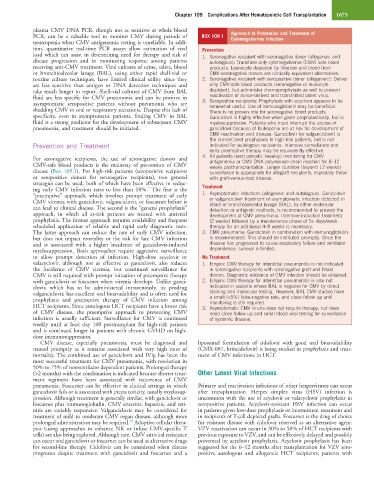
            plasma CMV DNA PCR, though not as sensitive as whole blood       Approach to Prevention and Treatment of
            PCR,  can  be  a  valuable  tool  to  monitor  CMV  during  periods  of   BOX 109.1   Cytomegalovirus Infection
            neutropenia when CMV antigenemia testing is unreliable. In addi-
            tion,  quantitative  real-time  PCR  assays  allow  estimation  of  viral   Prevention
            load which can assist in determining need for therapy and risk of   1.  Seronegative recipient with seronegative donor (allogeneic and
            disease  progression  and  in  monitoring  response  among  patients   autologous): Transfuse only cytomegalovirus (CMV) safe blood
            receiving anti-CMV treatment. Viral cultures of urine, saliva, blood   products. Leukocyte depletion by filtration and blood from
            or  bronchioalveolar  lavage  (BAL),  using  either  rapid  shell-vial  or   CMV-seronegative donors are clinically equivalent alternatives.
            routine  culture  techniques,  have  limited  clinical  utility  since  they   2.  Seronegative recipient with seropositive donor (allogeneic): Deliver
            are  less  sensitive  than  antigen  or  DNA  detection  techniques  and   only CMV-safe blood products (seronegative or leukocyte
            take much longer to report. Shell-vial cultures of CMV from BAL   depleted), but administer chemoprophylaxis as well to prevent
            fluid are less specific for CMV pneumonia and can be positive in   reactivation of donor-derived and transmitted latent virus.
            asymptomatic  seropositive  patients  without  pneumonia  who  are   3.  Seropositive recipients: Prophylaxis with acyclovir appears to be
                                                                      somewhat useful. Use of immunoglobulin may be beneficial.
            shedding CMV in oral or respiratory secretions. Despite this lack of   There is no proven role for seronegative blood products.
            specificity,  even  in  asymptomatic  patients,  finding  CMV  in  BAL   Ganciclovir is highly effective when given prophylactically, but is
            fluid is a strong predictor for the development of subsequent CMV   myelosuppressive. Patients who must interrupt the course of
            pneumonia, and treatment should be initiated.             ganciclovir because of leukopenia are at risk for development of
                                                                      CMV reactivation and disease. Ganciclovir (or valganciclovir) is
                                                                      the current best prophylaxis in high-risk patients, but is not
            Prevention and Treatment                                  indicated for autologous recipients. Intensive surveillance and
                                                                      early preemptive therapy may be equivalently effective.
                                                                   4.  All patients need periodic (weekly) monitoring for CMV
            For  seronegative  recipients,  the  use  of  seronegative  donors  and   antigenemia or CMV DNA polymerase chain reaction for 8–12
            CMV-safe  blood  products  is  the  mainstay  of  prevention  of  CMV   weeks posttransplantation. Longer duration (beyond 12 weeks)
            disease  (Box  109.1).  For  high-risk  patients  (seropositive  recipients   surveillance is appropriate for allograft recipients, especially those
            or  seropositive  donors  for  seronegative  recipients),  two  general   with graft-versus-host disease.
            strategies can be used, both of which have been effective in reduc-
                                                 7
            ing  early  CMV  infection  rates  to  less  than  10%.  The  first  is  the   Treatment
            “preemptive”  approach,  which  involves  prompt  treatment  of  early   1.  Asymptomatic infections (allogeneic and autologous): Ganciclovir
            CMV viremia with ganciclovir, valganciclovir, or foscarnet before it   or valganciclovir treatment of asymptomatic infection detected in
                                                                      blood or bronchioalveolar lavage (BAL), by either molecular
            can lead to clinical disease. The second is the “general prophylaxis”   detection or antigenic methods, is recommended to prevent the
            approach,  in  which  all  at-risk  patients  are  treated  with  antiviral    development of CMV pneumonia. Intensive induction treatment
            prophylaxis. The former approach requires availability and frequent   (2 weeks) followed by a maintenance phase of 5+ days/week
            scheduled  application  of  reliable  and  rapid  early  diagnostic  tests.   therapy for an additional 4–8 weeks is necessary.
            The  latter  approach  can  reduce  the  rate  of  early  CMV  infection,   2.  CMV pneumonia: Ganciclovir in combination with immunoglobulin
            but does not impact mortality or the risk for late CMV infection   is recommended. This should be instituted promptly. Once the
            and  is  associated  with  a  higher  incidence  of  ganciclovir-induced   disease has progressed to cause respiratory failure and ventilator
            myelosuppression.  Both  approaches  require  aggressive  surveillance   dependence, survival is limited.
            to  allow  prompt  detection  of  infection.  High-dose  acyclovir  or   No Treatment
            valacyclovir,  although  not  as  effective  as  ganciclovir,  also  reduces    1.  Empiric CMV therapy for interstitial pneumonitis is not indicated
            the  incidence  of  CMV  viremia,  but  continued  surveillance  for   in seronegative recipients with seronegative graft and blood
            CMV is still required with prompt initiation of preemptive therapy     donors. Diagnostic evidence of CMV infection should be obtained.
            with ganciclovir or foscarnet when viremia develops. Unlike ganci-  2.  Empiric CMV therapy for interstitial pneumonitis is also not
            clovir,  which  has  to  be  administered  intravenously,  its  prodrug     indicated in patients whose BAL is negative for CMV by direct
            valganciclovir, has excellent oral bioavailability and is often used for   staining and molecular testing. However, BAL CMV studies have
            prophylaxis  and  preemptive  therapy  of  CMV  infection  among   a small (<5%) false-negative rate, and close follow up and
                                                                      monitoring is still required.
            HCT recipients. Since autologous HCT recipients have a lower risk   3.  Asymptomatic CMV viruria does not require therapy, but does
            of  CMV  disease,  the  preemptive  approach  to  preventing  CMV   need close follow up and serial blood viral testing for surveillance
            infection  is  usually  sufficient.  Surveillance  for  CMV  is  continued   of systemic disease.
            weekly  until  at  least  day  100  posttransplant  for  high-risk  patients
            and is continued longer in patients with chronic GVHD on high-
            dose immunosuppression.
              CMV  disease,  especially  pneumonia,  must  be  diagnosed  and   liposomal  formulation  of  cidofovir  with  good  oral  bioavailability
            treated  promptly  as  it  remains  associated  with  very  high  rates  of   (CMX-001, brincidofovir) is being studied in prophylaxis and treat-
            mortality. The combined use of ganciclovir and IVIg has been the   ment of CMV infections in HCT.
            most successful treatment for CMV pneumonia, with resolution in
            50% to 75% of nonventilator dependent patients. Prolonged therapy
            (>2 months) with the combination is indicated because shorter treat-  Other Latent Viral Infections
            ment  regimens  have  been  associated  with  recurrence  of  CMV
            pneumonia. Foscarnet can be effective in clinical settings in which   Primary and reactivation infections of other herpesviruses can occur
            ganciclovir fails or is associated with excess toxicity, usually myelosup-  after  transplantation.  Herpes  simplex  virus  (HSV)  infection  is
            pression. Although treatment is generally similar, with ganciclovir or   uncommon with the use of acyclovir or valacyclovir prophylaxis in
            foscarnet plus immunoglobulin, CMV enteritis, hepatitis, and reti-  seropositive  patients.  Acyclovir-resistant  HSV  infection  can  occur
            nitis  are  variably  responsive.  Valganciclovir  may  be  considered  for   in patients given low-dose prophylaxis or intermittent treatment and
            treatment of mild to moderate CMV organ disease, although more   in recipients of T-cell depleted grafts. Foscarnet is the drug of choice
                                           10
            prolonged administration may be required.  Adoptive cellular thera-  for resistant disease with cidofovir reserved as an alternative agent.
            pies  (using  approaches  to  enhance  NK  or  infuse  CMV-specific T   VZV reactivation can occur in 30% to 50% of HCT recipients with
            cells) are also being explored. Although rare, CMV antiviral resistance   previous exposure to VZV, and can be effectively delayed and possibly
            can occur and ganciclovir or foscarnet can be used as alternative drugs   prevented by acyclovir prophylaxis. Acyclovir prophylaxis has been
            for second-line therapy. Cidofovir can be considered when disease   suggested for the 6–12 months after transplantation for VZV sero-
            progresses  despite  treatment  with  ganciclovir  and  foscarnet  and  a   positive  autologous  and  allogeneic  HCT  recipients;  patients  with

