


Page 1890 - Hematology_ Basic Principles and Practice ( PDFDrive )
P. 1890
1672   Part X  Transplantation


                               Day 0     Day 30            Day 100                    1 Year
                       Time     Preengraftment  Postengraftment          Late
                                 Neutropenia
                                   Mucositis
                                       Central line
                       Risk factors         Acute GVHD
                                                                     Chronic GVHD
                                                    Impaired cellular and humoral immunity

                                Gram-negative bacilli
                       Bacterial
                       infections  Viridans streptococci
                               Staphylococcus and Enterococcus spp.
                                                       Encapsulated bacteria (pneumococcus, meningococcus)

                               Herpes-simplex virus
                                                           Cytomegalovirus
                       Viral infections
                                                    Epstein-Barr virus–related lymphoproliferative disease
                                                                    Varicella-zoster virus

                                             Candida spp.
                       Fungal infections                Aspergillus spp.
                                                               Pneumocystis jiroveci
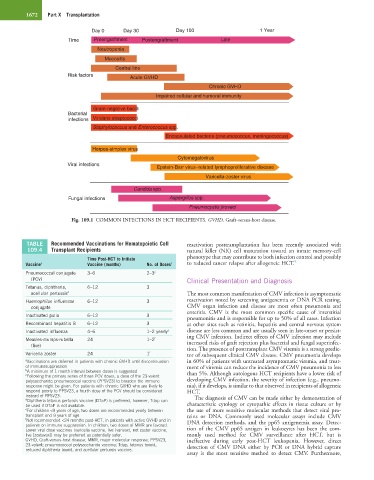
                        Fig. 109.1  COMMON INFECTIONS IN HCT RECIPIENTS. GVHD, Graft-versus-host disease.


          TABLE   Recommended Vaccinations for Hematopoietic Cell   reactivation  posttransplantation  has  been  recently  associated  with
          109.4   Transplant Recipients                       natural  killer  (NK)  cell  maturation  toward  an  innate  memory-cell
                              Time Post-HCT to Initiate       phenotype that may contribute to both infection control and possibly
                                                                                                 9
         Vaccine a            Vaccine (months)   No. of Doses b  to reduced cancer relapse after allogeneic HCT.
         Pneumococcal conjugate   3–6            2–3 c
           (PCV)                                              Clinical Presentation and Diagnosis
         Tetanus, diphtheria,   6–12             3
           acellular pertussis d                              The most common manifestation of CMV infection is asymptomatic
         Haemophilus influenzae   6–12           3            reactivation noted by screening antigenemia or DNA PCR testing.
           conjugate                                          CMV  organ  infection  and  disease  are  most  often  pneumonia  and
                                                              enteritis.  CMV  is  the  most  common  specific  cause  of  interstitial
         Inactivated polio    6–12               3
                                                              pneumonitis and is responsible for up to 50% of all cases. Infection
         Recombinant hepatitis B  6–12           3            at other sites such as retinitis, hepatitis and central nervous system
         Inactivated influenza  4–6              1–2 yearly e  disease are less common and are usually seen in late-onset or persist-
                                                              ing CMV infection. Indirect effects of CMV infection may include
         Measles-mumps-rubella   24              1–2 f        increased risks of graft rejection plus bacterial and fungal superinfec-
           (live)
                                                              tion. The presence of posttransplant CMV viremia is a strong predic-
         Varicella zoster     24                 1 f          tor of subsequent clinical CMV disease. CMV pneumonia develops
         a Vaccinations are deferred in patients with chronic GVHD until discontinuation   in 60% of patients with untreated asymptomatic viremia, and treat-
         of immunosuppression                                 ment of viremia can reduce the incidence of CMV pneumonia to less
         b A minimum of 1 month interval between doses is suggested
         c Following the primary series of three PCV doses, a dose of the 23-valent   than 5%. Although autologous HCT recipients have a lower risk of
         polysaccharide pneumococcal vaccine (PPSV23) to broaden the immune   developing CMV infection, the severity of infection (e.g., pneumo-
         response might be given. For patients with chronic GVHD who are likely to   nia), if it develops, is similar to that observed in recipients of allogeneic
         respond poorly to PPSV23, a fourth dose of the PCV should be considered   HCT.
         instead of PPSV23.                                      The diagnosis of CMV can be made either by demonstration of
         d Diphtheria tetanus pertussis vaccine (DTaP) is preferred, however, Tdap can
         be used if DTaP is not available.                    characteristic  cytology  or  cytopathic  effects  in  tissue  culture  or  by
         e For children <9 years of age, two doses are recommended yearly between   the use of more sensitive molecular methods that detect viral pro-
         transplant and 9 years of age.                       teins  or  DNA.  Commonly  used  molecular  assays  include  CMV
         f Not recommended <24 months post-HCT, in patients with active GVHD and in   DNA detection methods, and the pp65 antigenemia assay. Detec-
         patients on immune suppression. In children, two doses of MMR are favored.
         Lower viral dose vaccines (varicella vaccine, live [varivax], not zoster vaccine,   tion  of  the  CMV  pp65  antigen  in  leukocytes  has  been  the  com-
         live [zostavax]) may be preferred as potentially safer.  monly  used  method  for  CMV  surveillance  after  HCT,  but  is
         GVHD, Graft-versus-host disease; MMR, major molecular response; PPSV23,   ineffective  during  early  post-HCT  leukopenia.  However,  direct
         23-valent; pneumococcal polysaccharide vaccine; Tdap, tetanus toxoid,   detection  of  CMV  DNA  either  by  PCR  or  DNA  hybrid  capture
         reduced diphtheria toxoid, and acellular pertussis vaccine.
                                                              assay  is  the  most  sensitive  method  to  detect  CMV.  Furthermore,

