


Page 1897 - Hematology_ Basic Principles and Practice ( PDFDrive )
P. 1897
Chapter 109  Complications After Hematopoietic Cell Transplantation  1679


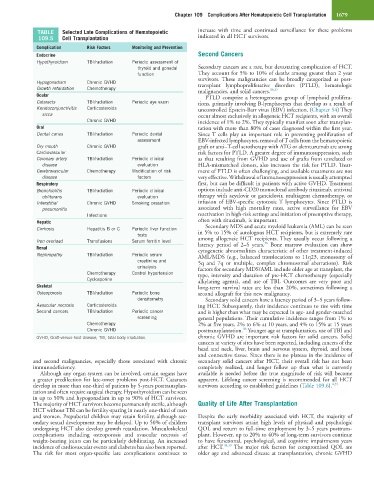
             TABLE   Selected Late Complications of Hematopoietic    increase  with  time  and  continued  surveillance  for  these  problems
              109.5   Cell Transplantation                        indicated in all HCT survivors.
             Complication    Risk Factors   Monitoring and Prevention
             Endocrine                                            Second Cancers
             Hypothyroidism  TBI/radiation  Periodic assessment of
                                              thyroid and gonadal   Secondary cancers are a rare, but devastating complication of HCT.
                                              function            They account for 5% to 10% of deaths among greater than 2 year
                                                                  survivors. These  malignancies  can  be  broadly  categorized  as  post-
             Hypogonadism    Chronic GVHD                         transplant  lymphoproliferative  disorders  (PTLD),  hematologic
             Growth retardation  Chemotherapy                     malignancies, and solid cancers. 36,37
             Ocular                                                 PTLD  comprise  a  heterogeneous  group  of  lymphoid  prolifera-
             Cataracts       TBI/radiation  Periodic eye exam     tions, primarily involving B-lymphocytes that develop as a result of
             Keratoconjunctivitis   Corticosteroids               uncontrolled Epstein-Barr virus (EBV) infection. (Chapter 54) They
               sicca                                              occur almost exclusively in allogeneic HCT recipients, with an overall
                             Chronic GVHD                         incidence of 1% to 2%. They typically manifest soon after transplan-
             Oral                                                 tation with more than 80% of cases diagnosed within the first year.
             Dental caries   TBI/radiation  Periodic dental       Since T cells play an important role in preventing proliferation of
                                              assessment          EBV-infected lymphocytes, removal of T cells from the hematopoietic
             Dry mouth       Chronic GVHD                         graft or anti–T-cell serotherapy with ATG or alemtuzumab are strong
             Cardiovascular                                       risk factors for PTLD. A greater degree of immunosuppression, such
             Coronary artery   TBI/radiation  Periodic clinical   as that resulting from GVHD and use of grafts from unrelated or
               disease                        evaluation          HLA-mismatched donors, also increases the risk for PTLD. Treat-
             Cerebrovascular   Chemotherapy  Modification of risk   ment of PTLD is often challenging, and available treatments are not
               disease                        factors             very effective. Withdrawal of immunosuppression is usually attempted
             Respiratory                                          first, but can be difficult in patients with active GVHD. Treatment
             Bronchiolitis   TBI/radiation  Periodic clinical     options include anti-CD20 monoclonal antibody rituximab, antiviral
               obliterans                     evaluation          therapy with acyclovir or ganciclovir, multiagent chemotherapy, or
             Interstitial    Chronic GVHD   Smoking cessation     infusion  of  EBV-specific  cytotoxic T  lymphocytes.  Since  PTLD  is
               pneumonitis                                        associated  with  high  mortality  rates,  active  surveillance  for  EBV
                             Infections                           reactivation in high-risk settings and initiation of preemptive therapy,
             Hepatic                                              often with rituximab, is important.
                                                                    Secondary MDS and acute myeloid leukemia (AML) can be seen
             Cirrhosis       Hepatitis B or C  Periodic liver function   in 5% to 15% of autologous HCT recipients, but is extremely rare
                                              tests
             Iron overload   Transfusions   Serum ferritin level  among allogeneic HCT recipients. They usually occur following a
                                                                                       36
                                                                  latency  period  of  2–5  years.   Bone  marrow  evaluation  can  show
             Renal                                                cytogenetic abnormalities characteristic of other treatment-induced
             Nephropathy     TBI/radiation  Periodic serum        AML/MDS (e.g., balanced translocations to 11q23, monosomy of
                                              creatinine and      5q  and  7q  or  multiple,  complex  chromosomal  aberrations).  Risk
                                              urinalysis          factors for secondary MDS/AML include older age at transplant, the
                             Chemotherapy   Control hypertension  type, intensity and duration of pre-HCT chemotherapy (especially
                             Cyclosporine                         alkylating  agents),  and  use  of  TBI.  Outcomes  are  very  poor  and
             Skeletal                                             long-term  survival  rates  are  less  than  20%,  sometimes  following  a
             Osteoporosis    TBI/radiation  Periodic bone         second allograft for this new malignancy.
                                              densitometry          Secondary solid cancers have a latency period of 3–5 years follow-
             Avascular necrosis  Corticosteroids                  ing HCT. Subsequently, their incidence continues to rise with time
             Second cancers  TBI/radiation  Periodic cancer       and is higher than what may be expected in age- and gender-matched
                                              screening           general populations. Their cumulative incidence ranges from 1% to
                             Chemotherapy                         2% at five years, 2% to 6% at 10 years, and 4% to 15% at 15 years
                                                                                36
                             Chronic GVHD                         posttransplantation.  Younger age at transplantation, use of TBI and
             GVHD, Graft-versus-host disease; TBI, total body irradiation.  chronic  GVHD  are  important  risk  factors  for  solid  cancers.  Solid
                                                                  cancers at variety of sites have been reported, including cancers of the
                                                                  head and neck, liver, brain and nervous system, thyroid, and bone
                                                                  and connective tissue. Since there is no plateau in the incidence of
            and  second  malignancies,  especially  those  associated  with  chronic     secondary solid cancers after HCT, their overall risk has not been
            immunodeficiency.                                     completely  realized,  and  longer  follow  up  than  what  is  currently
              Although any organ system can be involved, certain organs have   available  is  needed  before  the  true  magnitude  of  risk  will  become
            a greater predilection for late-onset problems post-HCT. Cataracts   apparent.  Lifelong  cancer  screening  is  recommended  for  all  HCT
            develop in more than one-third of patients by 5-years posttransplan-  survivors according to established guidelines (Table 109.6). 4,35
            tation and often require surgical therapy. Hypothyroidism can be seen
            in up to 50% and hypogonadism in up to 90% of HCT survivors.
            The majority of HCT survivors become permanently sterile, although   Quality of Life After Transplantation
            HCT without TBI can be fertility-sparing in nearly one-third of men
            and women. Prepubertal children may retain fertility, although sec-  Despite the early morbidity associated with HCT, the majority of
            ondary sexual development may be delayed. Up to 50% of children   transplant  survivors  attain  high  levels  of  physical  and  psychologic
            undergoing HCT also develop growth retardation. Musculoskeletal   QOL and return to full-time employment by 3–5 years posttrans-
            complications  including  osteoporosis  and  avascular  necrosis  of   plant. However, up to 20% to 40% of long-term survivors continue
            weight-bearing joints can be particularly debilitating. An increased   to have functional, psychological, and cognitive impairments years
            incidence of cardiovascular events and diabetes has also been reported.   after  HCT. 38,39  The  major  risk  factors  for  compromised  QOL  are
            The  risk  for  most  organ-specific  late  complications  continues  to   older age and advanced disease at transplantation, chronic GVHD

