


Page 1894 - Hematology_ Basic Principles and Practice ( PDFDrive )
P. 1894
1676   Part X  Transplantation


        host immunosuppression by the conditioning regimen and peritrans-  BOX 109.2   Sinusoidal Obstruction Syndrome
        plant immunoprophylaxis. T-lymphocyte depletion of donor marrow
        performed as GVHD prophylaxis can also adversely affect engraft-  Diagnostic Criteria for Sinusoidal Obstruction Syndrome (SOS)
        ment, even from matched sibling donors. Ex vivo marrow manipula-  Bilirubin  ≥2 mg/dL  before  day  21  post-HCT  and  at  least  two  of  the
        tion can deplete stem cells. T-cell depletion can also render the graft   following: (1) hepatomegaly or right upper quadrant pain, (2) ascites,
        immunoincompetent  and  functionally  less  capable  of  preventing   or (3) weight gain >5% over baseline.
        graft rejection.                                         SOS is a clinical diagnosis; liver ultrasound with Doppler studies or
           Compared  with  related  or  URD  allografts,  time  to  neutrophil   liver biopsy can support or confirm the diagnosis.
        recovery is significantly delayed in patients receiving UCB grafts. In   Risk Factors
        addition, the overall incidence of graft failure is somewhat greater,   Pretransplant Factors
        currently  5%  to  15%  with  present  selection  strategies.  The  most
        critical determinants of engraftment following UCB transplantation   Prior hepatic inflammatory disease (e.g., chronic hepatitis B or C,
                                                                    nonalcoholic steatohepatitis, alcoholic hepatitis)
        are both HLA matching and cell dose, and units with a total nucle-  Prior hepatic fibrotic disease (e.g., cirrhosis)
                                  7
        ated cell dose of at least 2.5 × 10  cells/kg or more have a greater   Extensive pre-HCT chemotherapy
        probability  of  successful  engraftment.  Since  each  UCB  unit  has  a   Prior exposure to gemtuzumab ozogamicin
        limited number of hematopoietic stem and progenitor cells, methods   Prior liver irradiation
        to overcome this limitation of cell dose are being investigated. These   Transplant-Related Factors
        include transplantation using multiple UCB units, ex vivo expansion
        to increase the number of progenitor cells, and approaches to improve   Conditioning regimen (e.g., myeloablative total body irradiation or
                                                                    busulfan-based regimens)
        homing including intrabone marrow injection of the graft or prein-  Exposure to other agents (e.g., sirolimus, itraconazole)
        cubation  with  prostaglandins.  Increasing  overall  cell  dose  and  the
        added antihost immunologic response with transplantation of two   Prognostic Factors
        UCB  units  has  increased  the  chances  of  successful  engraftment,   Adverse prognostic factors include: development of multiorgan failure,
        especially in adults.                                   rapid increase in weight, rapid increase in bilirubin.
           The  use  of  recombinant  G-CSF  or  GM-CSF,  which  stimulate   Treatment
        myelopoiesis, has improved the treatment of graft failure. Improve-  For >70% of patients, SOS will recover spontaneously with supportive
        ment in myelopoiesis can be seen in 50% to 60% patients with poor   care. However, mortality rates are >80% for patients with severe SOS.
        graft  function  within  14–21  days  after  initiation  of  growth  factor   Treatment  options,  especially  for  patients  with  more  severe  SOS,
        therapy. Myeloid growth factor therapy can increase peripheral blood   includes:
        leukocyte  recovery,  but  has  little  effect  on  platelet  reconstitution.   Pharmacologic
        Recombinant  human  thrombopoietin  receptor  agonists  are  now   Ursodeoxycholic acid (prophylaxis)
        available, although their efficacy and safety profile in HCT recipients   Defibrotide (investigational—prophylaxis and treatment)
        is currently being studied. Limited experience suggests the value of   Low-dose heparin and low-molecular-weight heparin (prophylaxis)
        recombinant  erythropoietin  in  reducing  red  blood  cell  transfusion   Tissue plasminogen activator (investigational – prophylaxis and
        needs.                                                      treatment)
           A second stem cell infusion can be useful if graft failure occurs.   Antithrombin III (investigational—prophylaxis and treatment)
        In the case of a failed autograft, infusion of previously harvested and   Nonpharmacologic
        frozen  marrow  or  blood  cells  frequently  reestablishes  functional   Supportive care with management of multiorgan failure
        hematopoiesis  and  hematologic  improvement.  In  the  case  of  graft   Transjugular intrahepatic portosystemic shunt
        failure after related-donor transplantation, a second infusion of donor   Liver transplantation
        marrow or cytokine-mobilized PBSC may allow successful engraft-
        ment. Sometimes, because of the presumption of immune-mediated
        rejection, reconditioning with reduced doses of cytotoxic agents or
        further immunosuppression with ATG, corticosteroids, or cyclospo-
        rine is used to prepare the recipient for a second infusion.
           The treatment of graft failure after URD transplantation poses   (TBI) used in pretransplant conditioning regimens produce sinusoidal
        special problems. URDs may not be available for a second marrow   endothelial injury. Subsequent deposition of fibronectin and factor
        harvest or blood stem cell apheresis. In experimental settings where   VIII/von Willebrand factor at the site of damaged endothelium can
        graft  failure  risks  are  high,  it  may  be  prudent  to  store  autologous   lead to activation of the coagulation system and subsequent sinusoidal
        stem cells from patients undergoing URD transplantation, although   obstruction. Such changes are often associated with depressed plasma
        this is rarely done. The original donor is not available in recipients of   protein C levels and other signs of procoagulant activity, including
        unrelated UCB grafts and the only treatment option for graft failure   lower antithrombin III levels and elevated factor VIII and fibrinogen
        in this setting is a second transplant using cells from a different UCB   levels. Cytokines such as tumor necrosis factor (TNF)-α and altera-
        or volunteer adult donor (related or unrelated) second allograft, or   tions in the levels of nitric oxide and matrix metalloproteinases may
        reinfusion of autologous backup cells, if available. Because of vari-  also have a role in its pathogenesis.
        ability in the circumstances and donor options available, there are few   Risk  factors  associated  with  the  development  of  SOS  include
        clear data on the outcomes of second allografts in these situations. 24  history of pretransplant hepatitis or liver injury, intensive preparative
                                                              regimens, increased TBI dose and dose rate and increased busulfan
                                                              dose. SOS may also be more frequent after mismatched related or
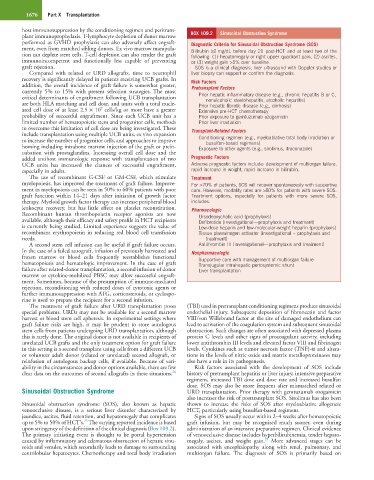
        Sinusoidal Obstruction Syndrome                       URD transplantation. Prior therapy with gemtuzumab ozogamicin
                                                              also increases the risk of posttransplant SOS. Sirolimus has also been
        Sinusoidal  obstruction  syndrome  (SOS),  also  known  as  hepatic   shown  to  increase  the  risks  of  SOS  after  myeloablative  allogeneic
        venoocclusive  disease,  is  a  serious  liver  disorder  characterized  by   HCT, particularly using busulfan-based regimens.
        jaundice, ascites, fluid retention, and hepatomegaly that complicates   Signs of SOS usually occur within 2–4 weeks after hematopoietic
                             25
        up to 5% to 50% of HCT’s.  The varying reported incidence is based   graft  infusion,  but  may  be  recognized  much  sooner,  even  during
        upon stringency of the definition of the clinical diagnosis (Box 109.2).   administration of an intensive preparative regimen. Clinical evidence
        The  primary  initiating  event  is  thought  to  be  portal  hypertension   of venoocclusive disease includes hyperbilirubinemia, tender hepato-
                                                                                        25
        caused by inflammatory and edematous obstruction of hepatic sinu-  megaly,  ascites,  and  weight  gain.   More  advanced  stages  can  be
        soids and venules, which secondarily leads to damage to surrounding   associated  with  encephalopathy  along  with  renal,  pulmonary,  and
        centrilobular hepatocytes. Chemotherapy and total body irradiation   multiorgan  failure.  The  diagnosis  of  SOS  is  primarily  based  on

