


Page 1898 - Hematology_ Basic Principles and Practice ( PDFDrive )
P. 1898
1680   Part X  Transplantation


          TABLE   Screening Guidelines for Common Cancers After   differentiate into effector cells and recruit mononuclear phagocytes
          109.6   Hematopoietic Cell Transplantation          and neutrophils and possibly NK cells which ultimately yield host
                                                              tissue destruction, primarily through apoptosis. T-cell depletion of
         Site    Screening Recommendations                    the graft reduces the risk of acute and chronic GVHD, albeit at the
         Breast  Mammogram annually starting at age 40 years; in women   cost of increasing risks of disease relapse caused by blunting of the
                   who have received ≥20 Gy to the chest region begin at   graft-versus-tumor  response.  Alternative  mechanisms  may  also  be
                   age 25 years or 8 years after radiation, whichever is later  involved in the pathogenesis of chronic GVHD including autoreac-
                                                              tivity, loss of self-tolerance and B-cell dysregulation. 42
         Cervix  Pap smear every year (for regular Pap test) or every 2 years
                   (for liquid-based Pap test); may screen every 2–3 years
                   after 30 years of age if patient has three consecutive   Acute Graft-Versus-Host Disease
                   normal tests
         Colorectal  Beginning at age 50 years, fecal occult blood annually and/  Risk Factors and Clinical Features
                   or flexible sigmoidoscopy every 5 years, or double
                   contrast barium enema every 5 years, or colonoscopy   Up to 50% of patients receiving HLA-identical sibling-donor and up
                   every 10 years; certain high-risk groups (e.g., patients   to  90%  of  patients  receiving  URD  HCT  develop  acute  GVHD.
                   with inflammatory bowel disease) may need earlier   Donor-recipient HLA disparity is the most important risk factor for
                   initiation and more frequent screening     acute GVHD. Additional risk factors include increasing recipient and
         Lung    Yearly pulmonary exam with imaging as appropriate  donor age, use of alloimmunized donors such as parous women, and
                                                              HCT from unrelated instead of sibling donors. Among recipients of
         Oral    Yearly oral cavity exam
                                                              UCB, acute GVHD occurs in 20% to 60% of patients; incidence of
         Thyroid  Yearly thyroid exam                         acute  GVHD,  though  of  only  moderate  severity,  may  be  higher
         Skin    Yearly skin exam                             among recipients of double UCB transplantation. 43
         Pap, Papanicolaou.                                      Skin, liver, and gastrointestinal tract are the most common sites
                                                              of GVHD. Acute GVHD of the skin is characterized by a maculo-
                                                              papular rash that, when severe, can lead to bullae or even resemble
                                                              toxic epidermal necrolysis. Hepatic involvement manifests as choles-
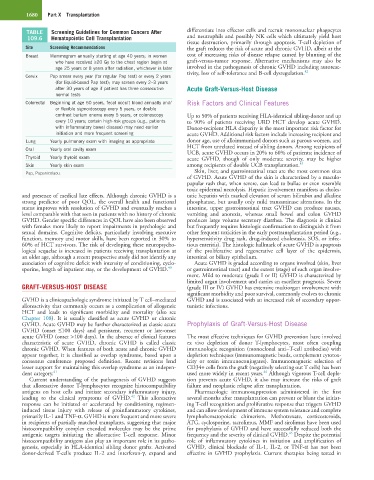
        and presence of medical late effects. Although chronic GVHD is a   tatic hepatitis with marked elevation of serum bilirubin and alkaline
        strong  predictor  of  poor  QOL,  the  overall  health  and  functional   phosphatase, but usually only mild transaminase alterations. In the
        status improves with resolution of GVHD and eventually reaches a   intestine,  upper  gastrointestinal  tract  GVHD  can  produce  nausea,
        level comparable with that seen in patients with no history of chronic   vomiting  and  anorexia,  whereas  small  bowel  and  colon  GVHD
        GVHD. Gender specific differences in QOL have also been observed   produces  large  volume  secretory diarrhea. The  diagnosis is clinical
        with females more likely to report impairments in psychologic and   but frequently requires histologic confirmation to distinguish it from
        sexual  domains.  Cognitive  deficits,  particularly  involving  executive   other frequent toxicities in the early posttransplantation period (e.g.,
        function, memory and motor skills, have been reported in 30% to   hypersensitivity drug rash, drug-induced cholestasis, SOS, or infec-
        60% of HCT survivors. The risk of developing these neuropsycho-  tious enteritis). The histologic hallmark of acute GVHD is apoptosis
        logical sequelae is increased in patients receiving transplantation at   of  the  proliferative  and  regenerative  cell  layer  of  the  epidermis,
        an older age, although a recent prospective study did not identify any   intestinal or biliary epithelium.
        association of cognitive deficit with intensity of conditioning, cyclo-  Acute GVHD is graded according to organs involved (skin, liver
        sporine, length of inpatient stay, or the development of GVHD. 40  or gastrointestinal tract) and the extent (stage) of each organ involve-
                                                              ment. Mild to moderate (grade I or II) GVHD is characterized by
                                                              limited organ involvement and carries an excellent prognosis. Severe
        GRAFT-VERSUS-HOST DISEASE                             (grade III or IV) GVHD has extensive multiorgan involvement with
                                                              significant morbidity and poor survival, commonly evolves to chronic
        GVHD is a clinicopathologic syndrome initiated by T cell–mediated   GVHD and is associated with an increased risk of secondary oppor-
        alloreactivity that commonly occurs as a complication of allogeneic   tunistic infections.
        HCT  and  leads  to  significant  morbidity  and  mortality  (also  see
        Chapter  108).  It  is  usually  classified  as  acute  GVHD  or  chronic
        GVHD. Acute GVHD may be further characterized as classic acute   Prophylaxis of Graft-Versus-Host Disease
        GVHD  (onset  ≤100  days)  and  persistent,  recurrent  or  late-onset
        acute GVHD (onset >100 days). In the absence of clinical features   The most effective techniques for GVHD prevention have involved
        characteristic  of  acute  GVHD,  chronic  GVHD  is  called  classic   ex  vivo  depletion  of  donor  T-lymphocytes,  most  often  coupling
        chronic GVHD. When features of both acute and chronic GVHD   immunologic recognition (monoclonal anti–T-cell antibodies) with
        appear together, it is classified as overlap syndrome, based upon a   depletion techniques (immunomagnetic beads, complement cytotox-
        consensus  conference  proposed  definition.  Recent  revisions  lend   icity  or  toxin  immunoconjugates).  Immunomagnetic  selection  of
        lesser support for maintaining this overlap syndrome as an indepen-  CD34+ cells from the graft (negatively selecting out T cells) has been
                                                                                       44
        dent category. 41                                     used more widely in recent years.  Although vigorous T-cell deple-
           Current  understanding  of  the  pathogenesis  of  GVHD  suggests   tion prevents acute GVHD, it also may increase the risks of graft
        that  alloreactive  donor T-lymphocytes  recognize  histocompatibility   failure and neoplastic relapse after transplantation.
        antigens  on  host  cells  and  initiate  secondary  inflammatory  injury,   Pharmacologic  immunosuppression  administered  in  the  first
                                            42
        leading  to  the  clinical  symptoms  of  GVHD.   This  alloreactive   several months after transplantation can prevent or blunt the initiat-
        response  can  be  initiated  or  accelerated  by  conditioning  regimen-  ing T-cell recognition and proliferative response that triggers GVHD
        induced  tissue  injury  with  release  of  proinflammatory  cytokines,   and can allow development of immune system tolerance and complete
        primarily IL-1 and TNF-α. GVHD is more frequent and more severe   lymphohematopoietic  chimerism.  Methotrexate,  corticosteroids,
        in recipients of partially matched transplants, suggesting that major   ATG, cyclosporine, tacrolimus, MMF and sirolimus have been used
        histocompatibility  complex  encoded  molecules  may  be  the  prime   for prophylaxis of GVHD and have successfully reduced both the
                                                                                                45
        antigenic  targets  initiating  the  alloreactive  T-cell  response.  Minor   frequency and the severity of clinical GVHD.  Despite the potential
        histocompatibility antigens also play an important role in its patho-  role  of  inflammatory  cytokines  in  initiation  and  amplification  of
        genesis, especially in HLA-identical sibling donor grafts. Activated   GVHD,  clinical  blockade  of  IL-1,  IL-2,  or TNF-α  has  not  been
        donor-derived  T-cells  produce  IL-2  and  interferon-γ,  expand  and   effective  in  GVHD  prophylaxis.  Current  therapies  being  tested  in

