


Page 1899 - Hematology_ Basic Principles and Practice ( PDFDrive )
P. 1899
Chapter 109  Complications After Hematopoietic Cell Transplantation  1681


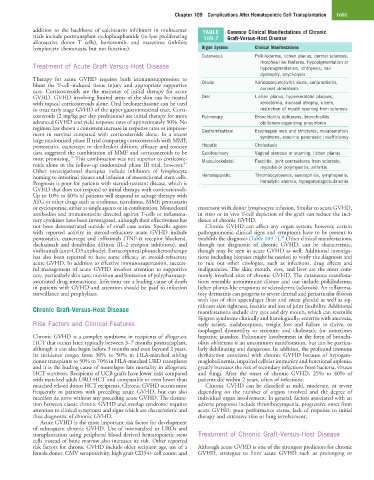
            addition  to  the  backbone  of  calcineurin  inhibitors  in  multicenter   TABLE   Common Clinical Manifestations of Chronic
            trials include posttransplant cyclophosphamide (to lyse proliferating   109.7   Graft-Versus-Host Disease
            alloreactive  donor  T  cells),  bortezomib,  and  maraviroc  (inhibits
            lymphocyte chemotaxis, but not function).              Organ System     Clinical Manifestations
                                                                   Cutaneous        Poikiloderma, lichen planus, dermal sclerosis,
                                                                                      morphea-like features, hypopigmentation or
            Treatment of Acute Graft-Versus-Host Disease                              hyperpigmentation, ichthyosis, nail
                                                                                      dystrophy, onycholysis
            Therapy  for  acute  GVHD  requires  both  immunosuppression  to
            blunt  the T-cell–induced  tissue  injury  and  appropriate  supportive   Ocular  Keratoconjunctivitis sicca, conjunctivitis,
            care.  Corticosteroids  are  the  mainstay  of  initial  therapy  for  acute   corneal ulcerations
            GVHD. GVHD involving limited areas of the skin can be treated   Oral    Lichen planus, hyperkeratotic plaques,
            with topical corticosteroids alone. Oral beclomethasone can be used       xerostomia, mucosal atrophy, ulcers,
            to treat early stage GVHD of the upper gastrointestinal tract. Corti-     restriction of mouth opening from sclerosis
            costeroids (2 mg/kg per day prednisone) are initial therapy for more   Pulmonary  Bronchiolitis obliterans, bronchiolitis
            advanced GVHD and yield response rates of approximately 50%. No           obliterans-organizing pneumonia
            regimen has shown a consistent increase in response rates or improve-  Gastrointestinal  Esophageal web and strictures, malabsorption
            ment  in  survival  compared  with  corticosteroids  alone.  In  a  recent   syndrome, exocrine pancreatic insufficiency
            large randomized phase II trial comparing corticosteroids with MMF,
            pentostatin, etanercept or denileukin diftitox, efficacy and toxicity   Hepatic  Cholestasis
            data suggested the combination of MMF and corticosteroids to be   Genitourinary  Vaginal stenosis or scarring, lichen planus
                        46
            most promising.  This combination was not superior to corticoste-  Musculoskeletal  Fasciitis, joint contractures from sclerosis,
                                                             47
            roids alone in the follow-up randomized phase III trial, however.         myositis or polymyositis, arthritis
            Other  investigational  therapies  include  inhibitors  of  lymphocyte
            homing to intestinal tissues and infusion of mesenchymal stem cells.   Hematopoietic  Thrombocytopenia, eosinophilia, lymphopenia,
            Prognosis is poor for patients with steroid-resistant disease, which is   hemolytic anemia, hypogammaglobulinemia
            GVHD that does not respond to initial therapy with corticosteroids.
            Up to 10% to 40% of patients will respond to salvage therapy with
            ATG or other drugs such as sirolimus, tacrolimus, MMF, pentostatin
            or cyclosporine, either as single agents or in combination. Monoclonal   treatment with donor lymphocyte infusion. Similar to acute GVHD,
            antibodies and immunotoxins directed against T-cells or inflamma-  in vitro or in vivo T-cell depletion of the graft can reduce the inci-
            tory cytokines have been investigated, although their effectiveness has   dence of chronic GVHD.
            not been demonstrated outside of small case series. Specific agents   Chronic  GVHD  can  affect  any  organ  system;  however,  certain
            with  reported  activity  in  steroid-refractory  acute  GVHD  include   pathognomonic clinical signs and symptoms have to be present to
                                                                                             48
            pentostatin,  etanercept  and  infliximab  (TNF-α  receptor  blockers),   establish the diagnosis (Table 109.7).  Other clinical manifestations,
            dacluzimab and denileukin  diftitox  (IL-2  receptor  inhibitors),  and   though  not  diagnostic  of  chronic  GVHD,  can  be  characteristic,
            visilizumab (anti-CD3 antibody). Extracorporeal photochemotherapy   though may be seen in acute GVHD as well. Additional investiga-
            has  also  been  reported  to  have  some  efficacy  in  steroid-refractory   tions including biopsies might be needed to verify the diagnosis and
            acute GVHD. In addition to effective immunosuppression, success-  to  rule  out  other  etiologies,  such  as  infections,  drug  effects  and
            ful  management  of  acute  GVHD  involves  attention  to  supportive   malignancies. The skin, mouth, eyes, and liver are the most com-
            care, particularly skin care, nutrition and limitation of polypharmacy-  monly involved sites of chronic GVHD. The cutaneous manifesta-
            associated drug interactions. Infections are a leading cause of death   tions resemble autoimmune disease and can include poikiloderma,
            in patients with GVHD and attention should be paid to infection   lichen planus-like eruptions or scleroderma (sclerosis). An inflamma-
            surveillance and prophylaxis.                         tory dermatitis can progress to severe dermal and periarticular fibrosis
                                                                  with loss of skin appendages (hair and sweat glands) as well as sig-
            Chronic Graft-Versus-Host Disease                     nificant skin tightness, fasciitis and loss of joint flexibility. Additional
                                                                  manifestations include dry eyes and dry mouth, which can resemble
                                                                  Sjögren syndrome clinically and histologically; enteritis with anorexia,
            Risk Factors and Clinical Features                    early  satiety,  malabsorption,  weight  loss  and  failure  to  thrive,  or
                                                                  esophageal  dysmotility  or  stricture;  and  cholestatic  (or  sometimes
            Chronic GVHD is a complex syndrome in recipients of allogeneic   hepatitic jaundice. Pulmonary involvement in the form of bronchi-
            HCT that occurs later, typically between 3–7 months posttransplant,   olitis obliterans is an uncommon manifestation, but can be particu-
            although it can also begin before 3 months and even beyond 2 years.   larly debilitating and dangerous. In addition, the profound immune
            Its  incidence  ranges  from  30%  to  50%  in  HLA-matched  sibling   dysfunction  associated  with  chronic  GVHD  because  of  hypogam-
            donor transplants to 50% to 70% in HLA-matched URD transplants   maglobulinemia, impaired cellular immunity and functional asplenia,
            and it is the leading cause of nonrelapse late mortality in allogeneic   greatly increases the risk of secondary infections from bacteria, viruses
            HCT survivors. Recipients of UCB grafts have lower risks compared   and  fungi.  After  the  onset  of  chronic  GVHD,  25%  to  40%  of
            with matched adult URD HCT and comparable or even lower than   patients die within 2 years, often of infections.
            matched related donor HCT recipients. Chronic GVHD occurs most   Chronic  GVHD  can  be  classified  as  mild,  moderate,  or  severe
            frequently  in  patients  with  preceding  acute  GVHD,  but  can  also   depending  on  the  number  of  organs  involved  and  the  degree  of
            manifest de novo without any preceding acute GVHD. The distinc-  individual organ involvement. In general, factors associated with an
            tion between classic chronic GVHD and overlap syndrome requires   adverse prognosis include thrombocytopenia, progressive onset from
            attention to clinical symptoms and signs which are characteristic and   acute GVHD, poor performance status, lack of response to initial
            thus diagnostic of chronic GVHD.                      therapy and extensive skin or lung involvement.
              Acute GVHD is the most important risk factor for development
            of  subsequent  chronic  GVHD.  Use  of  mismatched  or  URDs  and
            transplantation using peripheral blood derived hematopoietic stem   Treatment of Chronic Graft-Versus-Host Disease
            cells instead of bone marrow also increases its risk. Other reported
            risk factors for chronic GVHD include older recipient age, use of a   Although acute GVHD is one of the strongest predictors for chronic
            female donor, CMV seropositivity, high graft CD34+ cell count, and   GVHD,  strategies  to  limit  acute  GVHD  such  as  prolonging  or

