


Page 1895 - Hematology_ Basic Principles and Practice ( PDFDrive )
P. 1895
Chapter 109  Complications After Hematopoietic Cell Transplantation  1677


            clinical criteria that include presence of jaundice, plus either hepato-  polyribonucleotide  with  fibrinolytic,  antithrombotic,  and  antiisch-
            megaly,  weight  gain,  and/or  ascites  within  2–3  weeks  of  stem  cell   emic properties, has been favorable with 30% to 40% of patients with
            infusion.  However,  other  causes  of  hyperbilirubinemia  and  weight   severe SOS achieving complete resolution and improvement in sur-
                                                                      26
            gain early after transplantation (e.g., drugs, hepatitis, capillary leak,   vival.  Its efficacy in the prophylaxis and management of severe SOS
            cardiac  failure,  volume  overload)  can  complicate  the  differential   is currently being investigated in larger clinical trials.
            diagnosis, particularly for milder or less abrupt presentations of these
            symptoms. Percutaneous or transabdominal needle biopsy of the liver
            is hazardous in severely thrombocytopenic transplant recipients and   Interstitial Pneumonitis
            should be avoided. Transvenous biopsies may provide sufficient his-
            tologic material for diagnosis and may allow determination of hepatic   Interstitial pneumonitis is a common and frequently fatal complica-
            wedge pressure product (greater than 10 mm is associated with SOS),   tion, affecting up to 35% of allogeneic transplant recipients, although
            but  may  be  associated  with  hemorrhagic  complications  as  well.   recent advances in supportive care have substantially reduced this risk.
            Ultrasonographic  Doppler  flow  studies  demonstrating  reversal  of   Interstitial pneumonitis is notably less common after autografting. It
            portal flow or a higher portal vein resistive index have been suggested   is characterized by diffuse, interstitial inflammation accompanied by
            as a noninvasive means of confirming the diagnosis, but their validity   hypoxemia, dyspnea, and nonproductive cough, sometimes with fever.
            has recently been questioned. SOS can be graded from mild to severe   Risk factors associated with the development of interstitial pneumoni-
            depending  on  the  degree  of  hyperbilirubinemia  and  weight  gain.   tis include use of methotrexate for GVHD prophylaxis, older age at
            Severe SOS is almost universally fatal within several weeks of onset.  transplant,  severe  GVHD,  interval  from  diagnosis  of  hematologic
              Effective methods for prevention and treatment of SOS have not   disease to HCT of 6 months or greater, poor pretransplant performance
            been defined. Limited understanding of the cellular and microvascu-  status and use of higher TBI dose rate (>4 cGy/min). Remarkably, in
            lar pathophysiology of SOS has confounded development of more   one study, the reported risk of interstitial pneumonitis was 8% when
            rational  approaches  to  its  prevention  and  treatment.  Possible   none of these risk factors were present, compared with 94% when all
            approaches include preventive therapy with low-dose heparin, pros-  six factors were present. It has been hypothesized that URD transplan-
            taglandin E, pentoxifylline (a TNF-α blocking agent), although none   tation  is  more  immunosuppressive  and  thus  associated  with  more
            has proved effective in carefully performed prospective trials. Post-  severe opportunistic infections and greater risk of interstitial pneumo-
            HCT hepatic injury including SOS has become less frequent with   nitis, but this has not been rigorously investigated.
            widespread and prolonged administration of ursodiol as a choleretic   The course of interstitial pneumonitis is often catastrophic, mani-
            and hepatic protectant. Recombinant tissue plasminogen factor has   festing with rapidly progressive tachypnea, hypoxemia, and hemody-
            been used successfully to treat established SOS, however, thrombolyt-  namic  compromise.  Therefore,  therapeutic  intervention  most
            ics  are  associated  with  substantially  increased  risk  of  hemorrhage.   frequently occurs before the return of definitive results of diagnostic
            Transjugular intrahepatic portosystemic shunts have also been used   tests and must be initiated based on the assessment of clinical risk
            with some success. Early experience with defibrotide, a single-stranded   factors and the underlying clinical setting (Box 109.3).


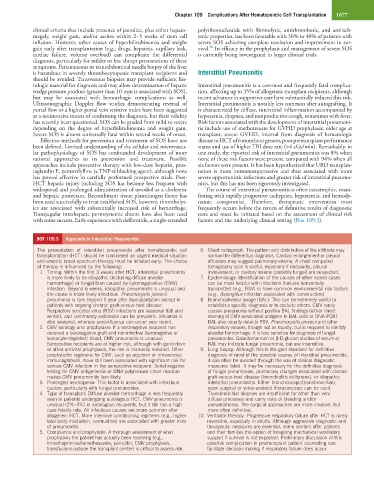
             BOX 109.3   Approach to Interstitial Pneumonitis
             The  presentation  of  interstitial  pneumonitis  after  hematopoietic  cell   6.  Chest radiograph: The pattern and distribution of the infiltrate may
             transplantation (HCT) should be considered an urgent medical situation   narrow the differential diagnosis. Cardiac enlargement or pleural
             and empiric broad-spectrum therapy must be initiated early. The choice   effusions may suggest pulmonary edema. A chest computed
             of therapy is influenced by the following:              tomography scan is useful, especially if nodularity, pleural
              1.  Timing: Within the first 3 weeks after HCT, interstitial pneumonitis   involvement, or cavitary lesions (possibly fungal) are suspected.
                is more likely to be idiopathic (including diffuse alveolar   7.  Epidemiology: Identification of the causes of other recent cases
                hemorrhage) or fungal than caused by cytomegalovirus (CMV)   can be most helpful with infections that are horizontally
                infection. Beyond 6 weeks, idiopathic pneumonitis is unusual and   transmitted (e.g., RSV) or have common environmental risk factors
                the cause is more likely infectious. Pneumocystis jirovecii   (e.g., Aspergillus infection associated with construction).
                pneumonia is rare beyond 1 year after transplantation except in   8.  Bronchoalveolar lavage (BAL): This can be extremely useful to
                patients with ongoing chronic graft-versus-host disease.   establish a specific diagnosis or to exclude others. CMV rarely
                Respiratory syncytial virus (RSV) infections are seasonal (fall and   causes pneumonia without positive BAL findings (either direct
                winter), and community outbreaks can be prevalent. Influenza is   staining of CMV-associated antigens in BAL cells or DNA-PCR).
                also seasonal, whereas parainfluenza can occur year round.  BAL also usually detects RSV, Pneumocystis jirovecii and other
              2.  CMV serology and prophylaxis: If a seronegative recipient has   respiratory viruses, though not as rapidly, but is required to identify
                received a seronegative graft and noninfective (seronegative or   alveolar hemorrhage. It is less sensitive for diagnosis of fungal
                leukocyte-depleted) blood, CMV pneumonia is unusual.   pneumonias. Galactomannan or β-D-glucan studies of serum or
                Seropositive recipients are at higher risk, although with ganciclovir   BAL may indicate fungal pneumonia, but are insensitive.
                or other antiviral prophylaxis, the risk is markedly reduced. Other   9.  Lung biopsy: Although this is the gold standard for definitive
                prophylactic regimens for CMV, such as acyclovir or intravenous   diagnosis of most of the possible causes of interstitial pneumonitis,
                immunoglobulin, have still been associated with significant risk for   it can often be avoided through the use of clinical diagnostic
                serious CMV infection in the seropositive recipient. Serial negative   measures listed. It may be necessary for the definitive diagnosis
                testing for CMV antigenemia or DNA-polymerase chain reaction   of fungal pneumonias, pulmonary changes associated with chronic
                makes CMV pneumonitis less likely.                   graft-versus-host disease (bronchiolitis obliterans), or idiopathic
              3.  Prolonged neutropenia: This factor is associated with infectious   interstitial pneumonitis. Either bronchoscopic(transbronchial),
                causes, particularly with fungal pneumonias.         open surgical or video-assisted thoracoscopic can be used.
              4.  Type of transplant: Diffuse alveolar hemorrhage is less frequently   Transbronchial biopsies are insufficient for other than very
                seen in patients undergoing autologous HCT. CMV pneumonia is   diffuse processes and carry risks of bleeding and/or
                unusual (2%–3%) in autologous recipients, but it still has a high   pneumothorax. The surgical approaches are more invasive, but
                case fatality rate. All infectious causes are more common after   more often definitive.
                allogeneic HCT. More intensive conditioning regimens (e.g., higher   10.  Ventilator therapy: Progressive respiratory failure after HCT is rarely
                total body irradiation, carmustine) are associated with greater risks   reversible, especially in adults. Although aggressive diagnostic and
                of pneumonitis.                                      therapeutic measures are essential, some centers offer patients
              5.  Compliance and prophylaxis: A thorough assessment of what   and their families the option of foregoing mechanical ventilatory
                prophylaxis the patient has actually been receiving (e.g.,   support if survival is not expected. Preliminary discussion of this
                trimethoprim-sulfamethoxazole, penicillin, CMV prophylaxis,   possible complication in pretransplant patient counseling can
                transfusions outside the transplant center) is critical to assess risk.  facilitate decision-making if respiratory failure does occur.

