


Page 1939 - Hematology_ Basic Principles and Practice ( PDFDrive )
P. 1939
Chapter 112  Clinical Considerations in Platelet Transfusion Therapy  1719


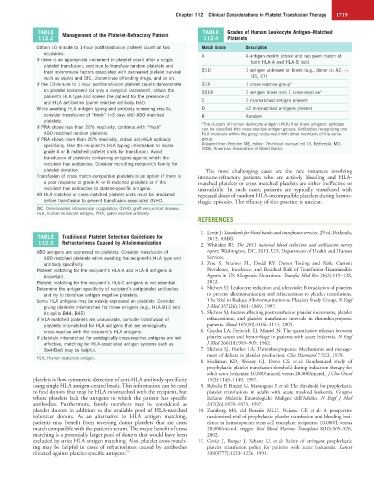
             TABLE   Management of the Platelet-Refractory Patient  TABLE   Grades of Human Leukocyte Antigen–Matched
              112.2                                                 112.4  Platelets
             Obtain 10-minute to 1-hour posttransfusion platelet count on two   Match Grade  Description
               occasions.                                          A             4-antigen match (donor and recipient match at
             If there is an appropriate increment in platelet count after a single   both HLA-A and HLA-B loci)
               platelet transfusion, continue to transfuse random platelets and
               treat nonimmune factors associated with decreased platelet survival   B1U  1 antigen unknown or blank (e.g., donor is: A2, –;
               such as sepsis and DIC, discontinue offending drugs, and so on.     B5, 27)
             If the 10-minute to 1-hour posttransfusion platelet counts demonstrate   B1X  1 cross-reactive group a
               no platelet increment (or only a marginal increment), obtain the   B2UX  1 antigen blank and 1 cross-reactive a
               patient’s HLA type and screen the patient for the presence of
               anti-HLA antibodies (panel reactive antibody test).  C            1 mismatched antigen present
             While awaiting HLA antigen typing and antibody screening results,   D  ≥2 mismatched antigens present
               consider transfusion of “fresh” (<3 days old) ABO-matched   R     Random
               platelets.                                          a
                                                                   The clusters of human leukocyte antigen (HLA) that share antigenic epitopes
             If PRA shows less than 20% reactivity, continue with “fresh”   can be classified into cross-reactive antigen groups. Antibodies recognizing one
               ABO-matched random platelets.                       HLA molecule within the group cross-react with other members of the same
             If PRA shows more than 20% reactivity, obtain anti-HLA antibody   group.
               specificity. Use the recipient’s HLA typing information to locate   Adapted from Brecher ME, editor: Technical manual, ed 15, Bethesda, MD,
                                                                   2005, American Association of Blood Banks.
               grade A or B matched platelet units for transfusion. Avoid
               transfusion of platelets containing antigens against which the
               recipient has antibodies. Consider recruiting recipient’s family for
               platelet donation.                                   The  most  challenging  cases  are  the  rare  instances  involving
             Transfusion of cross match-compatible platelets is an option if there is   immune-refractory  patients  who  are  actively  bleeding  and  HLA-
               a poor response to grade A- or B-matched platelets or if the   matched platelets or cross matched platelets are either ineffective or
               recipient has antibodies to platelet-specific antigens.  unavailable.  In  such  cases,  patients  are  typically  transfused  with
             All HLA-matched or cross-matched platelet units must be irradiated   repeated doses of random HLA-incompatible platelets during hemor-
               before transfusion to prevent transfusion-associated GVHD.  rhagic episodes. The efficacy of this practice is unclear.
             DIC, Disseminated intravascular coagulation; GVHD, graft-versus-host disease;
             HLA, human leukocyte antigen; PRA, panel reactive antibody.
                                                                  REFERENCES

                                                                   1.  Levitt J: Standards for blood banks and transfusion services, 29 ed, Bethesda,
             TABLE   Traditional Platelet Selection Guidelines for   2012, AABB.
              112.3  Refractoriness Caused by Alloimmunization     2.  Whitaker BI: The 2011 national blood collection and utilization survey
             ABO antigens are expressed on platelets. Consider transfusion of   report, Washington, DC, 2013, U.S. Department of Health and Human
               ABO-matched platelets while awaiting the recipient’s HLA type and   Services.
               antibody specificity                                3.  Zou  S,  Stramer  SL,  Dodd  RY:  Donor  Testing  and  Risk:  Current
             Platelet matching for the recipient’s HLA-A and HLA-B antigens is   Prevalence,  Incidence,  and  Residual  Risk  of Transfusion-Transmissible
               important.                                            Agents in US Allogeneic Donations. Transfus Med Rev 26(2):119–128,
             Platelet matching for the recipient’s HLA-C antigens is not essential.  2012.
             Determine the antigen specificity of recipient’s antiplatelet antibodies   4.  Slichter SJ: Leukocyte reduction and ultraviolet B irradiation of platelets
               and try to transfuse antigen negative platelets.      to prevent alloimmunization and refractoriness to platelet transfusions.
             Some HLA antigens may be weakly expressed on platelets. Consider   The Trial to Reduce Alloimmunization to Platelets Study Group. N Engl
               giving platelets mismatched for those antigens (e.g., HLA-B12 and   J Med 337(26):1861–1869, 1997.
               its splits B44, B45)                                5.  Slichter SJ: Factors affecting posttransfusion platelet increments, platelet
             If HLA-matched platelets are unavailable, consider transfusion of   refractoriness,  and  platelet  transfusion  intervals  in  thrombocytopenic
               platelets mismatched for HLA antigens that are serologically   patients. Blood 105(10):4106–4114, 2005.
               cross-reactive with the recipient’s HLA antigens.   6.  Gaydos LA, Freireich EJ, Mantel N: The quantitative relation between
             If platelets mismatched for serologically cross-reactive antigens are not   platelet count and hemorrhage in patients with acute leukemia. N Engl
               effective, matching for HLA-associated antigen systems such as   J Med 266(18):905–909, 1962.
               Bw4/Bw6 may be helpful.                             7.  Slichter SJ, Harker LA: Thrombocytopenia: Mechanisms and manage-
                                                                     ment of defects in platelet production. Clin Haematol 7:523, 1978.
             HLA, Human leukocyte antigen.
                                                                   8.  Heckman  KD,  Weiner  GJ,  Davis  CS,  et al:  Randomized  study  of
                                                                     prophylactic platelet transfusion threshold during induction therapy for
                                                                     adult acute leukemia: 10,000/microL versus 20,000/microL. J Clin Oncol
            platelets is flow cytometric detection of anti-HLA antibody specificity   15(3):1143–1149, 1997.
            using single HLA antigen-coated beads. This information can be used   9.  Rebulla P, Finazzi G, Marangoni F, et al: The threshold for prophylactic
            to find donors that may be HLA mismatched with the recipient, but   platelet  transfusions  in  adults  with  acute  myeloid  leukemia.  Gruppo
            whose platelets lack the antigens to which the patient has specific   Italiano  Malattie  Ematologiche  Maligne  dell’Adulto.  N  Engl  J  Med
            antibodies.  Furthermore,  family  members  may  be  considered  as   337(26):1870–1875, 1997.
            platelet donors in addition to the available pool of HLA-matched   10.  Zumberg  MS,  del  Rosario  MLU,  Nejame  CF,  et al:  A  prospective
            volunteer  donors.  As  an  alternative  to  HLA  antigen  matching,   randomized trial of prophylactic platelet transfusion and bleeding inci-
            patients  may  benefit  from  receiving  donor  platelets  that  are  cross   dence in hematopoietic stem cell transplant recipients: 10,000/L versus
            match compatible with the patient’s serum. The major benefit of cross   20,000/microL  trigger.  Biol  Blood  Marrow Transplant  8(10):569–576,
            matching is a potentially larger pool of donors that would have been   2002.
            excluded by strict HLA antigen matching. Also, platelet cross match-  11.  Gmür  J,  Burger  J,  Schanz  U,  et al:  Safety  of  stringent  prophylactic
            ing  may  be  helpful  in  cases  of  refractoriness  caused  by  antibodies   platelet  transfusion  policy  for  patients  with  acute  leukaemia.  Lancet
            directed against platelet-specific antigens. 30          338(8777):1223–1226, 1991.

