


Page 1938 - Hematology_ Basic Principles and Practice ( PDFDrive )
P. 1938
1718   Part XI  Transfusion Medicine


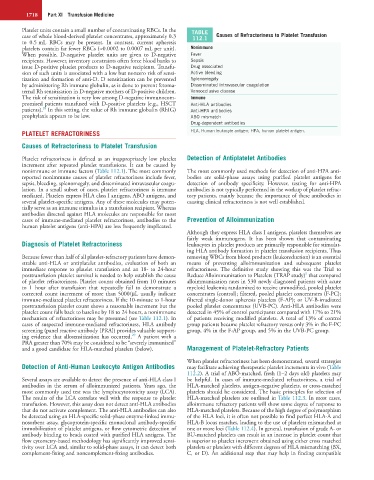
        Platelet units contain a small number of contaminating RBCs. In the   TABLE
        case of whole blood-derived platelet concentrates, approximately 0.3   112.1  Causes of Refractoriness to Platelet Transfusion
        to  0.5 mL  RBCs  may  be  present.  In  contrast,  current  apheresis
        platelets contain far fewer RBCs (≈0.0002 to 0.0007 mL per unit).   Nonimmune
        When  possible,  D-negative  platelet  units  are  given  to  D-negative   Fever
        recipients. However, inventory constraints often force blood banks to   Sepsis
        issue D-positive platelet products to D-negative recipients. Transfu-  Drug associated
        sion of such units is associated with a low but nonzero risk of sensi-  Active bleeding
        tization and formation of anti-D. D sensitization can be prevented   Splenomegaly
        by administering Rh immune globulin, as is done to prevent fetoma-  Disseminated intravascular coagulation
        ternal Rh sensitization in D-negative mothers of D-positive children.   Venoocclusive disease
        The risk of sensitization is very low among D-negative immunocom-  Immune
        promised patients transfused with D-positive platelets (e.g., HSCT   Anti-HLA antibodies
               28
        patients).  In this setting, the value of Rh immune globulin (RhIG)   Anti-HPA antibodies
        prophylaxis appears to be low.                         ABO mismatch
                                                               Drug-dependent antibodies
        PLATELET REFRACTORINESS                                HLA, Human leukocyte antigen; HPA, human platelet antigen.

        Causes of Refractoriness to Platelet Transfusion

        Platelet  refractoriness  is  defined  as  an  inappropriately  low  platelet   Detection of Antiplatelet Antibodies
        increment  after  repeated  platelet  transfusions.  It  can  be  caused  by
        nonimmune or immune factors (Table 112.1). The most commonly   The most commonly used methods for detection of anti-HPA anti-
        reported nonimmune causes of platelet refractoriness include fever,   bodies  are  solid-phase  assays  using  purified  platelet  antigens  for
        sepsis, bleeding, splenomegaly, and disseminated intravascular coagu-  detection  of  antibody  specificity.  However,  testing  for  anti-HPA
        lation. In a small subset of cases, platelet refractoriness is immune   antibodies is not typically performed in the workup of platelet refrac-
        mediated. Platelets express HLA class I antigens, ABO antigens, and   tory patients, mainly because the importance of these antibodies in
        several platelet-specific antigens. Any of these molecules may poten-  causing clinical refractoriness is not well established.
        tially serve as an immune stimulus in a transfusion recipient. Whereas
        antibodies directed against HLA molecules are responsible for most
        cases of immune-mediated platelet refractoriness, antibodies to the   Prevention of Alloimmunization
        human platelet antigens (anti-HPA) are less frequently implicated.
                                                              Although they express HLA class I antigens, platelets themselves are
                                                              fairly  weak  immunogens.  It  has  been  shown  that  contaminating
        Diagnosis of Platelet Refractoriness                  leukocytes in platelet products are primarily responsible for stimulat-
                                                              ing HLA antibody formation in platelet transfusion recipients. Thus
        Because fewer than half of all platelet-refractory patients have demon-  removing WBCs from blood products (leukoreduction) is an essential
        strable  anti-HLA  or  antiplatelet  antibodies,  evaluation  of  both  an   means  of  preventing  alloimmunization  and  subsequent  platelet
        immediate  response  to  platelet  transfusion  and  an  18-  to  24-hour   refractoriness.  The  definitive  study  showing  this  was  the  Trial  to
                                                                                                     5
        posttransfusion platelet survival is needed to help establish the cause   Reduce Alloimmunization to Platelets (TRAP study)  that compared
        of platelet refractoriness. Platelet counts obtained from 10 minutes   alloimmunization rates in 530 newly diagnosed patients with acute
        to  1  hour  after  transfusion  that  repeatedly  fail  to  demonstrate  a   myeloid leukemia randomized to receive unmodified, pooled platelet
        corrected count increment of more than 5000/µL usually indicate   concentrates (control); filtered, pooled platelet concentrates (F-PC);
        immune-mediated platelet refractoriness. If the 10-minute to 1-hour   filtered single-donor apheresis platelets (F-AP); or UV-B-irradiated
        posttransfusion platelet count shows a reasonable increment but the   pooled platelet concentrates (UVB-PC). Anti-HLA antibodies were
        platelet count falls back to baseline by 18 to 24 hours, a nonimmune   detected in 45% of control participants compared with 17% to 21%
        mechanism of refractoriness may be presumed (see Table 112.1). In   of patients receiving modified platelets. A total of 13% of control
        cases of suspected immune-mediated refractoriness, HLA antibody   group patients became platelet refractory versus only 3% in the F-PC
        screening (panel reactive antibody [PRA]) provides valuable support-  group, 4% in the F-AP group, and 5% in the UVB-PC group.
                                            29
        ing evidence that allosensitization has occurred.  A patient with a
        PRA greater than 70% may be considered to be “severely immunized”
        and a good candidate for HLA-matched platelets (below).  Management of Platelet-Refractory Patients
                                                              When platelet refractoriness has been demonstrated, several strategies
        Detection of Anti-Human Leukocyte Antigen Antibodies  may facilitate achieving therapeutic platelet increments in vivo (Table
                                                              112.2). A trial of ABO-matched, fresh (1–2 days old) platelets may
        Several assays are available to detect the presence of anti-HLA class I   be  helpful.  In  cases  of  immune-mediated  refractoriness,  a  trial  of
        antibodies  in  the  serum  of  alloimmunized  patients. Years  ago,  the   HLA-matched platelets, antigen-negative platelets, or cross-matched
        most commonly used test was the lymphocytotoxicity assay (LCA).   platelets should be considered. The basic principles for selection of
        The results of the LCA correlate well with the response to platelet   HLA-matched platelets are outlined in Table 112.3. In most cases,
        transfusion. However, this assay does not detect anti-HLA antibodies   alloimmune refractory patients will show some degree of response to
        that do not activate complement. The anti-HLA antibodies can also   HLA-matched platelets. Because of the high degree of polymorphism
        be detected using an HLA-specific solid-phase enzyme-linked immu-  of the HLA loci, it is often not possible to find perfect HLA-A and
        nosorbent assay, glycoprotein-specific monoclonal antibody-specific   HLA-B locus matches, leading to the use of platelets mismatched at
        immobilization of platelet antigens, or flow cytometric detection of   one or more loci (Table 112.4). In general, transfusion of grade A- or
        antibody binding to beads coated with purified HLA antigens. The   BU-matched platelets can result in an increase in platelet count that
        flow cytometry-based methodology has significantly improved sensi-  is superior to platelet increment obtained using either cross matched
        tivity over LCA and, similar to solid-phase assays, it can detect both   platelets or platelets with different degrees of HLA mismatching (BX,
        complement-fixing and noncomplement-fixing antibodies.  C, or D). An additional step that may help in finding compatible

