


Page 1943 - Hematology_ Basic Principles and Practice ( PDFDrive )
P. 1943
Chapter 113  Human Leukocyte Antigen and Human Neutrophil Antigen Systems  1723

                                                                  STRUCTURE OF THE HUMAN LEUKOCYTE
                                                                  ANTIGEN CLASS I AND II

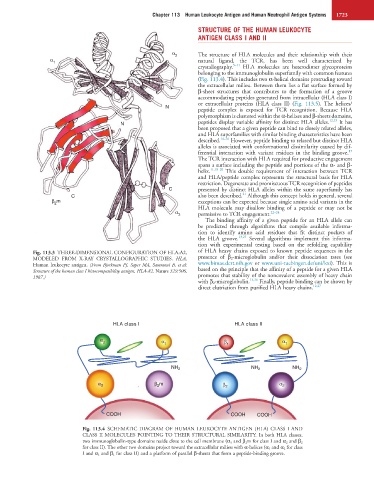
                                                         α 2      The  structure  of  HLA  molecules  and  their  relationship  with  their
                 α                                                natural  ligand,  the  TCR,  has  been  well  characterized  by
                  1
                                                                  crystallography. 9–11   HLA  molecules  are  heterodimer  glycoproteins
                                                                  belonging to the immunoglobulin superfamily with common features
                                                                  (Fig. 113.4). This includes two α-helical domains protruding toward
                                                                  the extracellular milieu. Between them lies a flat surface formed by
                                                                  β-sheet  structures  that  contributes  to  the  formation  of  a  groove
                                                                  accommodating peptides generated from intracellular (HLA class I)
                                                                  or  extracellular  proteins  (HLA  class  II)  (Fig.  113.5). The  helices/
                                                       N
                                                                  peptide  complex  is  exposed  for  TCR  recognition.  Because  HLA
                                                                  polymorphism is clustered within the α-helixes and β-sheets domains,
                                        N                         peptides display variable affinity for distinct HLA alleles. 12,13  It has
                                                                  been proposed that a given peptide can bind to closely related alleles,
                                                                  and HLA superfamilies with similar binding characteristics have been
                                                                  described. 14–16  However, peptide binding to related but distinct HLA
                                                                  alleles is associated with conformational dissimilarity caused by dif-
                                                                                                                   17
                                                                  ferential  interaction  with  variant  residues  in  the  binding  groove.
                                                                  The TCR interaction with HLA required for productive engagement
                                                                  spans a surface including the peptide and portions of the α- and β-
                                                                  helix. 11,18–20  This  double  requirement  of  interaction  between TCR
                                                                  and HLA/peptide complex represents the structural basis for HLA
                                                                  restriction. Degenerate and promiscuous TCR recognition of peptides
                                                        C         presented by distinct HLA alleles within the same superfamily has
                                                                                21
                        C                                         also been described.  Although this concept holds in general, several
                  β m                                             exceptions can be expected because single amino acid variants in the
                   2
                                                                  HLA  molecule  may  disallow  binding  of  a  peptide  or  may  not  be
                                                          α 3     permissive to TCR engagement. 22–24
                                                                    The  binding  affinity  of  a  given  peptide  for  an  HLA  allele  can
                                                                  be  predicted  through  algorithms  that  compile  available  informa-
                                                                  tion  to  identify  amino  acid  residues  that  fit  distinct  pockets  of
                                                                  the  HLA  groove. 13,25   Several  algorithms  implement  this  informa-
                                                                  tion  with  experimental  testing  based  on  the  refolding  capability
            Fig. 113.3  THREE-DIMENSIONAL CONFIGURATION OF HLA-A2,   of HLA heavy chains exposed to known peptide sequences in the
            MODELED  FROM  X-RAY  CRYSTALLOGRAPHIC  STUDIES.  HLA,   presence  of  β 2 -microglobulin  and/or  their  dissociation  rates  (see
            Human leukocyte antigen. (From Bjorkman PJ, Saper MA, Samraoui B, et al:   www.bimas.dcrt.nih.gov or www.uni-tuebingen.de/uni/kxi). This is
            Structure of the human class I histocompatibility antigen, HLA-A2. Nature 329:506,   based on the principle that the affinity of a peptide for a given HLA
            1987.)                                                promotes that stability of the noncovalent assembly of heavy chain
                                                                                   13,26
                                                                  with β 2 -microglobulin.   Finally, peptide binding can be shown by
                                                                  direct elutriation from purified HLA heavy chains. 12,27


                                      HLA class I                             HLA class II


                                  α                                                          α
                                   2                  α 1                 β 1                 1


                                                         NH 2                      NH 2          NH 2


                                 α 3                β m                   β 2               α 2
                                                    2


                                    COOH                                     COOH    COOH

                            Fig.  113.4  SCHEMATIC DIAGRAM OF HUMAN LEUKOCYTE ANTIGEN (HLA) CLASS I AND
                            CLASS II MOLECULES POINTING TO THEIR STRUCTURAL SIMILARITY. In both HLA classes,
                            two immunoglobulin-type domains reside close to the cell membrane (α 3 and β 2m for class I and α 2 and β 2
                            for class II). The other two domains project toward the extracellular milieu with α-helices (α 1 and α 2  for class
                            I and α 1 and β 1  for class II) and a platform of parallel β-sheets that form a peptide-binding groove.

