


Page 1946 - Hematology_ Basic Principles and Practice ( PDFDrive )
P. 1946
1726   Part XI  Transfusion Medicine


        unknown conditions, HLA-F may modulate the function of immune   forms HLA-Bw4. Because a single KIR can interact with multiple
        effector cells similarly to HLA-E and HLA-G.          HLA  class  I  alleles,  KIR  recognition  of  HLA  class  I  molecules  is
                                                              degenerate. Another NK inhibitory receptor (CD94-NKG2A) recog-
        NON-HUMAN LEUKOCYTE ANTIGEN POLYMORPHISM              nizes the nonclassic HLA-E molecule. In addition, each of the KIR
                                                              genes is extensively polymorphic.
        AND ITS CLINICAL SIGNIFICANCE                            Because the genes for KIR, HLA, and CD94-NKG2A are located
                                                              in separate chromosomes, they segregate independently and conse-
        Although this chapter is dedicated to HLA, it would be incomplete   quently individuals can carry genes for KIR for which there is no
                                                                                   97
        without mentioning the increasingly recognized polymorphisms of   correspondent HLA ligand.  As HLA-E is expressed in all individu-
        other immune modulators. The significance of non-HLA polymor-  als, NK cells that bear the CD94-NKG2A receptor are not alloreac-
        phism is evidenced by the development of GVHD in the presence of   tive. Because the specificity of KIR for their ligands is broad and each
                                                         92
        HLA identical matching among relatives. As recently summarized,    individual carries several KIRs, it is likely that in most cases all NK
        three general areas of polymorphism are being investigated: NK cell-  cells of a given person express at least one KIR that is specific for a
        receptor genes, mHags, and cytokines. Over the last decade, much   self-HLA class I allele. Thus in autologous settings, NK cells kill only
        progress has been made in identifying the mechanisms of action of   aberrant cells that have lost HLA class I expression. By contrast, NK
        NK cells. A major breakthrough was made in the discovery of HLA   cells can kill allogeneic cells that do not express HLA class I alleles
        class I-specific inhibitory receptors and in the role they play in the   recognized by their KIR. Thus, by knowing the KIR repertoire of a
        regulation of NK function with consequent effects on the eradication   given transplant recipient and the HLA type of the donor, it would
        of hematologic malignancies, prevention of graft rejection, or induc-  theoretically be possible to predict the likelihood of an NK-mediated
                     93
        tion  of  GVHD.   NK  cells  recognize  HLA  molecules  via  killer   alloreaction. Importantly, it appears that alloreactive NK cells undergo
        immunoglobulin-like  receptors  (KIRs). The  regulation  of  NK  cell   proliferation on exposure to the stimulatory cells and therefore can
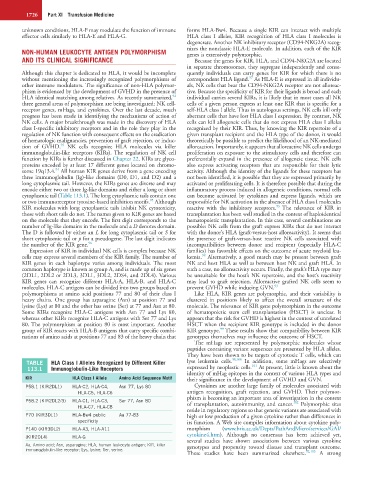
        function by KIRs is further discussed in Chapter 22. KIRs are glyco-  preferentially expand in the presence of allogeneic tissue. NK cells
        proteins encoded by at least 17 different genes located on chromo-  also  express  activating  receptors  that  are  responsible  for  their  lytic
                   94
        some 19q13.4.  All human KIR genes derive from a gene encoding   activity. Although the identity of the ligands for these receptors has
        three immunoglobulin (Ig)-like domains (D0, D1, and D2) and a   not been identified, it is possible that they are expressed primarily by
        long cytoplasmic tail. However, the KIRs genes are diverse and may   activated or proliferating cells. It is therefore possible that during the
        encode either two or three Ig-like domains and either a long or short   inflammatory process induced in allogeneic conditions, normal cells
        cytoplasmic tail (Table 113.1). The long cytoplasmic tails contain one   can  become  activated  by  cytokines  and  express  ligands,  which  are
                                                  95
        or two immunoreceptor tyrosine-based inhibition motifs.  Although   responsible for NK activation in the absence of HLA class I molecules
                                                                                           93
        KIR molecules with long cytoplasmic tails inhibit NK cytotoxicity,   reactive  with  the  inhibitory  receptors.   The  relevance  of  KIR  in
        those with short tails do not. The names given to KIR genes are based   transplantation has been well studied in the context of haploidentical
        on the molecule that they encode. The first digit corresponds to the   hematopoietic transplantation. In this case, several combinations are
        number of Ig-like domains in the molecule and a D denotes domain.   possible: NK cells from the graft express KIRs that do not interact
        The D is followed by either an L for long cytoplasmic tail or S for   with the donor’s HLA (graft-versus-host alloreactivity). It seems that
        short cytoplasmic tail or p for a pseudogene. The last digit indicates   the  presence  of  graft-versus-host  reactive  NK  cells  associated  with
        the number of the KIR gene. 96                        incompatibilities  between  donor  and  recipient  (especially  HLA-C
           Expression of KIR in individual NK cells is complex because NK   families) has favorable effects on the outcome of acute myeloid leu-
                                                                   98
        cells may express several members of the KIR family. The number of   kemia.  Alternatively, a good match may be present between graft
        KIR  genes  in  each  haplotype  varies  among  individuals. The  most   NK and host HLA as well as between host NK and graft HLA. In
        common haplotype is known as group A, and is made up of six genes   such a case, no alloreactivity occurs. Finally, the graft’s HLA type may
        (2DL1, 2DL2 or 2DL3, 3DL1, 3DL2, 2DS4, and 2DL4). Various   be unsuitable for the host’s NK repertoire, and the host’s reactivity
        KIR  genes  can  recognize  different  HLA-A,  HLA-B,  and  HLA-C   may  lead  to  graft  rejection.  Alloreactive  grafted  NK  cells  seem  to
        molecules. HLA-C antigens can be divided into two groups based on   prevent GVHD while inducing GVN. 93
        polymorphisms at amino acid positions 77 and 80 of their class I   Like  HLA,  KIR  genes  are  polymorphic,  and  their  variability  is
        heavy  chains.  One  group  has  asparagine  (Asn)  at  position  77  and   clustered  in  positions  likely  to  affect  the  overall  structure  of  the
        lysine (Lys) at 80 and the other has serine (Ser) at 77 and Asn at 80.   molecule. The relevance of KIR gene polymorphism in the outcome
        Some  KIRs  recognize  HLA-C  antigens  with  Asn  77  and  Lys  80,   of  hematopoietic  stem  cell  transplantation  (HSCT)  is  unclear.  It
        whereas other KIRs recognize HLA-C antigens with Ser 77 and Lys   appears that the risk for GVHD is highest in the context of unrelated
        80. The polymorphism at position 80 is most important. Another   HSCT when the recipient KIR genotype is included in the donor
                                                                         99
        group of KIR reacts with HLA-B antigens that carry specific combi-  KIR genotype.  These results show that compatibility between KIR
        nations of amino acids at positions 77 and 83 of the heavy chain that   genotypes themselves may influence the outcome of HSCT.
                                                                 The  mHags  are  represented  by  polymorphic  molecules  whose
                                                              peptides containing variant sequences are presented by HLA alleles.
                                                              They have been shown to be targets of cytotoxic T cells, which can
          TABLE   HLA Class I Alleles Recognized by Different Killer   lyse  leukemia  cells. 98,100   In  addition,  some  mHags  are  selectively
                                                                                   101
          113.1   Immunoglobulin-Like Receptors               expressed by neoplastic cells.  At present, little is known about the
                                                              identity of mHag epitopes in the context of various HLA types and
         KIR             HLA Class I Allele  Amino Acid Sequence Motif  their significance in the development of GVHD and GVN.
         P58.1 (KIR2DL1)  HLA-C2, HLA-C4,   Asn 77, Lys 80       Cytokines are another large family of molecules associated with
                           HLA-C5, HLA-C6                     antigen  recognition,  graft  rejection,  and  GVHD.  Their  polymor-
                                                              phism is becoming an important area of investigation in the context
         P58.2 (KIR2DL2/3)  HLA-C1, HLA-C3,   Ser 77, Asn 80  of transplantation, autoimmunity, and cancer.  Polymorphic sites
                                                                                                 102
                           HLA-C7, HLA-C8
                                                              reside in regulatory regions so that genetic variants are associated with
         P70 (KIR3DL1)   HLA-Bw4 public   Aa 77-83            high or low production of a given cytokine rather than differences in
                           specificity                        its function. A Web site compiles information about cytokine poly-
         P140 (KIR3DL2)  HLA-A3, HLA-A11                      morphism    (www.bris.ac.uk/Depts/PathAndMicro/services/GAI/
         (KIR2DL4)       HLA-G                                cytokine4.htm).  Although  no  consensus  has  been  achieved  yet,
                                                              several  studies  have  shown  associations  between  various  cytokine
         Aa, Amino acid; Asn, asparagine; HLA, human leukocyte antigen; KIR, killer   genotypes  and  propensity  toward  disease  and  transplant  outcome.
         immunoglobulin-like receptor; Lys, lysine; Ser, serine.                                     92,103
                                                              These  studies  have  been  summarized  elsewhere.    A  strong

