


Page 1944 - Hematology_ Basic Principles and Practice ( PDFDrive )
P. 1944
1724   Part XI  Transfusion Medicine


                                                              as  macrophages  and  dendritic  cells.  HLA  class  II  molecules  are
                                                              assembled within the endosomal compartment where they are com-
                                                              posed of a heterotrimer. This includes the α- and β-chains plus a
                                                              short  invariant  chain  that  stabilizes  the  molecule  by  occupying  its
                                                              groove while chaperoning its migration to the endosomal compart-
                                                              ment  where  exogenous  antigen  is  processed.  Upon  uptake,  the
                                                              exogenous antigen undergoes limited proteolysis in the membrane-
                                                              bound acidic endosomal compartment (MHC class II peptide-loading
                                                              compartment, MIIC). Upon entering the MIIC, the pre-HLA class
                                                              II complex is degraded, and antigenic peptides are loaded with the
                                                              help of the nonclassic HLA-DM molecule. 37

                                                              EXPRESSION OF HUMAN LEUKOCYTE
                                                              ANTIGEN MOLECULES

                                                              There are genetic and structural differences between the two classes
                                                              of HLA alleles. The most striking difference is functional, because
                                                              HLA class I molecules are expressed by most nucleated cells with the
              N                                               exception  of  germinal  cells,  whereas  HLA  class  II  molecules  are
                                                              expressed  mainly  by  specialized  antigen-presenting  cells. 38,39   HLA
                                                                                                40
                                                              class I molecules are also expressed by platelets.  They are responsible
                                                              for refractoriness after multiple transfusions and sufficiently, though
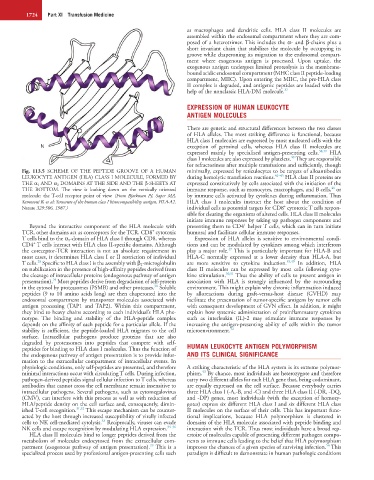
        Fig.  113.5  SCHEME  OF  THE  PEPTIDE  GROOVE  OF  A  HUMAN   minimally, expressed by reticulocytes to be targets of alloantibodies
        LEUKOCYTE ANTIGEN (HLA) CLASS I MOLECULE, FORMED BY   during hemolytic transfusion reactions. 41–45  HLA class II proteins are
        THE α 1 AND α 2 DOMAINS AT THE SIDE AND THE β-SHEETS AT   expressed constitutively by cells associated with the initiation of the
                                                                                                             46
        THE  BOTTOM.  The  view  is  looking  down  on  the  vertically  oriented   immune response, such as monocytes, macrophages, and B cells,  or
        molecule:  the T-cell  receptor  point  of  view.  (From  Bjorkman  PJ,  Saper  MA,   by immune cells activated by cytokines during inflammation. Thus
        Samraoui B, et al: Structure of the human class I histocompatibility antigen, HLA-A2.   HLA  class  I  molecules  instruct  the  host  about  the  condition  of
                                                                                              +
        Nature 329:506, 1987.)                                individual cells as potential targets for CD8  cytotoxic T cells respon-
                                                              sible for clearing the organisms of altered cells. HLA class II molecules
                                                              initiate immune responses by taking up pathogen components and
                                                                                 +
           Beyond  the  interactive  component  of  the  HLA  molecule  with   presenting them to CD4  helper T cells, which can in turn initiate
                                                   +
        TCR, other domains act as coreceptors for the TCR. CD8  cytotoxic   humoral and facilitate cellular immune responses.
        T cells bind to the α 3 -domain of HLA class I through CD8, whereas   Expression  of  HLA  alleles  is  sensitive  to  environmental  condi-
            +
        CD4  T cells interact with HLA class II-specific domains. Although   tions and can be modulated by cytokines among which interferons
                                                                            47
        the  coreceptor-TCR  interaction  is  not  an  absolute  requirement  in   play a major role.  This is particularly important for HLA-B and
        most cases, it determines HLA class I or II restriction of individual   HLA-C  normally  expressed  at  a  lower  density  than  HLA-A,  but
             28
        T cells.  Specific to HLA class I is the assembly with β 2 -microglobulin   are  more  sensitive  to  cytokine  induction. 48,49   In  addition,  HLA
        on stabilization in the presence of high-affinity peptides derived from   class  II  molecules  can  be  expressed  by  most  cells  following  cyto-
        the cleavage of intracellular proteins (endogenous pathway of antigen   kine stimulation. 50,51  Thus the ability of cells to present antigen in
                  29
        presentation).  Most peptides derive from degradation of self-protein   association  with  HLA  is  strongly  influenced  by  the  surrounding
                                                    30
        in the cytosol by proteasomes (PSMB) and other proteases.  Soluble   environment. This might explain why chronic inflammation induced
        peptides (9 to 10 amino acids long) are then chaperoned into the   by  alloreactions  during  graft-versus-host  disease  (GVHD)  may
        endosomal  compartment  by  transporter  molecules  associated  with   facilitate the presentation of tumor-specific antigens by tumor cells
        antigen  processing  (TAP1  and  TAP2).  Within  this  compartment,   with consequent development of GVN effect. In addition, it might
        they bind to heavy chains according to each individual’s HLA phe-  explain how systemic administration of proinflammatory cytokines
        notype.  The  binding  and  stability  of  the  HLA-peptide  complex   such  as  interleukin  (IL)-2  may  stimulate  immune  responses  by
        depends on the affinity of each peptide for a particular allele. If the   increasing  the  antigen-presenting  ability  of  cells  within  the  tumor
        stability  is  sufficient,  the  peptide-loaded  HLA  migrates  to  the  cell   microenvironment. 52
        surface.  Intracellular  pathogens  produce  proteins  that  are  also
        degraded  by  proteasomes  into  peptides  that  compete  with  self-
        peptides for binding to HLA class I molecules. Thus the function of   HUMAN LEUKOCYTE ANTIGEN POLYMORPHISM
        the endogenous pathway of antigen presentation is to provide infor-  AND ITS CLINICAL SIGNIFICANCE
        mation to the extracellular compartment of intracellular events. In
        physiologic conditions, only self-peptides are presented, and therefore   A striking characteristic of the HLA system is its extreme polymor-
                                                                   53
        minimal interactions occur with circulating T cells. During infection,   phism.  By chance, most individuals are heterozygote and therefore
        pathogen-derived peptides signal cellular infection to T cells, whereas   carry two different alleles for each HLA gene that, being codominant,
        antibodies that cannot cross the cell membrane remain insensitive to   are equally expressed on the cell surface. Because everybody carries
        intracellular pathogens. Several pathogens, such as cytomegalovirus   three HLA class I (-A,-B, and -C) and three HLA class II (-DR, -DQ,
        (CMV), can interfere with this process as well as with reduction of   and -DP) genes, most individuals (with the exception of homozy-
        HLA/peptide density on the cell surface and, consequently, dimin-  gotes) express six different HLA class I and six different HLA class
        ished T-cell recognition. 31,32  This escape mechanism can be counter-  II molecules on the surface of their cells. This has important func-
        acted by the host through increased susceptibility of virally infected   tional  implications,  because  HLA  polymorphism  is  clustered  in
                                  33
        cells to NK cell-mediated cytolysis.  Reciprocally, viruses can evade   domains of the HLA molecule associated with peptide binding and
        NK cells and escape recognition by modulating HLA expression. 34–36  interaction with the TCR. Thus most individuals have a broad rep-
           HLA class II molecules bind to longer peptides derived from the   ertoire of molecules capable of presenting different pathogen compo-
        metabolism  of  molecules  endocytosed  from  the  extracellular  com-  nents to immune cells leading to the belief that HLA polymorphism
                                                                                                            54
                                                  29
        partment (exogenous pathway of antigen presentation).  This is a   improves the chances of a given species of surviving infection.  This
        specialized process used by professional antigen-presenting cells such   paradigm is difficult to demonstrate in human pathologic conditions

