


Page 1949 - Hematology_ Basic Principles and Practice ( PDFDrive )
P. 1949
Chapter 113  Human Leukocyte Antigen and Human Neutrophil Antigen Systems  1729


            important, because antibodies identify structural differences on the   alleles result in ambiguous allele combinations that require additional
                                                                                  142
            surface of HLA molecules, variants caused by nucleotide polymor-  testing for resolution.  Finally, new methods based on high-density
            phism in nonexposed areas such as the peptide-binding groove of the   array technology are being developed that may allow extensive typing
            HLA heavy chain are not detectable. However, these differences are   of known and unknown polymorphisms on microchips. 143,144
            of functional significance because they determine the specificity and   High-resolution methods yield high-resolution information of an
            affinity of peptide binding and T-cell recognition of self and alloge-  individual’s HLA type. However, the wealth of information is coun-
            neic target cells. 23,131–133  DNA-based typing directly determines the   terbalanced by increased difficulty in identifying suitable HLA alleles
                   134
            sequence,   and  its  resolution  is  limited  only  by  the  number  of   during donor-recipient pairing or accrual into immunization proto-
            allele-specific  probes  used  to  identify  an  ever-growing  number  of   cols  restricted  to  specific  HLA-epitope  combinations.  Thus,  at
            alleles (see www.anthonynolan.com/HIG/index.htm). Various poly-  present, clinicians are faced with the daunting task of applying high-
            merase  chain  reaction  (PCR)-based  methods  have  been  described,   resolution typing results of unclear relevance to clinical settings. 145
            among which sequence-specific primer and sequence-specific oligo-
            nucleotide probe-based methods are the most universally used. 134–137
            The rich nature of HLA has led to proportionally increasing complex-  TESTING FOR ALLOSENSITIZATION AND
            ity of the assays used to cover all possible alleles. As a consequence,
            accurate HLA typing for donor and recipient matching in transplan-  DETERMINATION OF COMPATIBLE
            tation has become increasingly complex and burdensome. In addi-  RECIPIENT-DONOR PAIRS
            tion,  because  of  the  important  role  that  HLA  molecules  play  in
            antigen presentation and the stringency of the relationship between   Any  cell-containing  product  transfused  or  transplanted  between
            epitope and associated HLA allele, high-resolution typing is increas-  different individuals should be compatible in an ideal situation. Yet,
            ingly requested for appropriate enrollment of patients into immuni-  in most cases, histocompatibility is not prospectively sought. Thus
                                                            138
            zation  protocols  aimed  at  the  enhancement  of T-cell  responses.    patients  with  multiple  exposures  to  blood  products  often  become
            Therefore high-resolution HLA typing is increasingly in demand in   reactive to various antigens, including HLA. Transplant candidates
            clinical and experimental settings.                   often  develop  prior  alloreactivity  following  transfusion  of  platelet
              Although oligonucleotide-based methods could theoretically dis-  concentrates  contaminated  with  leukocytes,  even  though  the  inci-
            criminate any known polymorphic site, they have two major limita-  dence of allosensitization is much less because of leukodepletion of
            tions.  First,  they  require  a  specific  PCR  reaction  for  each  allele   blood products. Alloreactivity must be documented before transplan-
            investigated. Because each individual  has only two alleles for each   tation, because alloreactive patients can still undergo transplantation,
            locus, a disproportionately large number of PCR reactions must be   provided that the donor has no mismatched HLA antigens reacting
            performed to cover all possible polymorphisms to identify the two   with  the  patient’s  antibodies.  Patients  who  have  received  repeated
            borne by the individual tested. Because both methods are based on   platelet  transfusions  may  become  allosensitized  and  consequently
            specific interactions with known oligonucleotide sequences unique to   refractory to further transfusions unless HLA-compatible platelets are
            a  particular  allele,  they  cannot  identify  unknown  polymorphisms   used. Obviously the best compatibility consists of identical matching.
            unless the variation occurs within the region spanned by one of the   It is often impossible to identify a perfectly matched unrelated donor,
            oligonucleotides used in the assay. Because of these limitations, interest   particularly in the case of rare HLA types. Thus other strategies are
            is growing for definitive typing methods that yield conclusive informa-  adopted to identify the best possible match or compatible mismatch.
            tion about the identity of the alleles typed. The most comprehensive   Selection of unrelated donor-recipient pairs is carried out through
                                                                                                         146
            method  is  sequence-based  typing.  Unfortunately,  its  use  has  been   typing with serologic, cellular, and molecular methods.  The chances
            limited by the cost of equipment and reagents and by the high level   of identifying compatible donors based on full or partial HLA match-
            of expertise and time required for the interpretation of each typing.   ing have become increasingly low with the increasing resolution of
                                                                                 145
            More recently, high-throughput, robotic, sequence-based typing has   the typing methods.  To broaden compatibility, matching criteria
            been developed that allows sequencing of hundreds of genomic frag-  of donor-recipient pairs are based on shared public epitopes assigned
                                                                                           147
            ments each day. 139–141  However, even sequence-based typing has some   to cross-reactive groups (CREGs)  or shared amino acid polymor-
                                                                                                               148
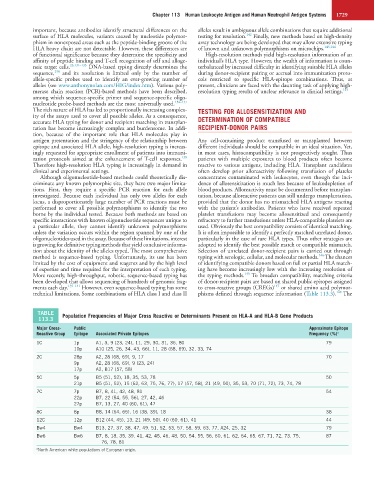
            technical limitations. Some combinations of HLA class I and class II   phisms defined through sequence information (Table 113.3).  The
             TABLE   Population Frequencies of Major Cross Reactive or Determinants Present on HLA-A and HLA-B Gene Products
              113.3
             Major Cross-   Public                                                                    Approximate Epitope
             Reactive Group  Epitope  Associated Private Epitopes                                     Frequency (%) a
             1C          1p     A1, 3, 9 (23, 24), 11, 29, 30, 31, 36, 80                                   79
                         10p    A10 (25, 26, 34, 43, 66), 11, 28 (68, 69), 32, 33, 74
             2C          28p    A2, 28 (68, 69), 9, 17                                                      70
                         9p     A2, 28 (68, 69), 9 (23, 24)
                         17p    A2, B17 (57, 58)
             5C          5p     B5 (51, 52), 18, 35, 53, 78                                                 50
                         21p    B5 (51, 52), 15 (62, 63, 75, 76, 77), 17 (57, 58), 21 (49, 50), 35, 53, 70 (71, 72), 73, 74, 78
             7C          7p     B7, 8, 41, 42, 48, 81                                                       54
                         22p    B7, 22 (54, 55, 56), 27, 42, 46
                         27p    B7, 13, 27, 40 (60, 61), 47
             8C          8p     B8, 14 (64, 65), 16 (38, 39), 18                                            38
             12C         12p    B12 (44, 45), 13, 21 (49, 50), 40 (60, 61), 41                              44
             Bw4         Bw4    B13, 27, 37, 38, 47, 49, 51, 52, 53, 57, 58, 59, 63, 77, A24, 25, 32        79
             Bw6         Bw6    B7, 8, 18, 35, 39, 41, 42, 45, 46, 48, 50, 54, 55, 56, 60, 61, 62, 64, 65, 67, 71, 72, 73, 75,   87
                                  76, 78, 81
             a North American white populations of European origin.

