


Page 1954 - Hematology_ Basic Principles and Practice ( PDFDrive )
P. 1954
1734   Part XI  Transfusion Medicine


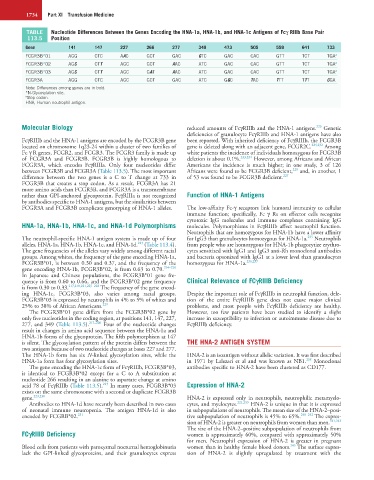
          TABLE   Nucleotide Differences Between the Genes Encoding the HNA-1a, HNA-1b, and HNA-1c Antigens of Fcγ RIIIb Base Pair
          113.5   Position
         Gene          141      147     227      266     277      349     473      505     559      641     733
         FCGR3B*01     AGG      CTC     AAC      GCT     GAC      GTC     GAC      CAC     GTT      TCT     TGA a
         FCGR3B*02     AGC      CTT     AGC      GCT     AAC      ATC     GAC      CAC     GTT      TCT     TGA a
         FCGR3B*03     AGC      CTT     AGC      GAT     AAC      ATC     GAC      CAC     GTT      TCT     TGA a
         FCGR3A        AGG      CTC     AGC      GCT     GAC      ATC     GGC      TAC     TTT      TTT     CGA
         Note: Differences among genes are in bold.
         *N-Glycosylation site.
         a Stop codon.
         HNA, Human neutrophil antigen.


        Molecular Biology                                     reduced amounts of FcγRIIIb and the HNA-1 antigens.  Genetic
                                                                                                        220
                                                              deficiencies of granulocyte FcγRIIIb and HNA-1 antigens have also
        FcγRIIIb and the HNA-1 antigens are encoded by the FCGR3B gene   been reported. With inherited deficiency of FcγRIIIb, the FCGR3B
        located on chromosome 1q23-24 within a cluster of two families of   gene is deleted along with an adjacent gene, FCGR2C. 224,232  Among
        Fc γ R genes, FCGR2, and FCGR3. The FCGR3 family is made up   white patients the incidence of individuals homozygous for FCGR3B
        of  FCGR3A  and  FCGR3B.  FCGR3B  is  highly  homologous  to   deletion is about 0.1%. 233,234  However, among Africans and African
        FCGR3A,  which  encodes  FcγRIIIa.  Only  four  nucleotides  differ   Americans  the  incidence  is  much  higher;  in  one  study,  3  of  126
                                                                                                 229
        between FCGR3B and FCGR3A (Table 113.5). The most important   Africans were found to be FCGR3B deficient,  and, in another, 1
        difference  between  the  two  genes  is  a  C  to  T  change  at  733  in   of 53 was found to be FCGR3B deficient. 227
        FCGR3B that creates a stop codon. As a result, FCGR3A has 21
        more amino acids than FCGR3B, and FCGR3A is a transmembrane
        rather than GPI-anchored glycoprotein. FcγRIIIa is not recognized   Function of HNA-1 Antigens
        by antibodies specific to HNA-1 antigens, but the similarities between
        FCGR3A and FCGR3B complicate genotyping of HNA-1 alleles.  The low-affinity Fc-γ receptors link humoral immunity to cellular
                                                              immune  function;  specifically,  Fc  γ  Rs  on  effector  cells  recognize
                                                              cytotoxic  IgG  molecules  and  immune  complexes  containing  IgG
        HNA-1a, HNA-1b, HNA-1c, and HNA-1d Polymorphisms      molecules.  Polymorphisms  in  FcγRIIIb  affect  neutrophil  function.
                                                              Neutrophils that are homozygous for HNA-1b have a lower affinity
                                                                                                      235
        The neutrophil-specific HNA-1 antigen system is made up of four   for IgG3 than granulocytes homozygous for HNA-1a.  Neutrophils
                                              223
        alleles, HNA-1a, HNA-1b, HNA-1c, and HNA-1d.  (Table 113.4).   from people who are homozygous for HNA-1b phagocytize erythro-
        The gene frequencies of the alleles vary widely among different racial   cytes sensitized with IgG1 and IgG3 anti-Rh monoclonal antibodies
        groups. Among whites, the frequency of the gene encoding HNA-1a,   and bacteria opsonized with IgG1 at a lower level than granulocytes
        FCGR3B*01, is between 0.30 and 0.37, and the frequency of the   homozygous for HNA-1a. 236,237
        gene encoding HNA-1b, FCGR3B*02, is from 0.63 to 0.70. 224–228
        In  Japanese  and  Chinese  populations,  the  FCGR3B*01  gene  fre-
        quency is from 0.60 to 0.66, and the FCGR3B*02 gene frequency   Clinical Relevance of FCγRIIIB Deficiency
        is from 0.30 to 0.33. 217,218,221,225–228  The frequency of the gene encod-
        ing  HNA-1c,  FCGR3B*03,  also  varies  among  racial  groups.   Despite the important role of FcγRIIIb in neutrophil function, dele-
        FCGR3B*03 is expressed by neutrophils in 4% to 5% of whites and   tion  of  the  entire  FcγRIIIB  gene  does  not  cause  major  clinical
        25% to 38% of African Americans. 229                  problems,  and  most  people  with  FcγRIIIb  deficiency  are  healthy.
           The  FCGR3B*01  gene  differs  from  the  FCGR3B*02  gene  by   However,  too  few  patients  have  been  studied  to  identify  a  slight
        only five nucleotides in the coding region, at positions 141, 147, 227,   increase in susceptibility to infection or autoimmune disease due to
        277,  and  349  (Table  113.5). 217–220   Four  of  the  nucleotide  changes   FcγRIIIb deficiency.
        result in changes in amino acid sequence between the HNA-1a and
        HNA-1b forms of the glycoprotein. The fifth polymorphism at 147
        is silent. The glycosylation pattern of the protein differs between the   THE HNA-2 ANTIGEN SYSTEM
        two antigens because of two nucleotide changes at bases 227 and 277.
        The  HNA-1b  form  has  six  N-linked  glycosylation  sites,  while  the   HNA-2 is an isoantigen without allelic variation. It was first described
                                                                                                     238
        HNA-1a form has four glycosylation sites.             in  1971  by  Lalezari  et  al  and  was  known  as  NB1.   Monoclonal
           The gene encoding the HNA-1c form of FcγRIIIb, FCGR3B*03,   antibodies specific to HNA-2 have been clustered as CD177.
        is  identical  to  FCGR3B*02  except  for  a  C  to  A  substitution  at
        nucleotide 266 resulting in an alanine to aspartate change at amino
                                   223
        acid 78 of FcγRIIIb (Table 113.5).  In many cases, FCGR3B*03   Expression of HNA-2
        exists on the same chromosome with a second or duplicate FCGR3B
        gene. 223,230                                         HNA-2  is  expressed  only  in  neutrophils,  neutrophilic  metamyelo-
           Antibodies to HNA-1d have recently been described in two cases   cytes, and myelocytes. 221,239  HNA-2 is unique in that it is expressed
        of  neonatal  immune  neutropenia.  The  antigen  HNA-1d  is  also   in subpopulations of neutrophils. The mean size of the HNA-2–posi-
        encoded by FCGRB*02. 231                              tive subpopulation of neutrophils is 45% to 65%. 240–242  The expres-
                                                              sion of HNA-2 is greater on neutrophils from women than men. 241,243
                                                              The size of the HNA-2–positive subpopulation of neutrophils from
        FCγRIIIB Deficiency                                   women is approximately 60%, compared with approximately 50%
                                                              for  men.  Neutrophil  expression  of  HNA-2  is  greater  in  pregnant
                                                                                                243
        Blood cells from patients with paroxysmal nocturnal hemoglobinuria   women than in healthy female blood donors.  The surface expres-
        lack  the  GPI-linked  glycoproteins,  and  their  granulocytes  express   sion  of  HNA-2  is  slightly  upregulated  by  treatment  with  the

