


Page 1955 - Hematology_ Basic Principles and Practice ( PDFDrive )
P. 1955
Chapter 113  Human Leukocyte Antigen and Human Neutrophil Antigen Systems  1735

                                      240
            chemotactic peptide F-met-leu-phe.  The administration of G-CSF   HNA-4 AND HNA-5 ANTIGEN SYSTEMS
            to healthy patients for several days increases the proportion of neu-
            trophils expressing HNA-2 to near 90%. 244            HNA-4 and HNA-5 antigens are located in the β 2-integrins. Each
                                                                  antigen system contains only a single antigen, HNA-4a and HNA-5a,
                                                                  respectively.  HNA-4a  antigen  was  previously  known  as  Mart(a).
            CD177 Glycoprotein Biochemistry                       HNA-4a  has  a  phenotype  frequency  of  99.1%  in  white  patients.
                                                                  HNA-4a has been located on the αM chain (CD11b) of the C3bi
            The glycoprotein carrying HNA-2a, CD177, was previously known   receptor (CR3) and is caused by a single nucleotide substitution of
                                                                                                    260
            as the NB1 glycoprotein. It is located on neutrophil plasma mem-  G to A at position 302 of the gene ITGAM.  The substitution is
            branes  and  secondary  granules 240,245   and  is  linked  to  the  plasma   predicted to result in an arginine to histidine polymorphism at amino
                                  240
            membrane via a GPI anchor.  Although some GPI-anchored pro-  acid 61.
            teins are shed by F-met-leu-phe–treated neutrophils, CD177 is not,   A second polymorphism of the β 2 -integrins, HNA-5a, was first
                                                   240
            nor is soluble CD177 glycoprotein present in plasma.  The molecu-  described as Ond(a). HNA-5a was found to be expressed on the αL
            lar  weight  of  CD177  is  58  to  64 kDa,  and  it  contains  N-linked   integrin  unit,  leukocyte  function-associated  antigen-1  (LFA-1)
            carbohydrate side chains. 240,245                     (CD11a), and is caused by a G to C single nucleotide substitution
                                                                  at position 2446 of the gene ITGAL. This change predicts an amino
                                                                  acid change of arginine to threonine at amino acid 766. 260
            Molecular Biology
            The gene encoding CD177 is located on chromosome 19q13.31, and
            its coding region consists of 1311 base pairs that code for a protein   CLINICAL SIGNIFICANCE OF ANTIBODIES
            of 416 and a signal peptide of 21 amino acids. 246,247  The predicted   TO NEUTROPHIL ANTIGENS
            protein  has  two  cysteine-rich  domains,  three  potential  N-linked
            glycosylation sites, and a potential ω-site for attachment of the GPI   Alloimmune Neonatal Neutropenia
                 247
            anchor.  This  gene  belongs  to  the  Ly-6  snake  toxin  superfamily.
            Other  genes  in  this  family  include  urokinase-type  plasminogen   During pregnancy, mothers can become alloimmunized to neutrophil
            activator  receptor  (uPAR;  CD87)  and  decay-accelerating  factor   antigens. Maternal IgG directed to neutrophils can cross the placenta
            (CD59).                                               and destroy the neonate’s neutrophils. Maternal alloimmunization to
                                                                  neutrophil antigens can occur in utero and affect the first child. Most
                                                                  neonates  experience  isolated  neutropenia,  but  the  cytopenias  are
            Polymorphisms                                         self-limiting and resolve as the antibody is cleared. The alloimmu-
                                                                  nized mothers produce and carry the antibodies; but the antibodies
            HNA-2 is expressed in neutrophils by approximately 97% of whites,   do not react with the mother’s blood cells or tissues, and they have
            95% of African Americans, and 89% to 99% of Japanese. 241,248–250    normal neutrophil counts. Antibodies to neutrophil-specific antigens
            HNA-2–negative  neutrophil  phenotype  is  caused  by  a  CD177   HNA-1a,  HNA-1b,  and  HNA-2  most  commonly  cause  neonatal
                           251
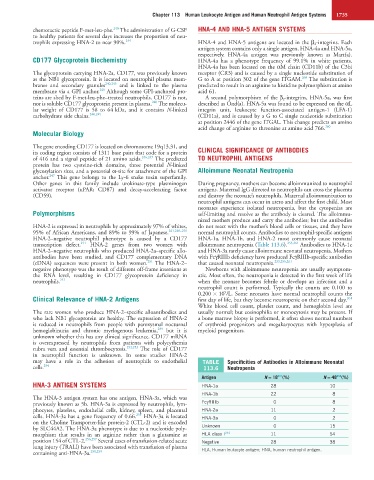
            transcription  defect.   HNA-2  genes  from  two  women  with   alloimmune neutropenia (Table 113.6). 255,261  Antibodies to HNA-1c
            HNA-2–negative neutrophils who produced HNA-2a–specific allo-  and HNA-3a rarely cause alloimmune neonatal neutropenia. Mothers
            antibodies  have  been  studied,  and  CD177  complementary  DNA   with FcγRIIIb deficiency have produced FcγRIIIb-specific antibodies
                                                 251
            (cDNA)  sequences  were  present  in  both  women.  The  HNA-2–  that caused neonatal neutropenia. 233,255,261
            negative phenotype was the result of different off-frame insertions at   Newborns with alloimmune neutropenia are usually asymptom-
            the  RNA  level,  resulting  in  CD177  glycoprotein  deficiency  in   atic. Most often, the neutropenia is detected in the first week of life
            neutrophils. 251                                      when  the  neonate  becomes  febrile  or  develops  an  infection  and  a
                                                                  neutrophil  count  is  performed. Typically  the  counts  are  0.100  to
                                                                          9
                                                                  0.200 × 10 /L. Some neonates have normal neutrophil counts the
            Clinical Relevance of HNA-2 Antigens                  first day of life, but they become neutropenic on their second day.
                                                                                                                  261
                                                                  White  blood  cell  count,  platelet  count,  and  hemoglobin  level  are
            The rare women who produce HNA-2–specific alloantibodies and   usually normal; but eosinophilia or monocytosis may be present. If
            who lack NB1 glycoprotein are healthy. The expression of HNA-2   a bone marrow biopsy is performed, it often shows normal numbers
            is  reduced  in  neutrophils  from  people  with  paroxysmal  nocturnal   of  erythroid  progenitors  and  megakaryocytes  with  hyperplasia  of
                                                     239
            hemoglobinuria  and  chronic  myelogenous  leukemia,   but  it  is   myeloid progenitors.
            unknown whether this has any clinical significance. CD177 mRNA
            is  overexpressed  by  neutrophils  from  patients  with  polycythemia
            rubra  vera  and  essential  thrombocytosis. 252,253  The  role  of  CD177
            in  neutrophil  function  is  unknown.  In  some  studies  HNA-2
            may  have  a  role  in  the  adhesion  of  neutrophils  to  endothelial    TABLE   Specificities of Antibodies in Alloimmune Neonatal
            cells. 254                                              113.6  Neutropenia
                                                                   Antigen              N = 18 211 (%)     N = 48 253 (%)
            HNA-3 ANTIGEN SYSTEMS                                  HNA-1a                 28                 10
                                                                   HNA-1b                 22                  8
            The HNA-3 antigen system has one antigen, HNA-3a, which was
            previously known as 5b. HNA-3a is expressed by neutrophils, lym-  FcγRIIIb    0                   8
            phocytes,  platelets,  endothelial  cells,  kidney,  spleen,  and  placental   HNA-2a  11         2
                                              255
            cells. HNA-3a has a gene frequency of 0.66.  HNA-3a is located   HNA-3a       0                   2
            on the Choline Transporter-like protein-2 (CTL-2) and is encoded
            by SLC44A2. The HNA-3a phenotype is due to a nucleotide poly-  Unknown        0                  15
            morphism  that  results  in  an  arginine  rather  than  a  glutamine  at   HLA class I 251  11  54
            position 154 of CTL-2. 256,257  Several cases of transfusion-related acute   Negative  28        38
            lung injury (TRALI) have been associated with transfusion of plasma   HLA, Human leukocyte antigen; HNA, human neutrophil antigen.
            containing anti-HNA-3a. 258,259

