


Page 1965 - Hematology_ Basic Principles and Practice ( PDFDrive )
P. 1965
Chapter 114  Principles of Neutrophil (Granulocyte) Transfusions  1739


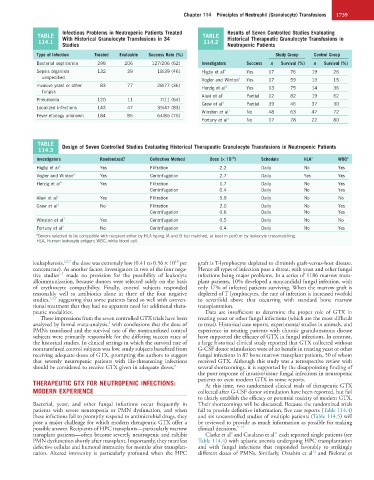
                     Infectious Problems in Neutropenic Patients Treated   Results of Seven Controlled Studies Evaluating
             TABLE   With Historical Granulocyte Transfusions in 34   TABLE   Historical Therapeutic Granulocyte Transfusions in
              114.1  Studies                                        114.2  Neutropenic Patients

             Type of Infection  Treated  Evaluable  Success Rate (%)                       Study Group  Control Group
             Bacterial septicemia  298    206      127/206 (62)    Investigators  Success  n  Survival (%)  n  Survival (%)
             Sepsis organism     132       39       18/39 (46)     Higby et al 5  Yes    17     76     19     26
               unspecified                                                     6
                                                                   Vogler and Winton  Yes  17   59     13     15
             Invasive yeast or other   83  77       28/77 (36)     Herzig et al 4  Yes   13     75     14     36
               fungus
                                                                   Alavi et al 1  Partial  12   82     19     62
             Pneumonia           120       11        7/11 (64)
                                                                   Graw et al 3   Partial  39   46     37     30
             Localized infections  143     47       39/47 (83)
                                                                   Winston et al 7  No   48     63     47     72
             Fever etiology unknown  184   85       64/85 (75)
                                                                   Fortuny et al 2  No   17     78     22     80


             TABLE   Design of Seven Controlled Studies Evaluating Historical Therapeutic Granulocyte Transfusions in Neutropenic Patients
              114.3
                                                                             10
             Investigators        Randomized?     Collection Method   Dose (× 10 )    Schedule      HLA a       WBC a
             Higby et al 5        Yes             Filtration             2.2          Daily         No          Yes
             Vogler and Winton 6  Yes             Centrifugation         2.7          Daily         Yes         Yes
             Herzig et al 4       Yes             Filtration             1.7          Daily         No          Yes
                                                  Centrifugation         0.4          Daily         No          Yes
             Alavi et al 1        Yes             Filtration             5.9          Daily         No          No
             Graw et al 3         No              Filtration             2.0          Daily         No          Yes
                                                  Centrifugation         0.6          Daily         No          Yes
             Winston et al 7      Yes             Centrifugation         0.5          Daily         No          No
             Fortuny et al 2      No              Centrifugation         0.4          Daily         No          Yes
             a Donors selected to be compatible with recipient either by HLA typing (A and B loci matched, at least in part) or by leukocyte crossmatching.
             HLA, Human leukocyte antigen; WBC, white blood cell.


                                                          10
            leukapheresis, 2,3,7  the dose was extremely low (0.41 to 0.56 × 10  per   graft is T-lymphocyte depleted to diminish graft-versus-host disease.
            concentrate). As another factor, investigators in two of the four nega-  Hence all types of infection pose a threat, with yeast and other fungal
                    1,7
            tive  studies   made  no  provision  for  the  possibility  of  leukocyte   infections being major problems. In a series of 1186 marrow trans-
            alloimmunization, because donors were selected solely on the basis   plant patients, 10% developed a noncandidal fungal infection, with
            of  erythrocyte  compatibility.  Finally,  control  subjects  responded   only 17% of infected patients surviving. When the marrow graft is
            reasonably  well  to  antibiotics  alone  in  three  of  the  four  negative   depleted of T lymphocytes, the rate of infection is increased twofold
            studies, 1,3,7  suggesting that some patients fared so well with conven-  to  sevenfold  above  that  occurring  with  standard  bone  marrow
            tional treatment that they had no apparent need for additional thera-  transplantation.
            peutic modalities.                                      Data  are  insufficient  to  determine  the  proper  role  of  GTX  in
              These impressions from the seven controlled GTX trials have been   treating yeast or other fungal infections (which are the most difficult
                                     8
            analyzed by formal meta-analysis,  with conclusions that the dose of   to treat). Historical case reports, experimental studies in animals, and
            PMNs transfused and the survival rate of the nontransfused control   experience in treating patients with chronic granulomatous disease
            subjects were primarily responsible for the differing success rates of   have supported the efficacy of GTX in fungal infections. In contrast,
            the historical studies. In clinical settings in which the survival rate of   a large historical clinical study reported that GTX collected without
            nontransfused control subjects was low, study subjects benefited from   G-CSF donor stimulation were of no benefit in treating yeast or other
            receiving adequate doses of GTX, prompting the authors to suggest   fungal infections in 87 bone marrow transplant patients, 50 of whom
            that  severely  neutropenic  patients  with  life-threatening  infections   received GTX. Although this study was a retrospective review with
            should be considered to receive GTX given in adequate doses. 8  several shortcomings, it is supported by the disappointing finding of
                                                                  the poor response of invasive/tissue fungal infections in neutropenic
            THERAPEUTIC GTX FOR NEUTROPENIC INFECTIONS:           patients to even modern GTX in some reports.
                                                                    At this time, two randomized clinical trials of therapeutic GTX
            MODERN EXPERIENCE                                     collected after G-CSF donor stimulation have been reported, but fail
                                                                  to clearly establish the efficacy or potential toxicity of modern GTX.
            Bacterial,  yeast,  and  other  fungal  infections  occur  frequently  in   Their shortcomings will be discussed. Because the randomized trials
            patients  with  severe  neutropenia  or  PMN  dysfunction,  and  when   fail to provide definitive information, five case reports (Table 114.4)
            these infections fail to promptly respond to antimicrobial drugs, they   and six uncontrolled studies of multiple patients (Table 114.5) will
            pose a major challenge for which modern therapeutic GTX offer a   be reviewed to provide as much information as possible for making
            possible answer. Recipients of HPC transplants—particularly marrow   clinical decisions. 9–19
                                                                             9
                                                                                           11
            transplant patients—often become severely neutropenic and exhibit   Clarke et al  and Catalano et al  each reported single patients (see
            PMN dysfunction shortly after transplant. Importantly, they manifest   Table 114.4) with aplastic anemia undergoing HPC transplantation
            defective cellular and humoral immunity for months after transplan-  and  with  fungal  infections  that  responded  favorably  to  strikingly
                                                                                                       12
            tation.  Altered  immunity  is  particularly  profound  when  the  HPC   different doses of PMNs. Similarly, Ozsahin et al  and Bielorai et

