


Page 1968 - Hematology_ Basic Principles and Practice ( PDFDrive )
P. 1968
1742   Part XI  Transfusion Medicine


        with severe forms of PMN dysfunction are relatively rare, and no ran-  Recipients were given 7.5 µg/kg G-CSF every 12 hours until blood
                                                                                                 9
        domized clinical trials have been reported to establish the efficacy of   PMNs were greater than or equal to 1.5 × 10 /L. Recipient blood
                                                                                                  9
        therapeutic GTX in their management. Firm recommendations about   PMNs were maintained at greater than 1.5 × 10 /L throughout the
        the use of GTX to treat patients cannot be made. However, several   5 days of posttransplant GTX. By comparison, a historical group of
        patients with chronic granulomatous disease, complicated by progres-  control recipients treated with G-CSF, but no GTX, exhibited lower
                                                                                                   9
        sive life-threatening fungal infections, have been reported to benefit.   mean blood PMN counts of less than 0.5 × 10 /L posttransplant.
        Because of the possibility of alloimmunization to leukocyte and red   Prophylactic  GTX  seemed  promising  in  this  setting  and  perhaps
        blood  cell  antigens  plus  the  other  risks  of  allogeneic  transfusions,   would  have  been  even  more  effective  (i.e.,  higher  recipient  blood
        such as pulmonary reactions and transfusion-transmitted infections,   PMN counts and fewer infections) if given daily.
                                                                                       25
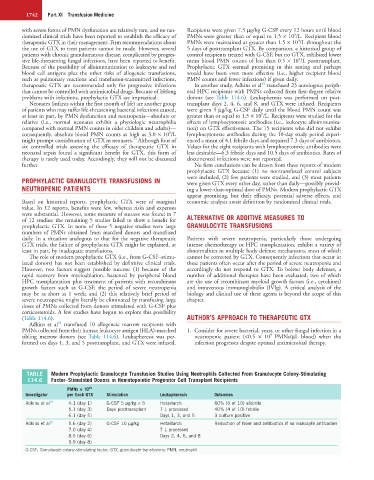
        therapeutic  GTX  are  recommended  only  for  progressive  infections   In another study, Adkins et al  transfused 23 autologous periph-
        that cannot be controlled with antimicrobial drugs. Because of lifelong   eral HPC recipients with PMNs collected from first-degree relative
        problems with infections, prophylactic GTX are impractical.  donors  (see  Table  114.6).  Leukapheresis  was  performed  on  post-
           Neonates (infants within the first month of life) are another group   transplant days 2, 4, 6, and 8, and GTX were infused. Recipients
        of patients who may suffer life-threatening bacterial infections caused,   were given 5 µg/kg G-CSF daily until the blood PMN count was
                                                                                      9
        at least in part, by PMN dysfunction and neutropenia—absolute or   greater than or equal to 1.5 × 10 /L. Recipients were studied for the
        relative  (i.e.,  normal  neonates  exhibit  a  physiologic  neutrophilia   effects of lymphocytotoxic antibodies (i.e., leukocyte alloimmuniza-
        compared with normal PMN counts in older children and adults)—  tion) on GTX effectiveness. The 15 recipients who did not exhibit
                                                        9
        consequently, absolute blood PMN counts as high as 3.0 × 10 /L   lymphocytotoxic antibodies during the 10-day study period experi-
                                             23
        might prompt consideration of GTX in neonates.  Although four of   enced a mean of 4.1 febrile days and required 7.3 days of antibiotics.
        six  controlled  trials  assessing  the  efficacy  of  therapeutic  GTX  in   Values for the eight recipients with lymphocytotoxic antibodies were
        neonatal  sepsis  found  a  significant  benefit  for  GTX,  this  form  of   less desirable—6.3 febrile days and 10.5 days of antibiotics. Rates of
        therapy is rarely used today. Accordingly, they will not be discussed   documented infections were not reported.
        further.                                                 No firm conclusions can be drawn from these reports of modern
                                                              prophylactic  GTX  because  (1)  no  nontransfused  control  subjects
        PROPHYLACTIC GRANULOCYTE TRANSFUSIONS IN              were included, (2) few patients were studied, and (3) most patients
                                                              were given GTX every other day, rather than daily—possibly provid-
        NEUTROPENIC PATIENTS                                  ing a lower-than-optimal dose of PMNs. Modern prophylactic GTX
                                                              appear  promising,  but  their  efficacy,  potential  adverse  effects,  and
        Based  on  historical  reports,  prophylactic  GTX  were  of  marginal   economic analysis await definition by randomized clinical trials.
        value. In 12 reports, benefits were few, whereas risks and expenses
        were substantial. However, some measure of success was found in 7
        of 12 studies; the remaining 5 studies failed to show a benefit for   ALTERNATIVE OR ADDITIVE MEASURES TO
        prophylactic  GTX.  In  none  of  these  5  negative  studies  were  large   GRANULOCYTE TRANSFUSIONS
        numbers of PMNs  obtained  from  matched  donors  and transfused
        daily. In a situation analogous to that for the negative therapeutic   Patients  with  severe  neutropenia,  particularly  those  undergoing
        GTX trials, the failure of prophylactic GTX might be explained, at   intense chemotherapy or HPC transplantation, exhibit a variety of
        least in part, by inadequate transfusions.            abnormalities in multiple body defense mechanisms, most of which
           The role of modern prophylactic GTX (i.e., from G-CSF–stimu-  cannot be corrected by GTX. Consequently infections that occur in
        lated  donors)  has  not  been  established  by  definitive  clinical  trials.   these patients often occur after the period of severe neutropenia and
        However,  two  factors  suggest  possible  success:  (1)  because  of  the   accordingly  do  not  respond  to  GTX. To  bolster  body  defenses,  a
        rapid  recovery  from  myeloablation,  hastened  by  peripheral  blood   number of additional therapies have been evaluated, two of which
        HPC  transplantation  plus  treatment  of  patients  with  recombinant   are the use of recombinant myeloid growth factors (i.e., cytokines)
        growth  factors  such  as  G-CSF,  the  period  of  severe  neutropenia   and  intravenous  immunoglobulin  (IVIg).  A  critical  analysis  of the
        may  be  as  short  as  1  week;  and  (2)  this  relatively  brief  period  of   biology and clinical use of these agents is beyond the scope of this
        severe neutropenia might literally be eliminated by transfusing large   chapter.
        doses of PMNs collected from donors stimulated with G-CSF plus
        corticosteroids. A few studies have begun to explore this possibility
        (Table 114.6).                                        AUTHOR’S APPROACH TO THERAPEUTIC GTX
                    24
           Adkins  et  al   transfused  10  allogeneic  marrow  recipients  with
        PMNs collected from their human leukocyte antigen (HLA)-matched   1.  Consider for severe bacterial, yeast, or other fungal infection in a
                                                                                         9
        sibling  marrow  donors  (see  Table  114.6).  Leukapheresis  was  per-  neutropenic  patient  (<0.5  ×  10   PMNs/µL  blood)  when  the
        formed on days 1, 3, and 5 posttransplant, and GTX were infused.   infection progresses despite optimal antimicrobial therapy.


          TABLE   Modern Prophylactic Granulocyte Transfusion Studies Using Neutrophils Collected From Granulocyte Colony-Stimulating
          114.6   Factor–Stimulated Donors in Hematopoietic Progenitor Cell Transplant Recipients
                       PMNs × 10
                              10
         Investigator  per Each GTX  Stimulation     Leukapheresis     Outcomes
         Adkins et al 24  4.1 (day 1)  G-CSF 5 µg/kg × 5  Hetastarch   60% (6 of 10) afebrile
                       5.1 (day 3)  Days posttransplant  7 L processed  40% (4 of 10) febrile
                       6.1 (day 5)                   Days 1, 3, and 5  3 culture positive
         Adkins et al 25  5.6 (day 2)  G-CSF 10 µg/kg  Hetastarch      Reduction of fever and antibiotics if no leukocyte antibodies
                       7.0 (day 4)                   7 L processed
                       8.5 (day 6)                   Days 2, 4, 6, and 8
                       9.9 (day 8)
         G-CSF, Granulocyte colony-stimulating factor; GTX, granulocyte transfusions; PMN, neutrophil.

