


Page 1972 - Hematology_ Basic Principles and Practice ( PDFDrive )
P. 1972
1746   Part XI  Transfusion Medicine


           100                                                rate or postoperative liver function tests between those who received
                                                              plasma from those who did not. Two other studies showed a poor
                                                              correlation  between  number  of  plasma  transfusions,  PT  and  PTT
          Coagulation factors (%)  50  Zone of normal hemostasis  plantation. Lastly, a randomized control trial revealed that intranasal
                                                              values, and number of RBCs transfusions needed during liver trans-
                                   (physiologic reserve)
                                                              desmopressin  was  both  less  expensive  and  as  effective  as  plasma
                                                              transfusions for liver disease patients with an INR between 2.0 and
                                                              3.0 undergoing minor surgery.
                                                                 As a result of these studies, authorities now suggest that the use
            30
                                                Zone of
                                                therapeutic
                                                              The transfusion of plasma in these patients should be guided by a
                                                anticoagulation  of plasma be more limited in liver disease and hepatectomy patients.
                                                              combination of clinical assessment, the evidence and degree of bleed-
                                                              ing, and by coagulation test results. Plasma products are currently not
                                                              recommended  prophylactically  before  a  surgical  challenge  or  liver
         PT (sec)  12 13 14 15 16 17 18 19 20 21 22
                                                              biopsy in these patients. However, as noted previously, plasma trans-
             INR  1.0  1.3   1.7 2.0 2.2    3.0               fusions may be considered when the PT/PTT is greater than 1.5 to
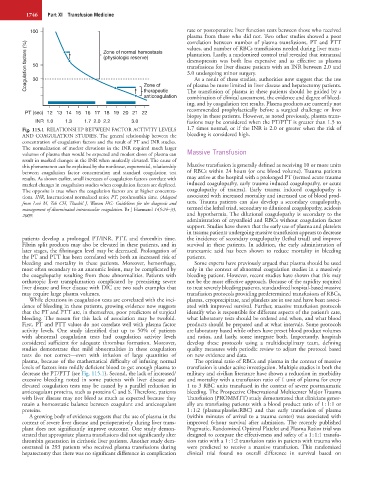
        Fig. 115.1  RELATIONSHIP BETWEEN FACTOR ACTIVITY LEVELS   1.7 times normal, or if the INR is 2.0 or greater when the risk of
        AND COAGULATION STUDIES. The general relationship between the   bleeding is considered high.
        concentration of coagulation factors and the result of PT and INR studies.
        The normalization of modest elevations in the INR required much larger
        volumes of plasma than would be expected and modest doses of plasma can   Massive Transfusion
        result in marked changes in the INR when markedly elevated. The cause of
        this phenomenon can be explained by the nonlinear, exponential, relationship   Massive transfusion is generally defined as receiving 10 or more units
        between  coagulation  factor  concentration  and  standard  coagulation  test   of RBCs within 24 hours (or one blood volume). Trauma patients
        results. As shown earlier, small increases of coagulation factors correlate with   may arrive at the hospital with a prolonged PT (termed acute trauma
        marked changes in coagulation studies when coagulation factors are depleted.   induced coagulopathy, early trauma induced coagulopathy, or acute
        The opposite is true when the coagulation factors are at higher concentra-  coagulopathy  of  trauma).  Early  trauma  induced  coagulopathy  is
        tions. INR, International normalized ratio; PT, prothrombin time. (Adapted   associated with increased mortality and increased use of blood prod-
        from  Levi  M, Toh  CH, Thachil  J, Watson  HG:  Guidelines  for  the  diagnosis  and   ucts. Trauma  patients  can  also  develop  a  secondary  coagulopathy,
        management of disseminated intravascular coagulation. Br J Haematol 145:24–33,   termed the lethal triad, secondary to dilutional coagulopathy, acidosis
        2009.                                                 and hypothermia. The dilutional coagulopathy is secondary to the
                                                              administration of crystalloid and RBCs without coagulation factor
                                                              support. Studies have shown that the early use of plasma and platelets
                                                              in trauma patients undergoing massive transfusion appears to decrease
        patients  develop  a  prolonged  PT/INR,  PTT,  and  thrombin  time.   the incidence of secondary coagulopathy (lethal triad) and improve
        Fibrin split products may also be elevated in these patients, and in   survival  in  these  patients.  In  addition,  the  early  administration  of
        later stages, the fibrinogen level may be decreased. Prolongation of   tranexamic  acid  has  been  shown  to  reduce  mortality  in  bleeding
        the PT and PTT has been correlated with both an increased risk of   patients.
        bleeding  and  mortality  in  these  patients.  Moreover,  hemorrhage,   Some experts have previously argued that plasma should be used
        most often secondary to an anatomic lesion, may be complicated by   only in the context of abnormal coagulation studies in a massively
        the coagulopathy resulting from these abnormalities. Patients with   bleeding patient. However, recent studies have shown that this may
        orthotopic  liver  transplantation  complicated  by  preexisting  severe   not be the most effective approach. Because of the rapidity required
        liver disease and liver disease with DIC are two such examples that   to treat severely bleeding patients, standardized hospital-based massive
        may require large plasma volumes.                     transfusion protocols providing predetermined transfusions of RBCs,
           While elevations in coagulation tests are correlated with the inci-  plasma, cryoprecipitate, and platelets are in use and have been associ-
        dence of bleeding in these patients, growing evidence now suggests   ated with improved survival. Further, massive transfusion protocols
        that the PT and PTT are, in themselves, poor predictors of surgical   identify who is responsible for different aspects of the patient’s care,
        bleeding. The  reason  for  this  lack  of  association  may  be  twofold.   what laboratory tests should be ordered and when, and what blood
        First, PT and PTT values do not correlate well with plasma factor   products should be prepared and at what intervals. Some protocols
        activity  levels.  One  study  identified  that  up  to  50%  of  patients   are laboratory based while others have preset blood product volumes
        with  abnormal  coagulation  tests  had  coagulation  activity  levels   and  ratios,  and  lastly,  some  integrate  both.  Importantly,  hospitals
        considered  sufficient  for  adequate  thrombus  formation.  Moreover,   develop  these  protocols  using  a  multidisciplinary  team,  defining
        studies  demonstrate  that  mild  abnormalities  in  these  coagulation   quality measures with periodic review to adjust the protocol based
        tests  do  not  correct—even  with  infusion  of  large  quantities  of   on new evidence and data.
        plasma,  because  of  the  mathematical  difficulty  of  infusing  normal   The optimal ratio of RBCs and plasma in the context of massive
        levels of factors into mildly deficient blood to get enough plasma to   transfusion is under active investigation. Multiple studies in both the
        decrease the PT/PTT (see Fig. 115.1). Second, the lack of increased/  military and civilian literature have shown a reduction in morbidity
        excessive  bleeding  noted  in  some  patients  with  liver  disease  and   and mortality with a transfusion ratio of 1 unit of plasma for every
        elevated coagulation tests may be caused by a parallel reduction in   1 to 3 RBC units transfused in the context of severe posttraumatic
        anticoagulant proteins, such as proteins C and S. Therefore, patients   bleeding. The Prospective Observational Multicenter Major Trauma
        with liver disease may not bleed as much as expected because they   Transfusion (PROMMTT) study demonstrated that clinicians gener-
        retain a homeostatic balance  between coagulant  and anticoagulant     ally are transfusing patients with a blood product ratio of 1 : 1:1 or
        proteins.                                             1 : 1:2  (plasma:platelet:RBC)  and  that  early  transfusion  of  plasma
           A growing body of evidence suggests that the use of plasma in the   (within minutes of arrival to a trauma center) was associated with
        context of severe liver disease and perioperatively during liver trans-  improved  6-hour  survival  after  admission. The  recently  published
        plant  does  not  significantly  improve  outcome.  One  study  demon-  Pragmatic, Randomized Optimal Platelet and Plasma Ratios trial was
        strated that appropriate plasma transfusions did not significantly alter   designed to compare the effectiveness and safety of a 1 : 1:1 transfu-
        thrombin generation in cirrhotic liver patients. Another study dem-  sion ratio with a 1 : 1:2 transfusion ratio in patients with trauma who
        onstrated in 293 patients who received plasma transfusions during   were  predicted  to  receive  a  massive  transfusion.  This  randomized
        hepatectomy that there was no significant difference in complication   clinical  trial  found  no  overall  difference  in  survival  based  on

