


Page 1974 - Hematology_ Basic Principles and Practice ( PDFDrive )
P. 1974
1748   Part XI  Transfusion Medicine


           TPE is not indicated in the treatment of individuals with diarrhea   Dosage
        associated hemolytic uremic syndrome (HUS) (also termed throm-
        botic microangiopathy, Shiga toxin mediated) unless there are severe   One unit of plasma derived from a unit of whole blood contains 200
        neurological  symptoms.  Seven  randomized  control  trials  were  per-  to  280 mL.  When  plasma  is  collected  by  apheresis,  as  much  as
        formed evaluating the efficacy of TPE for typical cases of HUS. These   800 mL  can  be  obtained  from  one  individual  (“jumbo”  plasma
        trials found that the use of plasma was not superior to supportive   units), but the majority of units clinically used have a volume around
        therapies  alone.  TPE  with  plasma  replacement  fluid,  however,  is   250 mL. On average, there is 0.7 to 1 unit/mL of activity of each
        currently  indicated  in  diarrhea-negative  (atypical)  HUS  (aHUS),   coagulation  factor  per  milliliter  of  plasma  and  1  to  2 mg/mL  of
        which is caused by a number of inherited and sporadic conditions   fibrinogen. The appropriate dose of plasma may be estimated from
        that lead to the uncontrolled activation of the alternative complement   the plasma volume, the desired increment of factor activity, and the
        system (i.e., deficiency or autoantibody to complement factor H). A   expected half-life of the factor being replaced (i.e., factor VII has a
        complete discussion of aHUS is beyond the scope of this chapter.   half-life of only 4–6 hours, and thus plasma doses should be repeated
        Typically, all patients diagnosed with aHUS are empirically treated   every few hours if replacing factor VII in a patient with factor VII
        with TPE or plasma transfusions until underlying disease or mutation   deficiency). Alternatively, the plasma dosage may be estimated as 10
        is further defined, which then determines treatment. TPE has been   to 15 mL/kg, and ideally should be ordered as the number of milli-
        theoretically proposed to effectively remove the potentially causative   liters to be infused. The frequency of administration depends on the
        autoantibody  or  mutated  circulating  complement  regulator,  while   clinical response to the infusion and correction of laboratory param-
        replacing absent or defective complement regulators. The reported   eters. Moreover, plasma infusions should be given as close to the time
        clinical response varies depending on the underlying cause, however.   as it is needed to allow for its maximum hemostatic effect if given
        For some causes of aHUS, plasma infusion can be initiated. Recently,   preprocedure.  A  recent  one-year  evaluation  of  10 U.S.  hospitals
        Eculizumab, a humanized monoclonal antibody against C5, has been   revealed that the current median dose of plasma was 2.0 units with
        shown  to  be  an  effective  alternative  treatment  for  some  causes  of   15.2%  receiving  only  1  unit. The  median  weight-adjusted  plasma
        aHUS (see Chapter 134).                               dose  was  only  7.3 mL/kg  with  only  29%  of  doses  being  at  least
           TPE  with  plasma  replacement  may  also  be  indicated  in  other   10 mL/kg and 15.5% being 15 mL/kg. Based on these findings, a
        thrombotic microangiopathies. Some medications cause thrombotic   large  proportion  of  patients  in  the  United  States  are  likely  being
        microangiopathies that require plasma exchange. Current examples   underdosed.
        include ticlopidine and clopidogrel, and potentially cyclosporine or
        tacrolimus. Lastly, TPE with plasma may also be used in the treat-
        ment  of  thrombotic  microangiopathy  associated  with  stem  cell   Compatibility
        transplantation.
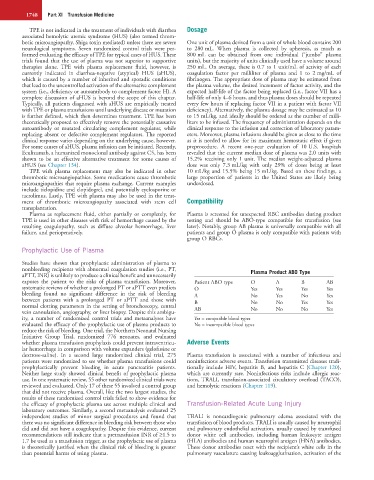
           Plasma  as  replacement  fluid,  either  partially  or  completely,  for   Plasma is screened for unexpected RBC antibodies during product
        TPE is used in other diseases with risk of hemorrhage caused by the   testing  and  should  be  ABO-type  compatible  for  transfusion  (see
        resulting  coagulopathy,  such  as  diffuse  alveolar  hemorrhage,  liver   later). Notably, group AB plasma is universally compatible with all
        failure, and perioperatively.                         patients and group O plasma is only compatible with patients with
                                                              group O RBCs.
        Prophylactic Use of Plasma

        Studies  have  shown  that  prophylactic  administration  of  plasma  to
        nonbleeding recipients with abnormal coagulation studies (i.e., PT,        Plasma Product ABO Type
        aPTT, INR) is unlikely to produce a clinical benefit and unnecessarily
        exposes  the  patient  to  the  risks  of  plasma  transfusion.  Moreover,   Patient ABO type  O  A  B  AB
        systematic reviews of whether a prolonged PT or aPTT even predicts   O     Yes     Yes      Yes     Yes
        bleeding  found  no  significant  difference  in  the  risk  of  bleeding   A  No  Yes      No      Yes
        between  patients  with  a  prolonged  PT  or  aPTT  and  those  with   B  No      No       Yes     Yes
        normal clotting parameters in the setting of bronchoscopy, central   AB    No      No       No      Yes
        vein cannulation, angiography, or liver biopsy. Despite this ambigu-
        ity,  a  number  of  randomized  control  trials  and  metaanalyses  have   Yes = compatible blood types
        evaluated the efficacy of the prophylactic use of plasma products to   No = incompatible blood types
        reduce the risk of bleeding. One trial, the Northern Neonatal Nursing
        Initiative  Group  Trial,  randomized  776  neonates,  and  evaluated
        whether plasma transfusion prophylaxis could prevent intraventricu-  Adverse Events
        lar hemorrhage in comparison with volume expanders (gelofusine or
        dextrose-saline).  In  a  second  large  randomized  clinical  trial,  275   Plasma  transfusion  is  associated  with  a  number  of  infectious  and
        patients were randomized to see whether plasma transfusions could   noninfectious adverse events. Transfusion transmitted diseases tradi-
        prophylactically  prevent  bleeding  in  acute  pancreatitis  patients.   tionally  include  HIV,  hepatitis  B,  and  hepatitis  C  (Chapter  120),
        Neither large study showed clinical benefit of prophylactic plasma   which  are  currently  rare.  Noninfectious  risks  include  allergic  reac-
        use. In one systematic review, 55 other randomized clinical trials were   tions, TRALI, transfusion-associated circulatory overload (TACO),
        reviewed and evaluated. Only 17 of these 55 involved a control group   and hemolytic reactions (Chapter 119).
        that did not receive plasma. Overall, like the two largest studies, the
        results of these randomized control trials failed to show evidence for
        the efficacy of prophylactic plasma use across multiple clinical and   Transfusion-Related Acute Lung Injury
        laboratory outcomes. Similarly, a second metaanalysis evaluated 25
        independent  studies  of  minor  surgical  procedures  and  found  that   TRALI  is  noncardiogenic  pulmonary  edema  associated  with  the
        there was no significant difference in bleeding risk between those who   transfusion of blood products. TRALI is usually caused by neutrophil
        did and did not have a coagulopathy. Despite this evidence, current   and pulmonary endothelial activation, usually caused by transfused
        recommendations still indicate that a pretransfusion INR of ≥1.5 to   donor  white  cell  antibodies,  including  human  leukocyte  antigen
        1.7 be used as a transfusion trigger, as the prophylactic use of plasma   (HLA) antibodies and human neutrophil antigen (HNA) antibodies.
        is theoretically justified when the clinical risk of bleeding is greater   These donor antibodies react with the recipient’s white cells in the
        than potential harms of using plasma.                 pulmonary vasculature causing leukoagglutination, activation of the

