


Page 201 - Hematology_ Basic Principles and Practice ( PDFDrive )
P. 201
Chapter 15  Vascular Growth in Health and Disease  153


                            Bone marrow–derived cells       Resident vascular cells    Cancer cells


                                                        Endothelial cells (CD31 , CD144 )
                                                              Mural cells — pericytes


                            Endothelial progenitor cells        (aSMA , NG2 )       Tumor-initiating cells


                           (VEGFR2 , CD45 , CD133 )                                  (CD133 , markers of

                                                                                      endothelial cells or
                                                                                         pericytes)
                             Neutrophils and myeloid         Angiogenesis              Macrophages

                            suppressors (Gr1 , CD11b)
                                                                                      (CD11b , F4/80)


                                   Vascular    Tie-2 expressing  Platelets  Hemangiocytes  Myeloid cells

                                  leukocytes  monocytes (TEMs)  (CD41 )   (VEGFR1 ,  (VEGFR1 , CXCR4 ,


                               (CD11b , CD144 )  (CD11b , Tie-2 )         CXCR4 )        CD11b )


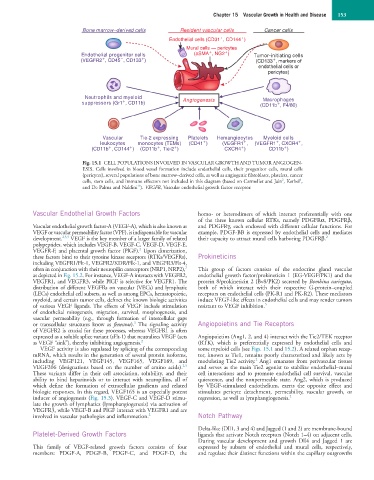
                            Fig. 15.1  CELL POPULATIONS INVOLVED IN VASCULAR GROWTH AND TUMOR ANGIOGEN-
                            ESIS. Cells involved in blood vessel formation include endothelial cells, their progenitor cells, mural cells
                            (pericytes), several populations of bone marrow–derived cells, as well as angiogenic fibroblasts, platelets, cancer
                                                                                             2
                                                                                                   4
                            cells, stem cells, and immune effectors not included in this diagram (based on Carmeliet and Jain , Kerbel ,
                                              13
                            and De Palma and Naldini ). VEGFR, Vascular endothelial growth factor receptor.
            Vascular Endothelial Growth Factors                   homo-  or  heterodimers  of  which  interact  preferentially  with  one
                                                                  of  the  three  known  cellular  RTKs,  namely  PDGFRα,  PDGFRβ,
            Vascular endothelial growth factor-A (VEGF-A), which is also known as   and PDGFRγ, each endowed with different cellular functions. For
            VEGF or vascular permeability factor (VPF), is indispensable for vascular   example, PDGF-BB is expressed by endothelial cells and mediates
            development. 2,3,5  VEGF is the key member of a larger family of related   their capacity to attract mural cells harboring PDGFRβ. 2
            polypeptides, which includes VEGF-B, VEGF-C, VEGF-D, VEGF-E,
                                               2
            VEGFR-F, and placental growth factor (PlGF).  Upon dimerization,
            these factors bind to their tyrosine kinase receptors (RTKs/VEGFRs),   Prokineticins
            including VEGFR1/Flt-1, VEGFR2/KDR/Flk-1, and VEGFR3/Flt-4,
                                                              2
            often in conjunction with their neuropilin coreceptors (NRP1, NRP2),    This  group  of  factors  consists  of  the  endocrine  gland  vascular
            as depicted in Fig. 15.2. For instance, VEGF-A interacts with VEGFR2,   endothelial growth factor/prokineticin 1 (EG-VEGF/PK1) and the
            VEGFR1, and VEGFR3, while PlGF is selective for VEGFR1. The   protein 8/prokineticin 2 (Bv8/PK2) secreted by Bombina variegata,
            distribution of different VEGFRs on vascular (VECs) and lymphatic   both  of  which  interact  with  their  respective  G-protein–coupled
            (LECs) endothelial cell subsets, as well as among EPCs, hematopoietic,   receptors on endothelial cells (PK-R1 and PK-R2). These mediators
            myeloid, and certain tumor cells, defines the known biologic activities   induce VEGF-like effects in endothelial cells and may render tumors
            of  various  VEGF  ligands. The  effects  of  VEGF  include  stimulation   resistant to VEGF inhibition. 5
            of  endothelial  mitogenesis,  migration,  survival,  morphogenesis,  and
            vascular  permeability  (e.g.,  through  formation  of  intercellular  gaps
                                             3
            or  transcellular  structures  know  as  fenestrae).   The  signaling  activity   Angiopoietins and Tie Receptors
            of VEGFR2 is crucial for these processes, whereas VEGFR1 is often
            expressed as a soluble splice variant (sFlt-1) that neutralizes VEGF (acts   Angiopoietins (Ang1, 2, and 4) interact with the Tie2/TEK receptor
            as VEGF “sink”), thereby inhibiting angiogenesis. 2   (RTK),  which  is  preferentially  expressed  by  endothelial  cells  and
              VEGF activity is also regulated by splicing of the corresponding   some myeloid cells (see Figs. 15.1 and 15.2). A related orphan recep-
            mRNA, which results in the generation of several protein isoforms,   tor, known as Tie1, remains poorly characterized and likely acts by
                                                                                     2
            including  VEGF121,  VEGF145,  VEGF165,  VEGF189,  and   modulating Tie2 activity.  Ang1 emanates from perivascular tissues
                                                             2,5
            VEGF206  (designations  based  on  the  number  of  amino  acids).    and serves as the main Tie2 agonist to stabilize endothelial–mural
            These  variants  differ  in  their  cell  association,  solubility,  and  their   cell  interactions  and  to  promote  endothelial  cell  survival,  vascular
            ability  to  bind  heparinoids  or  to  interact  with  neuropilins,  all  of   quiescence, and the nonpermeable state. Ang2, which is produced
            which  define  the  formation  of  extracellular  gradients  and  related   by  VEGF-stimulated  endothelium,  exerts  the  opposite  effect  and
            biologic responses. In this regard, VEGF165 is an especially potent   stimulates  pericyte  detachment,  permeability,  vascular  growth,  or
            inducer of angiogenesis (Fig. 15.3). VEGF-C and VEGF-D stimu-  regression, as well as lymphangiogenesis. 2
            late the growth of lymphatics (lymphangiogenesis) via activation of
            VEGFR3, while VEGF-B and PlGF interact with VEGFR1 and are
            involved in vascular pathologies and inflammation. 2  Notch Pathway
                                                                  Delta-like (Dll1, 3 and 4) and Jagged (1 and 2) are membrane-bound
            Platelet-Derived Growth Factors                       ligands that activate Notch receptors (Notch 1–4) on adjacent cells.
                                                                  During  vascular  development  and  growth  Dll4  and  Jagged  1  are
            This  family  of  VEGF-related  growth  factors  consists  of  four   expressed  by  subsets  of  endothelial  and  mural  cells,  respectively,
            members:  PDGF-A,  PDGF-B,  PDGF-C,  and  PDGF-D,  the   and regulate their distinct functions within the capillary outgrowths

