


Page 204 - Hematology_ Basic Principles and Practice ( PDFDrive )
P. 204
156    Part II  Cellular Basis of Hematology


                   Endothelial
                        cells                              Angiogenic gradient formation (“switch”)
                    Pericytes                 VEGF         Hypoxia, inflammation, oncogenic transformation
                                                           Increased expression of stimulators (VEGF)
                    Basement                               Decreased expression of inhibitors
                   membrane


                                                           Endothelial (phalanx) cell stimulation
                                              VEGF
                                                           Basement membrane dissolution
                                                           Pericyte "drop out"
                                                           Circumferential extension (mother vessels)

                                       Tip cell
                                       VEGFR2              Formation of endothelial tip cells

                                              VEGF         VEGF gradient sensing
                                                           Expression of tip cell markers
                                                           Metabolic adaptation (glycolysis)


                                                           Formation of endothelial sprouts
                                    NOTCH DII4             Directional migration of tip and stalk cells
                                                           Blockade of VEGFR2 expression on stalk cells
                                             VEGFR2
                                                           by tip cells via the Dll4/Notch pathway
                                                           Tip guidance (semaphorins, neuropilins, plexins, Robo4)
                                                           Extension of sprouts
                   Phalanx cells              Tie2         Growth and migration of stalk cells and lumen formation
                     Stalk cells             NRP1
                      Tip cells                            Myeloid cell–dependent anastomosis
                                                           Signalling by Tie2, Ang2, PlGF, PHD2, SDF-1a


                                                           Formation of new vascular loops
                                               Pericyte
                                               recruitment  Connection and anastomosis of sprouts
                                                           Vascular maturation
                                                           Pericyte recruitment/vessel maturation (PDGFRb, Ang1)
                                                           Restoration of basement membrane (TIMPs, PAI-1)
                                                           Endothelial quiescence–phalanx cells (Notch)
                                                           Junction formation (VE-cadherin)
                                                           Anticoagulant surfaces
                                                           Blood flow
                                     New capillary
                                                           Resolution of hypoxia
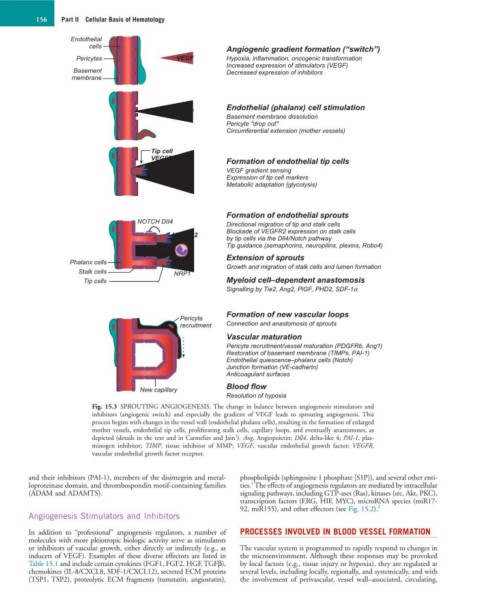
                        Fig. 15.3  SPROUTING ANGIOGENESIS. The change in balance between angiogenesis stimulators and
                        inhibitors  (angiogenic  switch)  and  especially  the  gradient  of  VEGF  leads  to  sprouting  angiogenesis. This
                        process begins with changes in the vessel wall (endothelial phalanx cells), resulting in the formation of enlarged
                        mother vessels, endothelial tip cells, proliferating stalk cells, capillary loops, and eventually anastomoses, as
                                                             2
                        depicted (details in the text and in Carmeliet and Jain ). Ang, Angiopoietin; Dll4, delta-like 4; PAI-1, plas-
                        minogen  inhibitor;  TIMP,  tissue  inhibitor  of  MMP;  VEGF,  vascular  endothelial  growth  factor;  VEGFR,
                        vascular endothelial growth factor receptor.


        and their inhibitors (PAI-1), members of the disintegrin and metal-  phospholipids (sphingosine 1 phosphate [S1P]), and several other enti-
                                                                 1
        loproteinase domain, and thrombospondin motif-containing families   ties.  The effects of angiogenesis regulators are mediated by intracellular
        (ADAM and ADAMTS).                                    signaling pathways, including GTP-ases (Ras), kinases (src, Akt, PKC),
                                                              transcription factors (ERG, HIF, MYC), microRNA species (miR17-
                                                              92, miR155), and other effectors (see Fig. 15.2). 2
        Angiogenesis Stimulators and Inhibitors
        In  addition  to  “professional”  angiogenesis  regulators,  a  number  of   PROCESSES INVOLVED IN BLOOD VESSEL FORMATION
        molecules with more pleiotropic biologic activity serve as stimulators
        or inhibitors of vascular growth, either directly or indirectly (e.g., as   The vascular system is programmed to rapidly respond to changes in
        inducers of VEGF). Examples of these diverse effectors are listed in   the microenvironment. Although these responses may be provoked
        Table 15.1 and include certain cytokines (FGF1, FGF2, HGF, TGFβ),   by local factors (e.g., tissue injury or hypoxia), they are regulated at
        chemokines (IL-8/CXCL8, SDF-1/CXCL12), secreted ECM proteins   several levels, including locally, regionally, and systemically, and with
        (TSP1, TSP2), proteolytic ECM fragments (tumstatin, angiostatin),   the  involvement  of  perivascular,  vessel  wall–associated,  circulating,

