


Page 2023 - Hematology_ Basic Principles and Practice ( PDFDrive )
P. 2023
1794   Part XI  Transfusion Medicine


                                                              incompatible donor RBCs. Because this is not an autoantibody, the
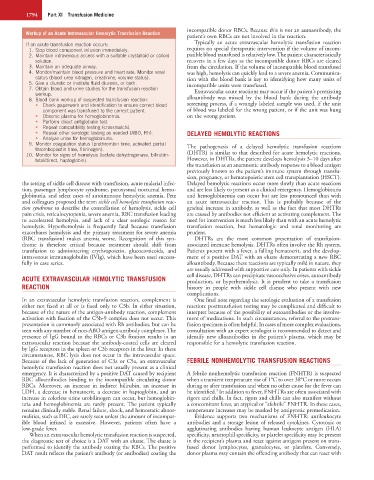
         Workup of an Acute Intravascular Hemolytic Transfusion Reaction
                                                              patient’s own RBCs are not involved in the reaction.
          If an acute transfusion reaction occurs:               Typically  an  acute  extravascular  hemolytic  transfusion  reaction
          1.  Stop blood component infusion immediately.      requires no special therapeutic intervention if the volume of incom-
          2.  Maintain intravenous access with a suitable crystalloid or colloid   patible blood transfused is relatively low. The patient characteristically
             solution.                                        recovers in a few days as the incompatible donor RBCs are cleared
          3.  Maintain an adequate airway.                    from the circulation. If the volume of incompatible blood transfused
          4.  Monitor/maintain blood pressure and heart rate. Monitor renal   was high, hemolysis can quickly lead to a severe anemia. Communica-
             status (blood urea nitrogen, creatinine, volume status).  tion with the blood bank is key to identifying how many units of
          5.  Give a diuretic or institute fluid diuresis, or both.  incompatible units were transfused.
          7.  Obtain blood and urine studies for the transfusion reaction   Extravascular acute reactions may occur if the patient’s preexisting
             workup.
          8.  Blood bank workup of suspected transfusion reaction:  alloantibody  was  missed  by  the  blood  bank  during  the  antibody
             •  Check paperwork and identification to ensure correct blood   screening process, if a wrongly labeled sample was used, if the unit
               component was transfused to the correct patient.  of blood was labeled for the wrong patient, or if the unit was hung
             •  Observe plasma for hemoglobinemia.            on the wrong patient.
             •  Perform direct antiglobulin test.
             •  Repeat compatibility testing (crossmatch).
             •  Repeat other serologic testing as needed (ABO, Rh).  DELAYED HEMOLYTIC REACTIONS
             •  Analyze urine for hemoglobinuria.
          9.  Monitor coagulation status (prothrombin time, activated partial   The  pathogenesis  of  a  delayed  hemolytic  transfusion  reactions
             thromboplastin time, fibrinogen).
          10.  Monitor for signs of hemolysis (lactate dehydrogenase, bilirubin-  (DHTR) is similar to that described for acute hemolytic reactions.
             total/direct, haptoglobin).                      However, in DHTRs, the patient develops hemolysis 3–10 days after
                                                              the transfusion as an anamnestic antibody response to a blood antigen
                                                              previously known to the patient’s immune system through transfu-
                                                              sion, pregnancy, or hematopoietic stem cell transplantation (HSCT).
        the setting of sickle cell disease with transfusion, acute malarial infec-  Delayed hemolytic reactions occur more slowly than acute reactions
        tion, passenger lymphocyte syndrome, paroxysmal nocturnal hemo-  and are less likely to present as a clinical emergency. Hemoglobinuria
        globinuria, and select cases of autoimmune hemolytic anemia. Petz   and hemoglobinemia can occur but are less pronounced than with
        and colleagues proposed the term sickle cell hemolytic transfusion reac-  an  acute  intravascular  reaction.  This  is  probably  because  of  the
        tion syndrome to describe the constellation of hemolysis, sickle cell   gradual increase in antibody, as well as the fact that most DHTRs
        pain crisis, reticulocytopenia, severe anemia, RBC transfusion leading   are caused by antibodies not efficient at activating complement. The
        to  accelerated  hemolysis,  and  lack  of  a  clear  serologic  reason  for   need for intervention is much less likely than with an acute hemolytic
        hemolysis.  Hyperhemolysis  is  frequently  fatal  because  transfusion   transfusion  reaction,  but  hematologic  and  renal  monitoring  are
        exacerbates hemolysis and the primary treatment for severe anemia   prudent.
        (RBC  transfusion)  makes  anemia  worse.  Recognition  of  this  syn-  DHTRs  are  the  most  common  presentation  of  transfusion-
        drome  is  therefore  critical  because  treatment  should  shift  from   associated immune hemolysis. DHTRs often involve the Rh system.
        transfusion  to  administering  erythropoietin,  glucocorticoids,  and   Patients present with a fever, a falling hematocrit, and the develop-
        intravenous immunoglobulin (IVIg), which have been used success-  ment of a positive DAT with an eluate demonstrating a new RBC
        fully in case series.                                 alloantibody. Because these reactions are typically mild in nature, they
                                                              are usually addressed with supportive care only. In patients with sickle
        ACUTE EXTRAVASCULAR HEMOLYTIC TRANSFUSION             cell disease, DHTRs can precipitate vasoocclusive crises, autoantibody
                                                              production, or hyperhemolysis. It is prudent to take a transfusion
        REACTION                                              history  in  people  with  sickle  cell  disease  who  present  with  new
                                                              complications.
        In  an  extravascular  hemolytic  transfusion  reaction,  complement  is   One final note regarding the serologic evaluation of a transfusion
        either not fixed at  all or is fixed only to  C3b.  In  either  situation,   reaction: posttransfusion testing may be complicated and difficult to
        because of the nature of the antigen-antibody reaction, complement   interpret because of the possibility of autoantibodies or the involve-
        activation with fixation of the C5b-9 complex does not occur. This   ment of medications. In such circumstances, referral to the pretrans-
        presentation is commonly associated with Rh antibodies, but can be   fusion specimen is often helpful. In cases of more complex evaluations,
        seen with any number of non-ABO antigen-antibody complexes. The   consultation with an expert serologist is recommended to detect and
        presence of IgG bound to the RBCs or C3b fixation results in an   identify  new  alloantibodies  in  the  patient’s  plasma,  which  may  be
        extravascular reaction because the antibody-coated cells are cleared   responsible for a hemolytic transfusion reaction.
        by IgG receptors in the spleen or C3b receptors in the liver. In these
        circumstances, RBC lysis does not occur in the intravascular space.
        Because of the lack of generation of C3a or C5a, an extravascular   FEBRILE NONHEMOLYTIC TRANSFUSION REACTIONS
        hemolytic transfusion reaction does not usually present as a clinical
        emergency. It is characterized by a positive DAT caused by recipient   A febrile nonhemolytic transfusion reaction (FNHTR) is suspected
        RBC alloantibodies binding to the incompatible circulating donor   when a transient temperature rise of 1°C to over 38°C or more occurs
        RBCs.  Moreover,  an  increase  in  indirect  bilirubin,  an  increase  in   during or after transfusion and when no other cause for the fever can
                                                                        3
        LDH, a decrease in hematocrit, a decrease in haptoglobin, and an   be identified.  In addition to fever, FNHTRs are often associated with
        increase in colorless urine urobilinogen can occur, but hemoglobin-  rigors and chills. In fact, rigors and chills can also manifest without
        uria  and  hemoglobinemia  are  rarely  present. The  patient  typically   a concomitant fever, an atypical or “afebrile” FNHTR. In these cases,
        remains clinically stable. Renal failure, shock, and hemostatic abnor-  temperature increases may be masked by antipyretic premedication.
        malities, such as DIC, are rarely seen unless the amount of incompat-  Evidence  supports  two  mechanisms  of  FNHTR:  antileukocyte
        ible  blood  infused  is  excessive.  However,  patients  often  have  a   antibodies and a storage lesion of released cytokines. Cytotoxic or
        low-grade fever.                                      agglutinating  antibodies  having  human  leukocyte  antigen  (HLA)
           When an extravascular hemolytic transfusion reaction is suspected,   specificity, neutrophil specificity, or platelet specificity may be present
        the diagnostic test of choice is a DAT with an eluate. The eluate is   in the recipient’s plasma and react against antigens present on trans-
        performed to identify the antibody coating the RBCs. The positive   fused  donor  lymphocytes,  granulocytes,  or  platelets.  Conversely,
        DAT result reflects the patient’s antibody (or antibodies) coating the   donor plasma may contain the offending antibody that can react with

