


Page 2026 - Hematology_ Basic Principles and Practice ( PDFDrive )
P. 2026
Chapter 119  Transfusion Reactions to Blood and Cell Therapy Products  1797


            immediate,  or  there  may  be  a  delay  of  several  hours  before  the   that activate the neutrophils in the lung parenchyma, leading to edema.
            symptoms become apparent. Especially for gram-positive bacteria, a   Complement and monocyte activation with aggregation of white blood
            reaction to infusion of a contaminated unit may not be distinguish-  cells also may occur when leukoagglutinins present in the recipient react
            able  from  an  FNHTR.  Shock  in  a  septic  transfusion  reaction  is   with leukocytes contained in the infused donor blood. As a result of the
            attributable to endotoxin produced by gram-negative bacteria. Septic   leukocyte antigen-antibody reaction, the activated leukocytes express
            transfusions differ from acute hemolytic reactions most notably by   adhesive molecules on their surface (CD11/CD18), which then permit
            the absence of characteristic hemoglobinuria and hemoglobinemia.  leukocytes to attach to pulmonary endothelial cells and migrate to the
              For a patient who appeared well and suddenly develops rigors,   interstitial space between the pulmonary capillaries and the alveolar
            fever,  and/or  shock  during  an  infusion,  an  infected  component   epithelium. Once in the interstitial space, neutrophils degranulate and
            should be considered. Blood infusion should be stopped the moment   through enzymatic digestion produce capillary dehiscence that results
            any transfusion reaction is suspected, and appropriate samples should   in fluid filling the alveolar sacs. Pulmonary leukostasis with pulmonary
            be sent to the blood bank for a DAT, hemolysis check, and bacterial   edema thus occurs as a result of microvascular occlusion and capillary
            culture. Broad-spectrum antibiotics should be started immediately if   leakage.  Complement-activated  granulocytes  also  produce  oxygen
            infusion of contaminated blood is suspected and continued until the   radicals that damage pulmonary endothelial cells, resulting in a further
            culture results are reported. It is also important to consider a bacteri-  increase in pulmonary vascular permeability and additional passage of
            ally contaminated blood component when a patient presents with   fluid into alveolar spaces. It has been reported that aged blood prod-
            signs  of  bacteremia  several  hours  after  a  transfusion  is  completed.   ucts may accumulate bioactive lipids and soluble mediators, such as
            Gram-positive bacteria, which are the most common bacterial con-  CD40L, that hamper the chemokine scavenging ability of erythrocytes
            taminants in platelet components, are less likely to cause shock, and   as a result of reduction in the expression of the Duffy antigens, and
            presentation of signs and symptoms of infection may be delayed by   this may represent a second hit in the two-hit model. Rodent model
            several hours.                                        systems for TRALI have also been described, and some of these models
              Because of the decrease in viral transmission by blood transfusion,   suggest a role for platelets in TRALI. Work is ongoing to elucidate the
            septic transfusion reactions now account for a significant portion of   different mechanisms leading to this syndrome, which may be a final
            the transfusion-related infections in the United States. Data from the   common pathway from a variety of initiating insults.
            Bacterial Contamination of Blood study showed that from 1998 to   Because TRALI is hard to distinguish from fluid overload without
            2000,  the  rate  of  transfusion-transmitted  bacteremia  was  9.98  per   central cardiovascular pressure measurements, it is often not straight-
            million single-donor platelets, 10.64 per million pooled platelets, and   forward to diagnose. When a patient shows signs of noncardiogenic
            0.21 per million RBC units; the rate of fatal reactions was 1.94 per   pulmonary edema, the infusion should be immediately stopped, as it
            million single-donor platelets, 2.22 per million pooled platelets, and   should be with all other reactions. These HLA/neutrophil antigen-
            0.13 per million RBC units, respectively. To decrease the likelihood   antibody reactions are usually donor-specific and should not recur
            of a septic unit of platelets being transfused, the expiration date of   with a unit from a different donor.
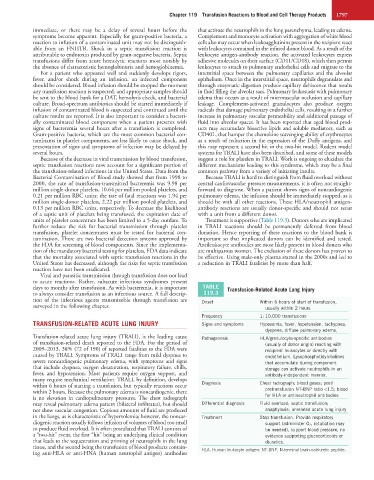
            units of platelet concentrate has been limited to a 5-day outdate. To   Treatment is supportive (Table 119.3). Donors who are implicated
            further  reduce  the  risk  for  bacterial  transmission  through  platelet   in  TRALI  reactions  should  be  permanently  deferred  from  blood
            transfusion,  platelet  concentrates  must  be  tested  for  bacterial  con-  donation. Hence reporting of these reactions to the blood bank is
            tamination. There are two bacterial detection systems approved by   important  so  that  implicated  donors  can  be  identified  and  tested.
            the FDA for screening of blood components. Since the implementa-  Antileukocyte antibodies are most likely present in blood donors who
            tion of the mandatory bacterial testing for platelets, FDA data indicate   are multiparous women. The exclusion of these donors has proven to
            that the mortality associated with septic transfusion reactions in the   be effective. Using male-only plasma started in the 2000s and led to
            United States has decreased, although the risks for septic transfusion   a reduction in TRALI fatalities by more than half.
            reaction have not been eradicated.
              Viral and parasitic transmission through transfusion does not lead
            to  acute  reactions.  Rather,  subacute  infectious  syndromes  present
            days to months after transfusion. As with bacteremia, it is important   TABLE   Transfusion-Related Acute Lung Injury
            to always consider transfusion as an infectious source. A full descrip-  119.3
            tion  of  the  infectious  agents  transmissible  through  transfusion  are   Onset  Within 6 hours of start of transfusion,
            surveyed in the following chapter.                                          usually within 2 hours
                                                                   Frequency          1 : 10,000 transfusions
            TRANSFUSION-RELATED ACUTE LUNG INJURY                  Signs and symptoms  Hypoxemia, fever, hypotension, tachypnea,
                                                                                        dyspnea, diffuse pulmonary edema,
            Transfusion-related  acute  lung  injury  (TRALI),  is  the  leading  cause   Pathogenesis  HLA/granulocyte-specific antibodies
            of transfusion-related death reported to the FDA. For the period of         (usually of donor origin) reacting with
            2009–2013, 38% (72 of 190) of reported fatalities to the FDA were           recipient leukocytes or directly with
            caused by TRALI. Symptoms of TRALI range from mild dyspnea to               endothelium. Lysophosphotidylcholines
            severe  noncardiogenic  pulmonary  edema,  with  symptoms  and  signs       that accumulate during component
            that include dyspnea, oxygen desaturation, respiratory failure, chills,     storage can activate neutrophils in an
            fever,  and  hypotension.  Most  patients  require  oxygen  support,  and   antibody-independent manner.
            many require mechanical ventilation. TRALI, by definition, develops
            within 6 hours of starting a transfusion, but typically reactions occur   Diagnosis  Chest radiograph; blood gases; post/
            within 2 hours. Because the pulmonary edema is noncardiogenic, there        pretransfusion NT-BNP ratio <1.5; blood
            is  no  elevation  in  cardiopulmonary  pressures. The  chest  radiograph   for HLA or antineutrophil antibodies
            may reveal pulmonary edema pattern (bilateral infiltrates), but should   Differential diagnosis  Fluid overload; septic transfusion;
            not show vascular congestion. Copious amounts of fluid are produced         anaphylaxis; unrelated acute lung injury
            in the lungs, as is characteristic of hypervolemia; however, the noncar-  Treatment  Stop transfusion. Provide respiratory
            diogenic reaction usually follows infusion of volumes of blood too small    support (administer O 2 , intubation may
            to produce fluid overload. It is often postulated that TRALI consists of    be needed), support blood pressure, no
            a “two-hit” event, the first “hit” being an underlying clinical condition   evidence supporting glucocorticoids or
            that leads to the sequestration and priming of neutrophils in the lung      diuretics.
            tissue, and the second being the transfusion of blood products contain-  HLA, Human leukocyte antigen; NT-BNP, N-terminal brain-natriuretic peptide.
            ing  anti-HLA  or  anti-HNA  (human  neutrophil  antigen)  antibodies

