


Page 2018 - Hematology_ Basic Principles and Practice ( PDFDrive )
P. 2018
Chapter 118  Hemapheresis  1789

                                     28
            stroke in donors receiving G-CSF.  Splenic enlargement occurs com-  Severe  toxicity  is  most  commonly  experienced  by  small  patients,
            monly, and several instances of splenic rupture have been reported.   particularly women, when the blood flow rate is rapid and the pro-
            Citrate toxicity is a common complication of PB-HSPC collections;   cedure is prolonged beyond a few hours. Symptoms correlate inversely
            although  usually  mild  and  transient,  it  may  be  severe  and  even     with the level of ionized calcium. Extremely low concentrations of
            life-threatening  in  some  individuals  (see  previous  section). Venous   ionized calcium are encountered routinely in therapeutic procedures
            access  requires  large-bore  multilumen  catheters,  and  these  appear   that  process  more  than  15 L  of  blood.  Acute  severe  hypocalcemia
            particularly susceptible to clotting, especially when patients receive   leading to fatal cardiac arrhythmia has been reported in patients who
            recombinant cytokine stimulation. Hemorrhage, especially in throm-  have  undergone  apheresis.  Controlled  infusions  of  10%  calcium
            bocytopenic patients, is another potentially severe complication of   gluconate  or  calcium  chloride  are  effective  in  the  management  of
            central venous catheter placement.                    these complications. Because metabolism of citrate occurs predomi-
              Some patients who have received multiple prior cycles of chemo-  nantly in the liver and kidney, patients with conditions affecting these
            therapy and a small proportion of normal healthy donors, referred to   organs  are  at  increased  risk  for  severe  citrate  reactions.  Studies  of
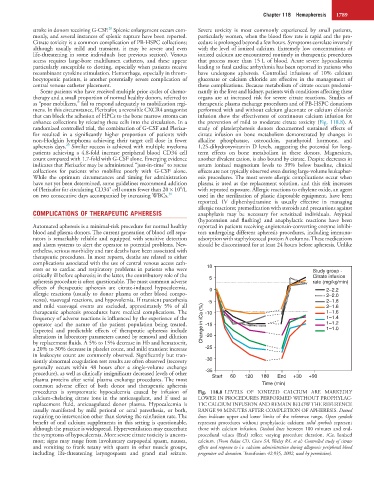
            as “poor mobilizers,” fail to respond adequately to mobilization regi-  therapeutic plasma exchange procedures and of PB-HSPC donations
            mens. In this circumstance, Plerixafor, a reversible CXCR4 antagonist   performed with and without calcium gluconate or calcium chloride
            that can block the adhesion of HPCs to the bone marrow stroma can   infusion show the effectiveness of continuous calcium infusion for
            enhance collections by releasing these cells into the circulation. In a   the prevention of mild to moderate citrate toxicity (Fig. 118.8). A
            randomized controlled trial, the combination of G-CSF and Plerixa-  study  of  plateletpheresis  donors  documented  sustained  effects  of
            for  resulted  in  a  significantly  higher  proportion  of  patients  with   citrate  infusion  on  bone  metabolism  demonstrated  by  changes  in
            non-Hodgkin  lymphoma  achieving  their  target  cell  dose  in  fewer   alkaline  phosphatase,  osteocalcin,  parathyroid  hormone,  and
                       29
            apheresis days.  Similar success is achieved with multiple myeloma   1,25-dihydroxyvitamin D levels, suggesting the potential for long-
            patients  achieving  a  4.8-fold  increase  peripheral  blood  CD34  cell   term  effects  on  bone  metabolism  in  these  donors.  Magnesium,
            count compared with 1.7-fold with G-CSF alone. Emerging evidence   another divalent cation, is also bound by citrate. Despite decreases in
            indicates that Plerixafor may be administered “just-in-time” to rescue   serum  ionized  magnesium  levels  to  39%  below  baseline,  clinical
            collections  for  patients  who  mobilize  poorly  with  G-CSF  alone.   effects are not typically observed even during large-volume leukapher-
            While  the  optimum  circumstances  and  timing  for  administration   esis procedures. The most severe allergic complications occur when
            have not yet been determined, some guidelines recommend addition   plasma is used as the replacement solution, and this risk increases
                                     +
                                                            6
            of Plerixafor for circulating CD34  cell counts fewer than 20 × 10 /L   with repeated exposure. Allergic reactions to ethylene oxide, an agent
            on two consecutive days accompanied by increasing WBCs. 30  used in the sterilization of plastic disposable equipment, have been
                                                                  reported.  IV  diphenhydramine  is  usually  effective  in  managing
                                                                  allergic reactions; premedication with steroids and precautions against
            COMPLICATIONS OF THERAPEUTIC APHERESIS                anaphylaxis  may  be  necessary  for  sensitized  individuals.  Atypical
                                                                  (hypotension  and  flushing)  and  anaphylactic  reactions  have  been
            Automated apheresis is a minimal-risk procedure for normal healthy   reported in patients receiving angiotensin-converting enzyme inhibi-
            blood and plasma donors. The current generation of blood cell sepa-  tors undergoing different apheresis procedures, including immuno-
            rators is remarkably reliable and equipped with sensitive detection   adsorption with staphylococcal protein A columns. These medications
            and alarm systems to alert the operator to potential problems. Nev-  should be discontinued for at least 24 hours before apheresis. Unlike
            ertheless, serious morbidity and rare deaths have been associated with
            therapeutic procedures. In most reports, deaths are related to either
            complications associated with the use of central venous access cath-
            eters  or  to  cardiac  and  respiratory  problems  in  patients  who  were   10           Study group -
            critically ill before apheresis; in the latter, the contributory role of the   5           Citrate infusion
            apheresis procedure is often questionable. The most common adverse                         rate (mg/kg/min)
            effects  of  therapeutic  apheresis  are  citrate-induced  hypocalcemia,   0                    2–2.2
            allergic reactions (usually to donor plasma or other blood compo-                               2–2.0
            nents), vasovagal reactions, and hypovolemia. If transient paresthesia   -5                     2–1.8
            and  mild  vasovagal  events  are  excluded,  approximately  5%  of  all                        2–1.6
            therapeutic  apheresis  procedures  have  medical  complications.  The   -10                    1–1.6
            frequency of adverse reactions is influenced by the experience of the                           1–1.4
            operator  and  the  nature  of  the  patient  population  being  treated.   Change in iCa (%)  -15  1–1.2
            Expected  and  predictable  effects  of  therapeutic  apheresis  include                        1–1.0
            alterations in laboratory parameters caused by removal and dilution   -20
            by replacement fluids. A 5% to 15% decrease in Hb and hematocrit,
            a 20% to 30% decrease in platelet count, and mild transient increase   -25
            in leukocyte count are commonly observed. Significantly but tran-
            siently abnormal coagulation test results are often observed (recovery   -30
            generally  occurs  within  48  hours  after  a  single-volume  exchange   -35
            procedure), as well as clinically insignificant decreased levels of other   Start  60  120  180  End  +30  +90
            plasma proteins after serial plasma exchange procedures. The most
            common  adverse  effect  of  both  donor  and  therapeutic  apheresis      Time (min)
            procedures  is  symptomatic  hypocalcemia  caused  by  infusion  of    Fig.  118.8  LEVELS  OF  IONIZED  CALCIUM  ARE  MARKEDLY
            calcium-chelating  citrate  ions  in  the  anticoagulant,  and  if  used  as   LOWER IN PROCEDURES PERFORMED WITHOUT PROPHYLAC-
            replacement  fluid,  anticoagulated  donor  plasma.  Hypocalcemia  is   TIC CALCIUM INFUSION AND REMAIN BELOW THE REFERENCE
            usually  manifested  by  mild  perioral  or  acral  paresthesia,  or  both,   RANGE 90 MINUTES AFTER COMPLETION OF APHERESIS. Dotted
            requiring no intervention other than slowing the reinfusion rate. The   lines  indicate  upper  and  lower  limits  of  the  reference  range. Open  symbols
            benefit of oral calcium supplements in this setting is questionable,   represent  procedures  without  prophylactic  calcium;  solid  symbols  represent
            although the practice is widespread. Hyperventilation may exacerbate   those  with  calcium  infusion.  Dashed  lines  between  180  minutes  and  end-
            the symptoms of hypocalcemia. More severe citrate toxicity is uncom-  procedural  values  (End)  reflect  varying  procedure  duration.  iCa,  Ionized
            mon; signs may range from involuntary carpopedal spasm, nausea,   calcium. (From Bolan CD, Cecco SA, Wesley RA, et al: Controlled study of citrate
            and vomiting to frank tetany with spasm in other muscle groups,   effects and response to i.v. calcium administration during allogeneic peripheral blood
            including  life-threatening  laryngospasm  and  grand  mal  seizure.   progenitor cell donation. Transfusion 42:935, 2002, used by permission).

