


Page 2022 - Hematology_ Basic Principles and Practice ( PDFDrive )
P. 2022
Chapter 119  Transfusion Reactions to Blood and Cell Therapy Products  1793


            24  hours  after  the  incompatible  transfusion,  the  episode  can  be   Acute Hemolytic Transfusion Reaction
            considered  to  be  over,  with  serious  sequelae  unlikely.  The  direct
            antiglobulin test (DAT) becomes positive in an immune hemolytic   A 15-year-old blood group O male with sickle cell disease presents for
            reaction (if tested before all the incompatible RBCs are destroyed).   routine simple transfusion for primary prevention of stroke. He has no
            Preparation of an antibody eluate is often necessary to identify the   history of red blood cell (RBC) alloimmunization and his pretransfusion
            presence of an offending IgG antibody. An elution is a procedure that   compatibility testing shows a negative screen for RBC alloantibodies.
            chemically separates the bound antibody from the RBCs and con-  Seven minutes into the transfusion, the patient reports not feeling well.
            centrates it so that it may be identified.             He quickly develops chills, abdominal pain, flank pain, and pain at the
              Initial therapy consists of immediately stopping the transfusion,   infusion site. The transfusion is stopped. Vital signs show a 15-mm Hg
            administering  intravenous  fluids,  cardiorespiratory  support,  and   drop in systolic blood pressure from baseline value, pulse of 130, and
            ensuring a brisk diuresis. Increasing renal blood flow is the best way   a temperature increase from afebrile pretransfusion to 38.9°C. Gross
                                                                   hematuria is seen in a subsequent urine sample. Reinspection of the
            to prevent acute oliguric renal failure. Usually, 0.9% NaCl is infused   blood unit shows that it is group A and labeled with the name of the
            to maintain a urine output of 100 mL/hour for approximately 24   child receiving blood in the infusion chair next to him. The patient is
            hours.  Diuresis  can  be  achieved  with  loop  diuretics  or  mannitol.   transferred  to  the  emergency  room  where  he  is  evaluated  for  renal
            Mannitol,  if  chosen,  must  be  used  with  caution;  if  acute  tubular   failure and DIC.
            necrosis (ATN) occurs before mannitol infusion, pulmonary edema   Recognition of the signs and symptoms at an acute hemolytic transfu-
            may occur as a result of the acute increase in intravascular volume   sion reaction are paramount for transfusion safety. Stopping transfusion
            secondary  to  fluid  expansion.  Maintaining  hydration  and  diuresis   at the first sign of incompatibility, usually fever, is critical for preventing
            can  be  complicated  in  the  setting  of  heart  failure  and  underlying   severe sequelae. Although almost all febrile reactions to blood transfu-
            renal  disease. The mechanisms  responsible for the beneficial  effect   sion are not caused by blood incompatibility, it is impossible to exclude
                                                                   this  possibility  at  the  bedside.  All  transfusion  reactions  need  to  be
            of  increased  renal  blood  flow  likely  include  increased  clearance  of   reported to the blood bank to exclude incompatibility.
            free hemoglobin and a return of more physiologic control of renal
            vasodilation.  Creatinine  and  blood  urea  nitrogen  (BUN)  should
            be  monitored;  dialysis  may  be  necessary  for  treatment  of  oliguric
            acute renal failure. Support of blood pressure and respiration may
            require the use of vasopressors, bronchodilators, or intubation. DIC
            can occur in severe cases. The prothrombin time, activated partial
            thromboplastin time, and fibrinogen level should be monitored (see                     MILD ALLERGIC
                                                                                                      FNHTR
            box  on  Workup  of  an  Acute  Intravascular  Hemolytic Transfusion                  FLUID OVERLOAD
            Reaction).
              Hyperhemolysis is a specific type of acute intravascular hemolysis       100
            of  bystander  RBCs  that  do  not  express  the  antigen  to  which  an
            immune-mediated hemolysis is directed. Hyperhemolysis occurs in
                                                                                       1,000
                                                                                                       TRALI
                                                                                                   ANAPHYLAXIS
             TABLE   Types of Acute Transfusion Reactions                                           HEMOLYTIC
              119.1
                                                                                      10,000
             Reaction Type    Presenting Signs and Symptoms           1/INCIDENCE
                                                                                                    SEPTIC
             Acute hemolytic  Fever, chills, dyspnea, vomiting, hypotension,
                                tachycardia, infusion site pain, back pain,
                                hemoglobinuria, hemoglobinemia, indirect              100,000
                                hyperbilirubinemia, renal failure, DIC                               FATAL
                                                                                                   REACTION
             Febrile reaction  Fever, chills, rigors
             Allergic         Urticaria, pruritus, flushing, angioedema,             1,000,000
                                dyspnea, bronchospasm stridor,                                       PTP
                                hypotension, tachycardia, abdominal                                 T-GVHD
                                cramping
             Hypervolemic     Dyspnea, tachycardia, hypertension,                    10,000,000
                                headache, jugular venous distention
             Septic           Fever, chills, hypotension, tachycardia,
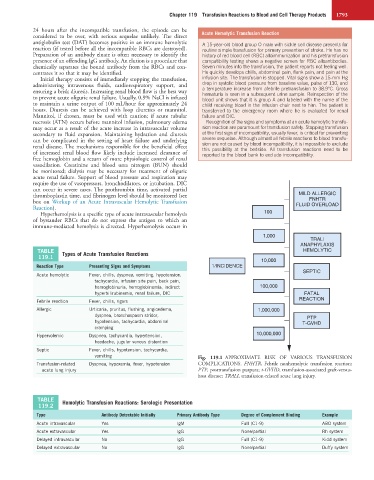
                                vomiting                          Fig.  119.1  APPROXIMATE  RISK  OF  VARIOUS  TRANSFUSION
             Transfusion-related   Dyspnea, hypoxemia, fever, hypotension  COMPLICATIONS.  FNHTR,  Febrile  nonhemolytic  transfusion  reaction;
               acute lung injury                                  PTP, posttransfusion purpura; t-GVHD, transfusion-associated graft-versus-
                                                                  host disease; TRALI, transfusion-related acute lung injury.


             TABLE   Hemolytic Transfusion Reactions: Serologic Presentation
              119.2
             Type                 Antibody Detectable Initially  Primary Antibody Type  Degree of Complement Binding  Example
             Acute intravascular  Yes                      IgM                  Full (C1-9)               ABO system
             Acute extravascular  Yes                      IgG                  None/partial              Rh system
             Delayed intravascular  No                     IgG                  Full (C1-9)               Kidd system
             Delayed extravascular  No                     IgG                  None/partial              Duffy system

