


Page 209 - Hematology_ Basic Principles and Practice ( PDFDrive )
P. 209
Chapter 15  Vascular Growth in Health and Disease  161


            Angiogenesis and Antiangiogenesis in Hematopoietic    most extensive clinical experience is in the area of cancer, where some
                                                                  toxicities  (e.g.,  hypertension,  proteinuria,  fatigue,  hypothyroidism)
            Malignancies                                          have been observed in this setting, along with hematologic side effects,
                                                                  mainly thrombosis and/or bleeding. While cancer patients are prone
                                                                            36
            The vascular bone marrow stroma plays a pivotal role in leukemogen-  to  thrombosis,   antiangiogenic  therapy  increases  the  risk  of  venous
                                                                                                6
               7
            esis.   Indeed,  angiogenesis,  increased  vascular  density,  and  increased   thromboembolism or arterial thrombosis.  The risk varies depending
            levels of angiogenic growth factors have all been observed in the bone   on the agent and the type of cancer, and is exacerbated by accompany-
                                                  7
                                                                                               36
            marrow of patients with hematopoietic malignancies.  VEGF may play   ing chemotherapy or hormonal therapy.  Thrombosis is of particular
            multiple roles in this context, including as (1) vascular growth stimula-  concern in patients with multiple myeloma who receive thalidomide
                                                  7
            tor; (2) paracrine growth factor for leukemic stem cells ; and (3) inducer   derivatives in combination with anthracyclins and dexamethasone. In
                                                                                                               36
                                                             10
            of angiocrine interactions between these cells and the endothelium.    this case the reported risk of thrombosis may be as high as 75%.  Beva-
            Consequently,  a  wide  spectrum  of  antiangiogenic  agents,  including   cizumab may increase the risk of arterial thrombosis up to twofold in
            VEGF antagonists (bevacizumab, sorafenib, sunitinib, cediranib), are   patients with solid tumors, especially in the elderly with additional risk
            under investigation for the treatment of hematologic disorders, such as   factors. These estimates are variable, however (0.9% to 19.4% according
            acute myelogeneous leukemia, chronic myelogeneous leukemia, acute   to different studies), and drug specific, because small-molecule tyrosine
            lymphoblastic  leukemia,  myelodysplastic  syndrome,  non-Hodgkin   kinase  inhibitors  acting  on  VEGFR  are  less  likely  to  trigger  venous
                                            7
            lymphoma,  multiple  myeloma,  and  others.   Additional  agents  with   thromboembolism (0% to 3%; also see Chapters 126 and 149). 36
            antiangiogenic activity have also been explored, including bortezomib   Bleeding complications were also recorded with several of these
                                                                                                    37
            and antiinflammatory antiangiogenics (thalidomide and lenalidomide),   agents, ranging from minor to life threatening.  In general, however,
            some of which are already in human use in hematologic malignancies   antiangiogenic  agents  are  relatively  well  tolerated,  and  their  side
            (e.g., in mantle cell lymphoma, multiple myeloma, and myelodysplastic   effects are usually manageable with careful monitoring and standard
                                     7
            syndrome; see Medinger and Mross  for review, also Chapter 55).  supportive care. 6
            Hematologic Complications Associated With Blood       SUMMARY
            Vessel–Directed Agents
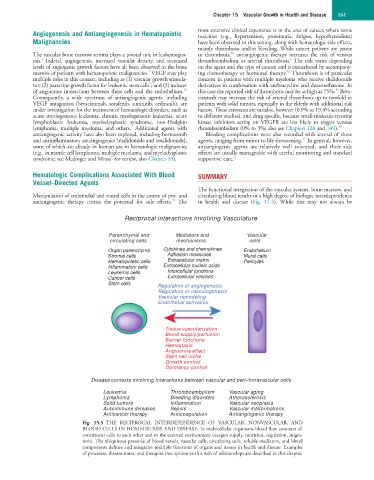
                                                                  The functional integration of the vascular system, bone marrow, and
            Manipulation of endothelial and mural cells in the course of pro- and   circulating blood results in a high degree of biologic interdependence
                                                         35
            antiangiogenic  therapy  creates  the  potential  for  side  effects.   The   in  health  and  disease  (Fig.  15.5).  While  this  may  not  always  be
                                          Reciprocal interactions involving Vasculature
                                     Parenchymal and       Mediators and          Vascular
                                     circulating cells     mechanisms              cells
                                    Organ parenchyma  Cytokines and chemokines   Endothelium
                                    Stromal cells        Adhesion molecules      Mural cells
                                    Hematopoietic cells     Extracellular matrix  Pericytes
                                    Inflammatory cells  Extracellular nucleic acids
                                    Leukemic cells       Intercellular junctions
                                    Cancer cells         Extracellular vesicles
                                    Stem cells       Regulation of angiogenesis
                                                     Regulation of vasculogenesis
                                                     Vascular remodeling
                                                     Endothelial activation


                                                       Tissue vascularization
                                                       Blood supply/perfusion
                                                       Barrier functions
                                                       Hemostasis
                                                       Angiocrine effect
                                                       Stem cell niche
                                                       Growth control
                                                       Dormancy control

                               Disease contexts involving interactions between vascular and peri-/intravascular cells
                                   Leukemia              Thromboembolism    Vascular aging
                                   Lymphoma              Bleeding disorders  Atherosclerosis
                                   Solid tumors          Inflammation       Vascular neoplasia
                                   Autoimmune diseases   Sepsis             Vascular malformations
                                   Anticancer therapy       Anticoagulation  Antiangiogenic therapy
                            Fig.  15.5  THE  RECIPROCAL  INTERDEPENDENCE  OF  VASCULAR,  NONVASCULAR,  AND
                            BLOOD CELLS IN HOMEOSTASIS AND DISEASE. In multicellular organisms blood flow connects all
                            constituent cells to each other and to the external environment (oxygen supply, nutrition, regulation, migra-
                            tion). The ubiquitous presence of blood vessels, vascular cells, circulating cells, soluble mediators, and blood
                            components defines and integrates multiple functions of organs and tissues in health and disease. Examples
                            of processes, disease states, and therapies that epitomize this web of relationships are described in this chapter.

