


Page 2063 - Hematology_ Basic Principles and Practice ( PDFDrive )
P. 2063
1832   Part XII  Hemostasis and Thrombosis


                            Antiplatelet                 Anticoagulant        Profibrinolytic
                                                 Heparan
                       NO    CD39 Prostacyclin    sulfate  TM   EPCR    TFPI   t-PA   u-PA


                                                                                            Endothelium

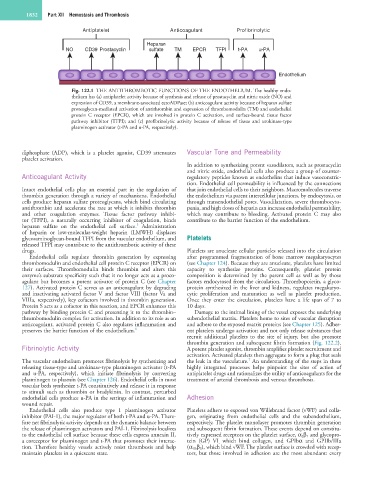
                        Fig. 122.1  THE ANTITHROMBOTIC FUNCTIONS OF THE ENDOTHELIUM. The healthy endo-
                        thelium has (a) antiplatelet activity because of synthesis and release of prostacyclin and nitric oxide (NO) and
                        expression of CD39, a membrane-associated ectoADPase; (b) anticoagulant activity because of heparan sulfate
                        proteoglycan-mediated activation of antithrombin and expression of thrombomodulin (TM) and endothelial
                        protein  C  receptor  (EPCR),  which  are  involved  in  protein  C  activation,  and  surface-bound  tissue  factor
                        pathway  inhibitor  (TFPI);  and  (c)  profibrinolytic  activity  because  of  release  of  tissue  and  urokinase-type
                        plasminogen activator (t-PA and u-PA, respectively).


        diphosphate  (ADP),  which  is  a  platelet  agonist,  CD39  attenuates   Vascular Tone and Permeability
        platelet activation.
                                                              In addition to synthesizing potent vasodilators, such as prostacyclin
                                                              and nitric oxide, endothelial cells also produce a group of counter-
        Anticoagulant Activity                                regulatory peptides known as endothelins that induce vasoconstric-
                                                              tion. Endothelial cell permeability is influenced by the connections
        Intact  endothelial  cells  play  an  essential  part  in  the  regulation  of   that join endothelial cells to their neighbors. Macromolecules traverse
        thrombin generation through a variety of mechanisms. Endothelial   the endothelium via patent intercellular junctions, by endocytosis, or
        cells produce heparan sulfate proteoglycans, which bind circulating   through transendothelial pores. Vasodilatation, severe thrombocyto-
        antithrombin and accelerate the rate at which it inhibits thrombin   penia, and high doses of heparin can increase endothelial permeability,
        and  other  coagulation  enzymes.  Tissue  factor  pathway  inhibi-  which  may  contribute  to  bleeding.  Activated  protein  C  may  also
        tor  (TFPI),  a  naturally  occurring  inhibitor  of  coagulation,  binds   contribute to the barrier function of the endothelium.
                                              5
        heparan  sulfate  on  the  endothelial  cell  surface.   Administration
        of  heparin  or  low-molecular-weight  heparin  (LMWH)  displaces
        glycosaminoglycan-bound TFPI from the vascular endothelium, and   Platelets
        released TFPI may contribute to the antithrombotic activity of these
        drugs.                                                Platelets are anucleate cellular particles released into the circulation
           Endothelial  cells  regulate  thrombin  generation  by  expressing   after  programmed  fragmentation  of  bone  marrow  megakaryocytes
        thrombomodulin and endothelial cell protein C receptor (EPCR) on   (see Chapter 124). Because they are anucleate, platelets have limited
        their  surfaces.  Thrombomodulin  binds  thrombin  and  alters  this   capacity  to  synthesize  proteins.  Consequently,  platelet  protein
        enzyme’s substrate specificity such that it no longer acts as a proco-  composition  is  determined  by  the  parent  cell  as  well  as  by  those
        agulant but becomes a potent activator of protein C (see Chapter   factors endocytosed from the circulation. Thrombopoietin, a glyco-
        127). Activated protein C serves as an anticoagulant by degrading   protein  synthesized  in  the  liver  and  kidneys,  regulates  megakaryo-
        and inactivating activated  factor V and  factor VIII (factor Va and   cytic  proliferation  and  maturation  as  well  as  platelet  production.
        VIIIa, respectively), key cofactors involved in thrombin generation.   Once  they  enter  the  circulation,  platelets  have  a  life  span  of  7  to
        Protein S acts as a cofactor in this reaction, and EPCR enhances this   10 days.
        pathway by binding protein C and presenting it to the thrombin–  Damage to the intimal lining of the vessel exposes the underlying
        thrombomodulin complex for activation. In addition to its role as an   subendothelial matrix. Platelets home to sites of vascular disruption
        anticoagulant, activated protein C also regulates inflammation and   and adhere to the exposed matrix proteins (see Chapter 125). Adher-
        preserves the barrier function of the endothelium. 6  ent platelets undergo activation and not only release substances that
                                                              recruit  additional  platelets  to  the  site  of  injury,  but  also  promote
                                                              thrombin generation and subsequent fibrin formation (Fig. 122.2).
        Fibrinolytic Activity                                 A potent platelet agonist, thrombin amplifies platelet recruitment and
                                                              activation. Activated platelets then aggregate to form a plug that seals
                                                                                  7
        The vascular endothelium promotes fibrinolysis by synthesizing and   the leak in the vasculature.  An understanding of the steps in these
        releasing tissue-type and urokinase-type plasminogen activator (t-PA   highly  integrated  processes  helps  pinpoint  the  sites  of  action  of
        and  u-PA,  respectively),  which  initiate  fibrinolysis  by  converting   antiplatelet drugs and rationalizes the utility of anticoagulants for the
        plasminogen to plasmin (see Chapter 126). Endothelial cells in most   treatment of arterial thrombosis and venous thrombosis.
        vascular beds synthesize t-PA constitutively and release it in response
        to stimuli such as thrombin or bradykinin. In contrast, perturbed
        endothelial cells produce u-PA in the settings of inflammation and   Adhesion
        wound repair.
           Endothelial  cells  also  produce  type  1  plasminogen  activator   Platelets adhere to exposed von Willebrand factor (vWF) and colla-
        inhibitor (PAI-1), the major regulator of both t-PA and u-PA. There-  gen,  originating  from  endothelial  cells  and  the  subendothelium,
        fore net fibrinolytic activity depends on the dynamic balance between   respectively. The platelet monolayer promotes thrombin generation
        the release of plasminogen activators and PAI-1. Fibrinolysis localizes   and subsequent fibrin formation. These events depend on constitu-
        to the endothelial cell surface because these cells express annexin II,   tively expressed receptors on the platelet surface, α 2β 1 and glycopro-
        a coreceptor for plasminogen and t-PA that promotes their interac-  tein  (GP)  VI ,  which  bind  collagen,  and  GPIbα  and  GPIIb/IIIa
        tion. Therefore  healthy  vessels  actively  resist  thrombosis  and  help   (α IIb β 3), which bind vWF. The platelet surface is crowded with recep-
        maintain platelets in a quiescent state.              tors, but those involved in adhesion are the most abundant: every

