


Page 2064 - Hematology_ Basic Principles and Practice ( PDFDrive )
P. 2064
Chapter 122  Overview of Hemostasis and Thrombosis  1833


                                                     Plaque disruption


                                    Tissue Factor       Collagen          vWF


                                                      Platelet adhesion and secretion


                                                Aspirin    X COX-1
                                                                         ADP
                                                          TXA 2                     Ticlopidine
                                                                                   Clopidogrel
                                                                          X
                                     Thrombin                                       Prasugrel
                                                                                    Ticagrelor
                                                            Platelet recruitment
                                                X
                                                              and activation
                                             Vorapaxar
                                                            GPIIb/IIIa activation
                                                                                    Abciximab
                                                                   X                Eptifibatide
                                                                                     Tirofiban
                                                           Platelet aggregation
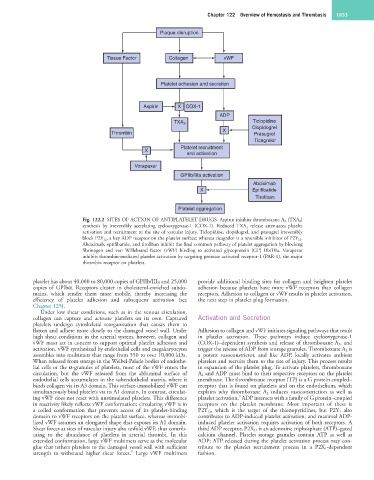
                            Fig. 122.2  SITES OF ACTION OF ANTIPLATELET DRUGS. Aspirin inhibits thromboxane A 2 (TXA 2)
                            synthesis  by  irreversibly  acetylating  cyclooxygenase-1  (COX-1).  Reduced  TXA 2  release  attenuates  platelet
                            activation and recruitment to the site of vascular injury. Ticlopidine, clopidogrel, and prasugrel irreversibly
                            block P2Y 12, a key ADP receptor on the platelet surface; whereas ticagrelor is a reversible inhibitor of P2Y 12.
                            Abciximab, eptifibatide, and tirofiban inhibit the final common pathway of platelet aggregation by blocking
                            fibrinogen  and  von  Willebrand  factor  (vWF)  binding  to  activated  glycoprotein  (GP)  IIb/IIIa.  Vorapaxar
                            inhibits thrombin-mediated platelet activation by targeting protease activated receptor-1 (PAR-1), the major
                            thrombin receptor on platelets.


            platelet has about 40,000 to 80,000 copies of GPIIb/IIIa and 25,000   provide  additional  binding  sites  for  collagen  and  heighten  platelet
            copies  of  GPIbα.  Receptors  cluster  in  cholesterol-enriched  subdo-  adhesion because platelets have more vWF receptors than collagen
            mains,  which  render  them  more  mobile,  thereby  increasing  the     receptors. Adhesion to collagen or vWF results in platelet activation,
            efficiency  of  platelet  adhesion  and  subsequent  activation  (see     the next step in platelet plug formation.
            Chapter 125).
              Under  low  shear  conditions,  such  as in  the  venous  circulation,
            collagen  can  capture  and  activate  platelets  on  its  own.  Captured   Activation and Secretion
            platelets  undergo  cytoskeletal  reorganization  that  causes  them  to
            flatten and adhere more closely to the damaged vessel wall. Under   Adhesion to collagen and vWF initiates signaling pathways that result
            high shear conditions in the arterial system, however, collagen and   in  platelet  activation.  These  pathways  induce  cyclooxygenase-1
            vWF must act in concert to support optimal platelet adhesion and   (COX-1)–dependent synthesis and release of thromboxane A 2 , and
            activation. vWF synthesized by endothelial cells and megakaryocytes   trigger the release of ADP from storage granules. Thromboxane A 2  is
            assembles into multimers that range from 550 to over 10,000 kDa.   a  potent  vasoconstrictor,  and  like  ADP,  locally  activates  ambient
            When released from storage in the Weibel-Palade bodies of endothe-  platelets and recruits them to the site of injury. This process results
            lial cells or the α-granules of platelets, most of the vWF enters the   in expansion of the platelet plug. To activate platelets, thromboxane
            circulation,  but  the  vWF  released  from  the  abluminal  surface  of   A 2  and ADP must bind to their respective receptors on the platelet
            endothelial cells accumulates in the subendothelial matrix, where it   membrane. The thromboxane receptor (TP) is a G protein coupled–
            binds collagen via its A3 domain. This surface-immobilized vWF can   receptor that is found on platelets and on the endothelium, which
            simultaneously bind platelets via its A1 domain. In contrast, circulat-  explains  why  thromboxane  A 2   induces  vasoconstriction  as  well  as
                                                                               9
            ing vWF does not react with unstimulated platelets. This difference   platelet activation.  ADP interacts with a family of G protein–coupled
            in reactivity likely reflects vWF conformation; circulating vWF is in   receptors  on  the  platelet  membrane.  Most  important  of  these  is
            a  coiled  conformation  that  prevents  access  of  its  platelet-binding   P2Y 12,  which  is  the  target  of  the  thienopyridines,  but  P2Y 1  also
            domain to vWF receptors on the platelet surface, whereas immobi-  contributes to ADP-induced platelet activation, and maximal ADP-
            lized vWF assumes an elongated shape that exposes its A1 domain.   induced platelet activation requires activation of both receptors. A
            Shear forces at sites of vascular injury also unfold vWF, thus contrib-  third ADP receptor, P2X 1, is an adenosine triphosphate (ATP)–gated
            uting  to  the  abundance  of  platelets  in  arterial  thrombi.  In  this   calcium  channel.  Platelet  storage  granules  contain  ATP  as  well  as
            extended conformation, large vWF multimers serve as the molecular   ADP; ATP released during the platelet activation process may con-
            glue that tethers platelets to the damaged vessel wall with sufficient   tribute  to  the  platelet  recruitment  process  in  a  P2X 1-dependent
                                            8
            strength  to  withstand  higher  shear  forces.   Large  vWF  multimers   fashion.

