


Page 2065 - Hematology_ Basic Principles and Practice ( PDFDrive )
P. 2065
1834   Part XII  Hemostasis and Thrombosis


                      IIa
                                                                                     IIa


                         IIa                                                   LDPR
                                     LDPRSFLLR                                 RLLFS


                                            C                                  C
                                         C                                  C


                                                                           Response
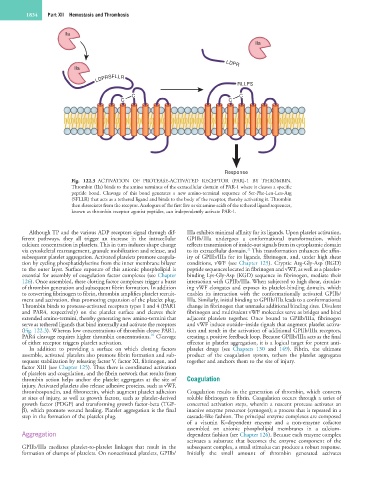
                        Fig.  122.3  ACTIVATION  OF  PROTEASE-ACTIVATED  RECEPTOR  (PAR)-1  BY  THROMBIN.
                        Thrombin (IIa) binds to the amino terminus of the extracellular domain of PAR-1 where it cleaves a specific
                        peptide  bond.  Cleavage  of  this  bond  generates  a  new  amino-terminal  sequence  of  Ser-Phe-Leu-Leu-Arg
                        (SFLLR) that acts as a tethered ligand and binds to the body of the receptor, thereby activating it. Thrombin
                        then dissociates from the receptor. Analogues of the first five or six amino acids of the tethered ligand sequences,
                        known as thrombin receptor agonist peptides, can independently activate PAR-1.


           Although TP and the various ADP receptors signal through dif-  IIIa exhibits minimal affinity for its ligands. Upon platelet activation,
        ferent  pathways,  they  all  trigger  an  increase  in  the  intracellular   GPIIb/IIIa  undergoes  a  conformational  transformation,  which
        calcium concentration in platelets. This in turn induces shape change   reflects transmission of inside-out signals from its cytoplasmic domain
                                                                                  11
        via cytoskeletal rearrangement, granule mobilization and release, and   to its extracellular domain.  This transformation enhances the affin-
        subsequent platelet aggregation. Activated platelets promote coagula-  ity of GPIIb/IIIa for its ligands, fibrinogen, and, under high shear
        tion by cycling phosphatidylserine from the inner membrane bilayer   conditions,  vWF  (see  Chapter  125).  Cryptic  Arg-Gly-Asp  (RGD)
        to the outer layer. Surface exposure of this anionic phospholipid is   peptide sequences located in fibrinogen and vWF, as well as a platelet-
        essential for assembly of coagulation factor complexes (see Chapter   binding Lys-Gly-Asp (KGD) sequence in fibrinogen, mediate their
        126). Once assembled, these clotting factor complexes trigger a burst   interaction with GPIIb/IIIa. When subjected to high shear, circulat-
        of thrombin generation and subsequent fibrin formation. In addition   ing vWF elongates and exposes its platelet-binding domain, which
        to converting fibrinogen to fibrin, thrombin amplifies platelet recruit-  enables  its  interaction  with  the  conformationally  activated  GPIIb/
        ment and activation, thus promoting expansion of the platelet plug.   IIIa. Similarly, initial binding to GPIIb/IIIa leads to a conformational
        Thrombin binds to protease-activated receptors types 1 and 4 (PAR1   change in fibrinogen that unmasks additional binding sites. Divalent
        and  PAR4,  respectively)  on  the  platelet  surface  and  cleaves  their   fibrinogen and multivalent vWF molecules serve as bridges and bind
        extended amino-termini, thereby generating new amino-termini that   adjacent  platelets  together.  Once  bound  to  GPIIb/IIIa,  fibrinogen
        serve as tethered ligands that bind internally and activate the receptors   and vWF induce outside–inside signals that augment platelet activa-
        (Fig. 122.3). Whereas low concentrations of thrombin cleave PAR1,   tion and result in the activation of additional GPIIb/IIIa receptors,
                                                  10
        PAR4 cleavage requires higher thrombin concentrations.  Cleavage   creating a positive feedback loop. Because GPIIb/IIIa acts as the final
        of either receptor triggers platelet activation.      effector in platelet aggregation, it is a logical target for potent anti-
           In  addition  to  providing  a  surface  on  which  clotting  factors   platelet  drugs  (see  Chapters  130  and  149).  Fibrin,  the  ultimate
        assemble, activated platelets also promote fibrin formation and sub-  product  of  the  coagulation  system,  tethers  the  platelet  aggregates
        sequent stabilization by releasing factor V, factor XI, fibrinogen, and   together and anchors them to the site of injury.
        factor XIII (see Chapter 125). Thus there is coordinated activation
        of platelets and coagulation, and the fibrin network that results from
        thrombin action helps anchor the platelet aggregates at the site of   Coagulation
        injury. Activated platelets also release adhesive proteins, such as vWF,
        thrombospondin, and fibronectin, which augment platelet adhesion   Coagulation results in the generation of thrombin, which converts
        at sites of injury, as well as growth factors, such as platelet-derived   soluble fibrinogen to fibrin. Coagulation occurs through a series of
        growth factor (PDGF) and transforming growth factor-beta (TGF-  concerted  activation  steps,  wherein  a  nascent  protease  activates  an
        β), which promote wound healing. Platelet aggregation is the final   inactive enzyme precursor (zymogen); a process that is repeated in a
        step in the formation of the platelet plug.           cascade-like fashion. The principal enzyme complexes are composed
                                                              of  a  vitamin  K–dependent  enzyme  and  a  non-enzyme  cofactor
                                                              assembled  on  anionic  phospholipid  membranes  in  a  calcium-
        Aggregation                                           dependent fashion (see Chapter 126). Because each enzyme complex
                                                              activates  a  substrate  that  becomes  the  enzyme  component  of  the
        GPIIb/IIIa  mediates  platelet-to-platelet  linkages  that  result  in  the   subsequent complex, a small stimulus can produce a robust response.
        formation of clumps of platelets. On nonactivated platelets, GPIIb/  Initially  the  small  amount  of  thrombin  generated  activates

