


Page 2068 - Hematology_ Basic Principles and Practice ( PDFDrive )
P. 2068
Chapter 122  Overview of Hemostasis and Thrombosis  1837


                                                                  inhibitors  modulate  coagulation:  TFPI  and  antithrombin.  TFPI,
                          K             PK                        which  is  located  on  platelets  and  microvascular  endothelial  cells,
                                                                  inhibits factor VIIa in a factor Xa-dependent manner. TFPI effectively
                        HK            HK                          halts tissue factor-mediated initiation of coagulation, but not before
                                                                  sufficient factor Xa is generated to propagate clotting. The high levels
                                                                  of thrombin produced during the amplification phase are controlled
                     XII           XIIa
                                         Surface                  by antithrombin. This serine protease inhibitor (serpin) also inacti-
                                                                  vates other coagulation proteases, including factors VIIa, IXa, Xa, and
                                                                  Xia. Although antithrombin is abundant, it exhibits only moderate
                                                                  inhibitory activity, except in the presence of cell-associated glycosami-
                                                                  noglycans, such as heparan sulfate. This is the biochemical basis for
                              XI          XIa                     use of heparin as an anticoagulant (see Chapter 149). Further regula-
                                                                  tion of thrombin generation is mediated by the protein C anticoagu-
                                                                  lant pathway which is catalyzed by thrombin. These processes ensure
                                     IX          IXa              that thrombin generation is localized and limited. Sufficient thrombin
                                                                  is produced, however, to ensure that coagulation occurs.


                                               Common             Fibrin Formation
                                   Surface     Pathway
                                                                  Thrombin converts soluble fibrinogen into insoluble fibrin. Fibrino-
                                                                  gen is a dimeric molecule, each half of which is composed of three
                                                                  polypeptide chains, the Aα, Bβ, and γ chains. Numerous disulfide
                                              Thrombin
                                                                  bonds covalently link the chains together and join the two halves of
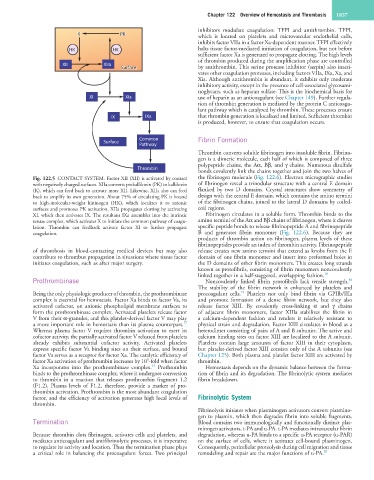
            Fig. 122.5  CONTACT SYSTEM. Factor XII (XII) is activated by contact   the fibrinogen molecule (Fig. 122.6). Electron micrographic studies
            with negatively charged surfaces. XIIa converts prekallikrein (PK) to kallikrein   of fibrinogen reveal a trinodular structure with a central E domain
            (K), which can feed back to activate more XII. Likewise, XIIa also can feed   flanked  by  two  D  domains.  Crystal  structures  show  symmetry  of
            back to amplify its own generation. About 75% of circulating PK is bound   design with the central E domain, which contains the amino termini
            to  high-molecular-weight  kininogen  (HK),  which  localizes  it  to  anionic   of the fibrinogen chains, joined to the lateral D domains by coiled-
            surfaces and promotes PK activation. XIIa propagates clotting by activating   coil regions.
            XI, which then activates IX. The resultant IXa assembles into the intrinsic   Fibrinogen circulates in a soluble form. Thrombin binds to the
            tenase complex, which activates X to initiate the common pathway of coagu-  amino termini of the Aα and Bβ chains of fibrinogen, where it cleaves
            lation.  Thrombin  can  feedback  activate  factor  XI  to  further  propagate   specific peptide bonds to release fibrinopeptide A and fibrinopeptide
            coagulation.                                          B  and  generates  fibrin  monomer  (Fig.  122.6).  Because  they  are
                                                                  products  of  thrombin  action  on  fibrinogen,  plasma  levels  of  these
                                                                  fibrinopeptides provide an index of thrombin activity. Fibrinopeptide
            of  thrombosis  in  blood-contacting  medical  devices  but  may  also   release creates new amino termini that extend as knobs from the E
            contribute to thrombus propagation in situations where tissue factor   domain of one fibrin monomer and insert into preformed holes in
            initiates coagulation, such as after major surgery.   the D domains of other fibrin monomers. This creates long strands
                                                                  known as protofibrils, consisting of fibrin monomers noncovalently
                                                                  linked together in a half-staggered, overlapping fashion. 18
            Prothrombinase                                          Noncovalently  linked  fibrin  protofibrils  lack  tensile  strength.
                                                                                                                   18
                                                                  The  stability  of  the  fibrin  network  is  enhanced  by  platelets  and
                                                                                19
            Being the only physiologic producer of thrombin, the prothrombinase   procoagulant  cells.   Platelets  not  only  bind  fibrin  via  GPIIb/IIIa
            complex is essential for hemostasis. Factor Xa binds to factor Va, its   and  promote  formation  of  a  dense  fibrin  network,  but  they  also
            activated  cofactor,  on  anionic  phospholipid  membrane  surfaces  to   release  factor  XIII.  By  covalently  cross-linking  α  and  γ  chains
            form the prothrombinase complex. Activated platelets release factor   of  adjacent  fibrin  monomers,  factor  XIIIa  stabilizes  the  fibrin  in
            V from their α-granules, and this platelet-derived factor V may play   a  calcium-dependent  fashion  and  renders  it  relatively  resistant  to
                                                             17
            a more important role in hemostasis than its plasma counterpart.    physical strain and degradation. Factor XIII circulates in blood as a
            Whereas  plasma  factor V  requires  thrombin  activation  to  exert  its   heterodimer consisting of pairs of A and B subunits. The active and
            cofactor activity, the partially activated factor V released from platelets   calcium binding sites on factor XIII are localized to the A subunit.
            already  exhibits  substantial  cofactor  activity.  Activated  platelets   Platelets  contain  large  amounts  of  factor  XIII  in  their  cytoplasm,
            express specific factor Va binding sites on their surface, and bound   but platelet-derived factor XIII consists only of the A subunits (see
            factor Va serves as a receptor for factor Xa. The catalytic efficiency of   Chapter 125). Both plasma and platelet factor XIII are activated by
                                                 5
            factor Xa activation of prothrombin increases by 10 -fold when factor   thrombin.
                                                   13
            Xa  incorporates  into  the  prothrombinase  complex.   Prothrombin   Hemostasis depends on the dynamic balance between the forma-
            binds to the prothrombinase complex, where it undergoes conversion   tion of fibrin and its degradation. The fibrinolytic system mediates
            to  thrombin  in  a  reaction  that  releases  prothrombin  fragment  1.2   fibrin breakdown.
            (F1.2).  Plasma  levels  of  F1.2,  therefore,  provide  a  marker  of  pro-
            thrombin activation. Prothrombin is the most abundant coagulation
            factor, and the efficiency of activation generates high local levels of   Fibrinolytic System
            thrombin.
                                                                  Fibrinolysis initiates when plasminogen activators convert plasmino-
                                                                  gen to plasmin, which then degrades fibrin into soluble fragments.
            Termination                                           Blood contains two immunologically and functionally distinct plas-
                                                                  minogen activators, t-PA and u-PA. t-PA mediates intravascular fibrin
            Because thrombin clots fibrinogen, activates cells and platelets, and   degradation, whereas u-PA binds to a specific u-PA receptor (u-PAR)
            mediates anticoagulant and antifibrinolytic processes, it is imperative   on  the  surface  of  cells,  where  it  activates  cell-bound  plasminogen.
            to regulate its activity and location. Thus the termination phase plays   Consequently, pericellular proteolysis during cell migration and tissue
            a  critical  role  in  balancing  the  procoagulant  forces. Two  principal   remodeling and repair are the major functions of u-PA. 20

