


Page 2072 - Hematology_ Basic Principles and Practice ( PDFDrive )
P. 2072
Chapter 122  Overview of Hemostasis and Thrombosis  1841


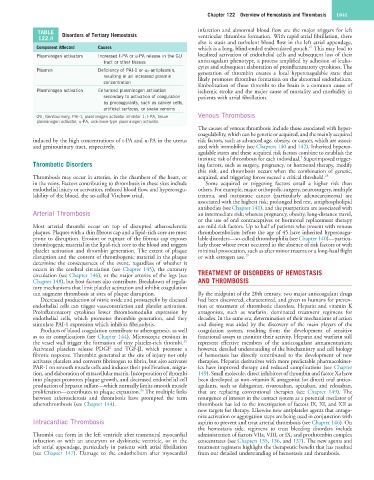
             TABLE   Disorders of Tertiary Hemostasis             infarction and abnormal blood flow are the major triggers for left
              122.4                                               ventricular thrombus formation. With rapid atrial fibrillation, there
                                                                  also is stasis and turbulent blood flow in the left atrial appendage,
             Component Affected  Causes                           which is a long, blind-ended trabeculated pouch.  This may lead to
                                                                                                      27
             Plasminogen activators  Increased t-PA or u-PA release in the GU   localized activation of endothelial cells and subsequent loss of their
                                   tract or other tissues         anticoagulant phenotype, a process amplified by adhesion of leuko-
                                                                  cytes and subsequent elaboration of proinflammatory cytokines. The
             Plasmin             Deficiency of PAI-1 or α 2 -antiplasmin,   generation  of  thrombin  creates  a  local  hypercoagulable  state  that
                                   resulting in an increased plasmin   likely promotes thrombus formation on the abnormal endothelium.
                                   concentration
                                                                  Embolization of these thrombi to the brain is a common cause of
             Plasminogen activation  Enhanced plasminogen activation   ischemic stroke and the major cause of mortality and morbidity in
                                   secondary to activation of coagulation   patients with atrial fibrillation.
                                   by procoagulants, such as cancer cells,
                                   artificial surfaces, or snake venoms
             GU, Genitourinary; PAI-1, plasminogen activator inhibitor 1; t-PA, tissue   Venous Thrombosis
             plasminogen activator; u-PA, urokinase-type plasminogen activator.
                                                                  The causes of venous thrombosis include those associated with hyper-
                                                                  coagulability, which can be genetic or acquired, and the mainly acquired
            induced by the high concentrations of t-PA and u-PA in the uterus   risk factors, such as advanced age, obesity, or cancer, which are associ-
            and genitourinary tract, respectively.                ated with immobility (see Chapters 140 and 142). Inherited hyperco-
                                                                  agulable states and these acquired risk factors combine to establish the
                                                                                                   2
                                                                  intrinsic risk of thrombosis for each individual.  Superimposed trigger-
            Thrombotic Disorders                                  ing factors, such as surgery, pregnancy, or hormonal therapy, modify
                                                                  this  risk,  and  thrombosis  occurs  when  the  combination  of  genetic,
            Thrombosis may occur in arteries, in the chambers of the heart, or   acquired, and triggering forces exceed a critical threshold. 28
            in the veins. Factors contributing to thrombosis in these sites include   Some  acquired  or  triggering  factors  entail  a  higher  risk  than
            endothelial injury or activation, reduced blood flow, and hypercoagu-  others. For example, major orthopedic surgery, neurosurgery, multiple
            lability of the blood, the so-called Virchow triad.   trauma,  and  metastatic  cancer  (particularly  adenocarcinoma)  are
                                                                  associated with the highest risk; prolonged bed rest, antiphospholipid
                                                                  antibodies (see Chapter 141), and the puerperium are associated with
            Arterial Thrombosis                                   an intermediate risk; whereas pregnancy, obesity, long-distance travel,
                                                                  or the use of oral contraceptives or hormonal replacement therapy
            Most  arterial  thrombi  occur  on  top  of  disrupted  atherosclerotic   are mild risk factors. Up to half of patients who present with venous
            plaques. Plaques with a thin fibrous cap and a lipid-rich core are most   thromboembolism before the age of 45 have inherited hypercoagu-
            prone to disruption. Erosion or rupture of the fibrous cap exposes   lable disorders—so-called thrombophilia (see Chapter 140)—particu-
            thrombogenic material in the lipid-rich core to the blood and triggers   larly those whose event occurred in the absence of risk factors or with
            platelet  activation  and  thrombin  generation. The  extent  of  plaque   minimal provocation, such as after minor trauma or a long-haul flight
            disruption and the content of thrombogenic material in the plaque   or with estrogen use. 29
            determine  the  consequences  of  the  event,  regardless  of  whether  it
            occurs  in  the  cerebral  circulation  (see  Chapter  145),  the  coronary
            circulation (see Chapter 146), or the major arteries of the legs (see   TREATMENT OF DISORDERS OF HEMOSTASIS
            Chapter 148), but host factors also contribute. Breakdown of regula-  AND THROMBOSIS
            tory mechanisms that limit platelet activation and inhibit coagulation
            can augment thrombosis at sites of plaque disruption.  By the midpoint of the 20th century, two major anticoagulant drugs
              Decreased production of nitric oxide and prostacyclin by diseased   had been discovered, characterized, and given to humans for preven-
            endothelial cells can trigger vasoconstriction and platelet activation.   tion or treatment of thrombotic disorders. Heparin and vitamin K
            Proinflammatory  cytokines  lower  thrombomodulin  expression  by   antagonists,  such  as  warfarin,  dominated  treatment  regimens  for
            endothelial  cells,  which  promotes  thrombin  generation,  and  they   decades. In the same era, determination of their mechanisms of action
            stimulate PAI-1 expression which inhibits fibrinolysis.  and  dosing  was  aided  by  the  discovery  of  the  main  players  of  the
              Products of blood coagulation contribute to atherogenesis, as well   coagulation  system,  resulting  from  the  development  of  sensitive
            as to its complications (see Chapter 144). Microscopic erosions in   functional assays to monitor their activity. Heparin and warfarin still
                                                             26
            the vessel wall trigger the formation of tiny platelet-rich thrombi.    represent  effective  members  of  the  anticoagulant  armamentarium;
            Activated  platelets  release  PDGF  and  TGF-β,  which  promote  a   however, detailed understanding of the biochemistry and cell biology
            fibrotic response. Thrombin generated at the site of injury not only   of  hemostasis  has  directly  contributed  to  the  development  of  new
            activates platelets and converts fibrinogen to fibrin, but also activates   therapies. Heparin derivatives with more predictable pharmacokinet-
            PAR-1 on smooth muscle cells and induces their proliferation, migra-  ics have improved therapy and reduced complications (see Chapter
            tion, and elaboration of extracellular matrix. Incorporation of thrombi   149). Small molecule, direct inhibitors of thrombin and factor Xa have
            into plaques promotes plaque growth, and decreased endothelial cell   been developed as non–vitamin K antagonist (or direct) oral antico-
            production of heparan sulfate—which normally limits smooth muscle   agulants,  such  as  dabigatran,  rivaroxaban,  apixaban,  and  edoxaban,
                                               26
            proliferation—contributes to plaque expansion.  The multiple links   that  are  replacing  conventional  therapies  (see  Chapter  149).  The
            between  atherosclerosis  and  thrombosis  have  prompted  the  term   resurgence of interest in the contact system as a potential mediator of
            atherothrombosis (see Chapter 144).                   thrombosis has led to the investigation of factors IX, XI, and XII as
                                                                  new targets for therapy. Likewise new antiplatelet agents that antago-
                                                                  nize activation or aggregation steps are being used in conjunction with
            Intracardiac Thrombosis                               aspirin to prevent and treat arterial thrombosis (see Chapter 146). On
                                                                  the  hemostasis  side,  regimens  to  treat  bleeding  disorders  include
            Thrombi can form in the left ventricle after transmural myocardial   administration of factors VIIa, VIII, or IX, and prothrombin complex
            infarction  or  with  an  aneurysm  or  dyskinetic  ventricle,  or  in  the    concentrates (see Chapters 135, 136, and 137). The new agents and
            left atrial appendage, particularly in patients with atrial fibrillation   treatment regimens highlight the therapeutic benefit that has resulted
            (see  Chapter  147).  Damage  to  the  endothelium  after  myocardial   from our detailed understanding of hemostasis and thrombosis.

