


Page 2071 - Hematology_ Basic Principles and Practice ( PDFDrive )
P. 2071
1840   Part XII  Hemostasis and Thrombosis


        destruction of platelets can occur via immune mechanisms, such as   bleeding with minimal trauma. Those with factor levels between 1%
        immune thrombocytopenic purpura (ITP), alloimmune thrombocy-  and 5% have an intermediate phenotype, whereas patients with factor
        topenia, posttransfusion purpura, and drug-induced thrombocytope-  VIII or IX levels above 5% usually have mild disease and bleed only
        nia (see Chapter 131), or nonimmune mechanisms, which include   with trauma or surgery. The frequency of bleeding episodes in patients
        microangiopathic  disorders,  such  as  thrombotic  thrombocytopenic   with severe hemophilia can be reduced with prophylactic administra-
        purpura and hemolytic uremic syndrome (see Chapter 134), as well   tion  of  the  appropriate  factor  concentrate;  such  treatment  is  also
        as consumption because of activation of coagulation, such as occurs   administered to hemophiliacs with overt bleeding, or in preparation
        with disseminated intravascular coagulation (see Chapter 139).  for surgery or other major interventions. Long-lasting factor VIII and
           Platelet function disorders include disorders of platelet (a) adhesion,   IX molecules have been developed to reduce the frequency of factor
        such as von Willebrand disease (see Chapter 138) and Bernard-Soulier   replacement.  The  half-lives  of  these  recombinant  full-length  or
        syndrome (see Chapter 125); (b) thromboxane synthesis; (c) secretion,   truncated  proteins  have  been  prolonged  by  conjugating  them  to
        such  as  alpha  or  dense  granule  deficiency  or  aspirin-like  secretion   hydrophilic polymers such as polyethylene glycol or by fusing them
        defects;  (d)  aggregation,  such  as  Glanzmann  thrombasthenia  (see   with albumin or the Fc fragment of IgG 1. Conjugation to polyethyl-
        Chapter 125); or (e) procoagulant activity (Scott syndrome) where the   ene glycol protects the proteins from proteolytic degradation, whereas
        platelets fail to support clotting factor complex assembly (see Chapter   fusion  technology  creates  new  recycling  pathways  that  diminish
        126).  Acquired  disorders  of  platelet  function  can  occur  in  patients   natural  protein  breakdown  (see  Chapter  136).  Management  of
        taking drugs that impair platelet function, such as aspirin or nonste-  hemophilia becomes more complicated if patients develop inhibitory
        roidal antiinflammatory drugs, or in patients with uremia, paraproteins   antibodies that attenuate or abolish the activity of the infused factor.
        or myelodysplastic or myeloproliferative disorders (see Chapter 130).  Congenital deficiencies of prothrombin (factor II), factors V, VII,
           Bleeding can also occur with inflammation or malformations of   X, or XI (hemophilia C), or fibrinogen are less common causes of
        the blood vessels or abnormalities of the connective tissue supporting   bleeding (see Chapter 137). In contrast, deficiencies of components of
        the blood vessels. Inflammatory disorders include Henoch-Schonlein   the contact pathway—factor XII, high-molecular-weight kininogen,
        purpura (see Chapter 152) and the vasculitis that occurs with para-  and prekallikrein—are not associated with bleeding. The clinical and
        proteins or cryoglobulins or in patients with systemic lupus erythe-  laboratory evaluation of such patients is detailed in Chapters 128 and
                                      23
        matosis  or  other  immune  disorders.   Hereditary  hemorrhagic   129, respectively, whereas their treatment is outlined in Chapter 115.
        telangiectasia is an inherited disorder associated with malformations   Acquired  deficiencies  of  coagulation  factors  can  result  from
        of the capillaries. Telangiectatic vessels can often be seen in the oral   decreased synthesis due to severe liver disease, vitamin K deficiency
        and nasal cavities of patients with this disorder and bleeding episodes,   or intake of drugs that interfere with vitamin K metabolism, con-
        primarily  from  the  nose  and  gastrointestinal  tract,  are  common.   sumption  because  of  excessive  activation  of  coagulation  (e.g.,  dis-
        Abnormalities of the connective tissue matrix supporting the blood   seminated intravascular coagulation; see Chapter 139), or accelerated
        vessels  include  Marfan  syndrome,  Ehlers-Danlos  syndrome,  and   clearance due to adsorption by paraproteins or amyloid (see Chapters
                             24
        pseudoxanthoma elasticum.  Patients with these disorders frequently   86 and 87) or to autoantibodies that shorten the half-life or attenuate
        report easy bruising.                                 or abolish clotting factor activity.
                                                                 Congenital disorders of fibrinogen include absence or low levels
                                                              of fibrinogen (afibrinogenemia and hypofibrinogenemia, respectively)
        Disorders of Secondary Hemostasis                     or synthesis of a dysfunctional protein (dysfibrinogenemia). Acquired
                                                              disorders of fibrinogen include decreased synthesis or production of
        Secondary  hemostasis  depends  on  rapid  generation  of  sufficient   an  abnormal  fibrinogen,  increased  fibrinogen  consumption  or  the
        amounts of thrombin to generate a fibrin mesh that not only con-  presence of inhibitors that interfere with fibrin polymerization, such
        solidates the platelet aggregates that form at sites of vascular injury,   as paraproteins, autoantibodies, particularly in patients with systemic
        but also is stable enough to provide a barrier that prevents leakage of   lupus erythematosis or other immune disorders or elevated levels of
                                    19
        blood from the damaged blood vessel.  Secondary hemostasis can be   fibrin(ogen) degradation products.
        compromised by (a) impaired thrombin generation because of con-  Stabilization of fibrin requires cross-linking of the α and γ chains
        genital or acquired deficiencies of coagulation factors or cofactors or   of adjacent fibrin monomers to yield a polymer that is resistant to
        intake  of  drugs  that  inhibit  one  or  more  steps  in  the  coagulation   premature  breakdown.  Factor  XIIIa,  a  transglutaminase,  performs
        pathways,  (b)  congenital  or  acquired  fibrinogen  deficiency  or  dys-  this function by catalyzing the condensation of lysine residues on one
                                                                                                     25
        function, and/or (c) impaired cross-linking of fibrinogen because of   chain with glutamic acid residues on another chain.  Congenital or
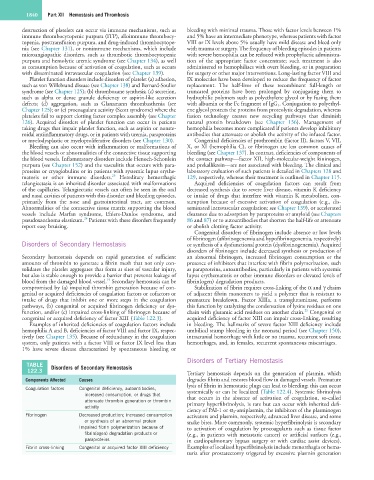
        congenital or acquired deficiency of factor XIII (Table 122.3).  acquired deficiency of factor XIII can impair cross-linking, resulting
           Examples of inherited deficiencies of coagulation factors include   in bleeding. The hallmarks of severe factor XIII deficiency include
        hemophilia A and B, deficiencies of factor VIII and factor IX, respec-  umbilical stump bleeding in the neonatal period (see Chapter 150),
        tively (see Chapter 135). Because of redundancy in the coagulation   intracranial hemorrhage with little or no trauma, recurrent soft tissue
        system, only patients with a factor VIII or factor IX level less than   hemorrhages, and, in females, recurrent spontaneous miscarriages.
        1%  have  severe  disease  characterized  by  spontaneous  bleeding  or

                                                              Disorders of Tertiary Hemostasis
          TABLE   Disorders of Secondary Hemostasis
          122.3                                               Tertiary  hemostasis  depends  on  the  generation  of  plasmin,  which
         Components Affected  Causes                          degrades fibrin and restores blood flow in damaged vessels. Premature
                                                              lysis of fibrin in hemostatic plugs can lead to bleeding; this can occur
         Coagulation factors  Congenital deficiency, autoantibodies,   systemically or can be localized (Table 122.4). Systemic fibrinolysis
                             increased consumption, or drugs that   that  occurs  in  the  absence  of  activation  of  coagulation,  so-called
                             attenuate thrombin generation or thrombin   primary hyperfibrinolysis, is rare but can occur with inherited defi-
                             activity
                                                              ciency of PAI-1 or α 2-antiplasmin, the inhibitors of the plasminogen
         Fibrinogen        Decreased production; increased consumption   activators and plasmin, respectively, advanced liver disease, and some
                             or synthesis of an abnormal protein  snake bites. More commonly, systemic hyperfibrinolysis is secondary
                           Impaired fibrin polymerization because of   to activation of coagulation by procoagulants such as tissue factor
                             fibrin(ogen) degradation products or   (e.g., in patients with metastatic cancer) or artificial surfaces (e.g.,
                             paraproteins                     in  cardiopulmonary  bypass  surgery  or  with  cardiac  assist  devices).
         Fibrin cross-linking  Congenital or acquired factor XIII deficiency  Examples of localized hyperfibrinolysis include menorrhagia or hema-
                                                              turia after prostatectomy triggered by excessive plasmin generation

