


Page 2070 - Hematology_ Basic Principles and Practice ( PDFDrive )
P. 2070
Chapter 122  Overview of Hemostasis and Thrombosis  1839


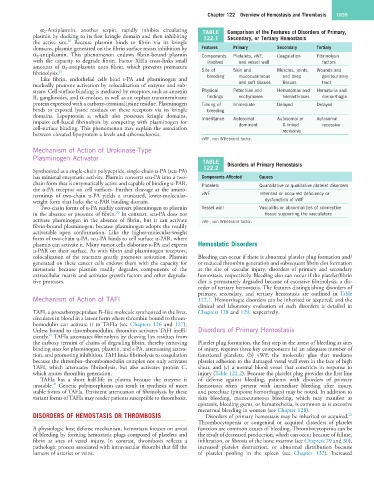
              α 2-Antiplasmin,  another  serpin,  rapidly  inhibits  circulating   TABLE   Comparison of the Features of Disorders of Primary,
            plasmin by docking to its first kringle domain and then inhibiting   122.1  Secondary, or Tertiary Hemostasis
                       20
            the  active  site.   Because  plasmin  binds  to  fibrin  via  its  kringle
            domains, plasmin generated on the fibrin surface resists inhibition by   Features  Primary  Secondary  Tertiary
            α 2-antiplasmin.  This  phenomenon  endows  fibrin-bound  plasmin   Components   Platelets, vWF,   Coagulation  Fibrinolysis
            with  the  capacity  to  degrade  fibrin.  Factor  XIIIa  cross-links  small   involved  and vessel wall  factors
            amounts  of  α 2-antiplasmin  onto  fibrin,  which  prevents  premature
            fibrinolysis. 19                                       Site of   Skin and       Muscles, joints,   Wounds and
              Like  fibrin,  endothelial  cells  bind  t-PA  and  plasminogen  and   bleeding  mucocutaneous   and deep   genitourinary
            markedly promote activation by colocalization of enzyme and sub-   and soft tissues  tissues  tract
            strate. Cell-surface binding is mediated by receptors such as annexin   Physical   Petechiae and   Hematomas and   Hematuria and
            II, gangliosides, and α-enolase, as well as an orphan transmembrane   findings  ecchymoses  hemarthroses  menorrhagia
            protein expressed with a carboxy-terminal lysine residue. Plasminogen   Timing of   Immediate  Delayed  Delayed
            binds  to  exposed  lysine  residues  on  these  receptors  via  its  kringle   bleeding
            domains.  Lipoprotein  a,  which  also  possesses  kringle  domains,   Inheritance  Autosomal   Autosomal or   Autosomal
            impairs  cell-based  fibrinolysis  by  competing  with  plasminogen  for   dominant  X-linked   recessive
            cell-surface binding. This phenomenon may explain the association                recessive
            between elevated lipoprotein a levels and atherosclerosis.
                                                                   vWF, von Willebrand factor.
            Mechanism of Action of Urokinase-Type
            Plasminogen Activator
                                                                   TABLE   Disorders of Primary Hemostasis
                                                                    122.2
            Synthesized as a single-chain polypeptide, single-chain u-PA (scu-PA)
            has minimal enzymatic activity. Plasmin converts scu-PA into a two-  Components Affected  Causes
            chain form that is enzymatically active and capable of binding u-PAR,   Platelets  Quantitative or qualitative platelet disorders
            the u-PA receptor on cell surfaces. Further cleavage at the amino-
            terminus  of  two-chain  u-PA  yields  a  truncated,  lower-molecular-  vWF  Inherited or acquired deficiency or
            weight form that lacks the u-PAR binding domain.                            dysfunction of vWF
              Two-chain forms of u-PA readily convert plasminogen to plasmin   Vessel wall  Vasculitis or abnormalities of connective
                                       20
            in the absence or presence of fibrin.  In contrast, scu-PA does not         tissue supporting the vasculature
            activate  plasminogen  in  the  absence  of  fibrin,  but  it  can  activate   vWF, von Willebrand factor.
            fibrin-bound plasminogen, because plasminogen adopts the readily
            activatable  open  conformation.  Like  the  higher-molecular-weight
            form of two-chain u-PA, scu-PA binds to cell surface u-PAR, where
            plasmin can activate it. Many tumor cells elaborate u-PA and express   Hemostatic Disorders
            u-PAR on their surface. As with fibrin and plasminogen receptors,
            colocalization of the reactants greatly promotes activation. Plasmin   Bleeding can occur if there is abnormal platelet plug formation and/
            generated on these cancer cells endows them with the capacity for   or reduced thrombin generation and subsequent fibrin clot formation
            metastasis  because  plasmin  readily  degrades  components  of  the   at  the  site  of  vascular  injury;  disorders  of  primary  and  secondary
            extracellular matrix and activates growth factors and other degrada-  hemostasis, respectively. Bleeding also can occur if the platelet/fibrin
            tive proteases.                                       clot is prematurely degraded because of excessive fibrinolysis; a dis-
                                                                  order of tertiary hemostasis. The features distinguishing disorders of
                                                                  primary,  secondary,  and  tertiary  hemostasis  are  outlined  in  Table
            Mechanism of Action of TAFI                           122.1. Hemorrhagic disorders can be inherited or acquired, and the
                                                                  clinical  and  laboratory  evaluation  of  such  disorders  is  detailed  in
            TAFI, a procarboxypeptidase B–like molecule synthesized in the liver,   Chapters 128 and 129, respectively.
            circulates in blood in a latent form where thrombin bound to throm-
            bomodulin  can  activate  it  to TAFIa  (see  Chapters  126  and  127).
            Unless bound to thrombomodulin, thrombin activates TAFI ineffi-  Disorders of Primary Hemostasis
                 21
            ciently.  TAFIa attenuates fibrinolysis by cleaving Lys residues from
            the carboxy termini of chains of degrading fibrin, thereby removing   Platelet plug formation, the first step in the arrest of bleeding at sites
            binding sites for plasminogen, plasmin, and t-PA, attenuating activa-  of injury, requires three key components (a) an adequate number of
            tion, and promoting inhibition. TAFI links fibrinolysis to coagulation   functional  platelets,  (b)  vWF,  the  molecular  glue  that  mediates
            because the thrombin–thrombomodulin complex not only activates   platelet adhesion to the damaged vessel wall even in the face of high
            TAFI,  which  attenuates  fibrinolysis,  but  also  activates  protein  C,   shear, and (c) a normal blood vessel that constricts in response to
            which mutes thrombin generation.                      injury (Table 122.2). Because the platelet plug provides the first line
              TAFIa  has  a  short  half-life  in  plasma  because  the  enzyme  is   of  defense  against  bleeding,  patients  with  disorders  of  primary
                  21
            unstable.  Genetic polymorphisms can result in synthesis of more   hemostasis  often  present  with  immediate  bleeding  after  injury,
            stable forms of TAFIa. Persistent attenuation of fibrinolysis by these   and petechiae (pinpoint hemorrhages) may be noted. In addition to
            variant forms of TAFIa may render patients susceptible to thrombosis.  skin  bleeding,  mucocutaneous  bleeding,  which  may  manifest  as
                                                                  epistaxis, bleeding gums, or hematochezia, is common as is excessive
                                                                  menstrual bleeding in women (see Chapter 128).
            DISORDERS OF HEMOSTASIS OR THROMBOSIS                   Disorders of primary hemostasis may be inherited or acquired.
                                                                                                                   22
                                                                  Thrombocytopenia  or  congenital  or  acquired  disorders  of  platelet
            A physiologic host defense mechanism, hemostasis focuses on arrest   function are common causes of bleeding. Thrombocytopenia can be
            of bleeding by forming hemostatic plugs composed of platelets and   the result of decreased production, which can occur because of failure,
            fibrin  at  sites  of  vessel  injury.  In  contrast,  thrombosis  reflects  a   infiltration, or fibrosis of the bone marrow (see Chapters 29 and 30),
            pathologic process associated with intravascular thrombi that fill the   increased  platelet  destruction,  or  abnormal  distribution  because
            lumens of arteries or veins.                          of  platelet  pooling  in  the  spleen  (see  Chapter  132).  Increased

