


Page 2069 - Hematology_ Basic Principles and Practice ( PDFDrive )
P. 2069
1838   Part XII  Hemostasis and Thrombosis


                                  COOH            NH 2  NH 2          COOH
                               Aα                  FPA  FPA               Aα
                                 Bβ                FPB  FPB             Bβ   Fibrinogen
                                   γ                                    γ


                                     D domain  Colied  E domain  Colied  D domain
                                             coil            coil

                                           D         E         D             Fibrinogen


                                              Thrombin    FPA, FPB


                                           D         E         D          Fibrin monomer


                                   D       E       D   D       E        D
                                                                             Fibrin polymer
                                 E       D   D       E        D  D        E

                                             Factor XIIIa


                                   D       E       D   D       E        D    Cross-linked
                                                                             fibrin polymer
                                 E        D  D       E        D  D        E

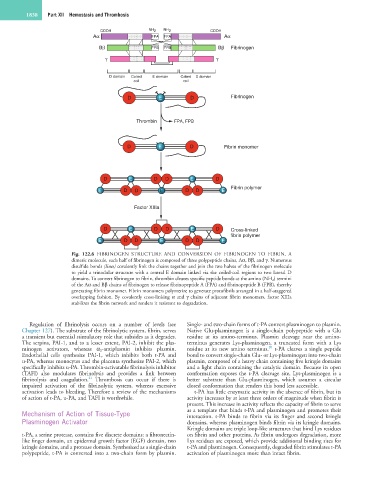
                        Fig.  122.6  FIBRINOGEN  STRUCTURE  AND  CONVERSION  OF  FIBRINOGEN  TO  FIBRIN.  A
                        dimeric molecule, each half of fibrinogen is composed of three polypeptide chains, Aα, Bβ, and γ. Numerous
                        disulfide bonds (lines) covalently link the chains together and join the two halves of the fibrinogen molecule
                        to yield a trinodular structure with a central E domain linked via the coiled-coil regions to two lateral D
                        domains. To convert fibrinogen to fibrin, thrombin cleaves specific peptide bonds at the amino (NH 2) termini
                        of the Aα and Bβ chains of fibrinogen to release fibrinopeptide A (FPA) and fibrinopeptide B (FPB), thereby
                        generating fibrin monomer. Fibrin monomers polymerize to generate protofibrils arranged in a half-staggered
                        overlapping fashion. By covalently cross-linking α and γ chains of adjacent fibrin monomers, factor XIIIa
                        stabilizes the fibrin network and renders it resistant to degradation.


           Regulation  of  fibrinolysis  occurs  on  a  number  of  levels  (see   Single- and two-chain forms of t-PA convert plasminogen to plasmin.
        Chapter 127). The substrate of the fibrinolytic system, fibrin, serves   Native  Glu-plasminogen  is  a  single-chain  polypeptide  with  a  Glu
        a transient but essential stimulatory role that subsides as it degrades.   residue  at  its  amino-terminus.  Plasmin  cleavage  near  the  amino-
        The serpins, PAI-1, and to a lesser extent, PAI-2, inhibit the plas-  terminus  generates  Lys-plasminogen,  a  truncated  form  with  a  Lys
                                                                                         20
        minogen  activators,  whereas  α 2 -antiplasmin  inhibits  plasmin.   residue  at  its  new  amino  terminus.   t-PA  cleaves  a  single  peptide
        Endothelial  cells  synthesize  PAI-1,  which  inhibits  both  t-PA  and   bond to convert single-chain Glu- or Lys-plasminogen into two-chain
        u-PA, whereas monocytes and the placenta synthesize PAI-2, which   plasmin, composed of a heavy chain containing five kringle domains
        specifically inhibits u-PA. Thrombin-activatable fibrinolysis inhibitor   and a light chain containing the catalytic domain. Because its open
        (TAFI)  also  modulates  fibrinolysis  and  provides  a  link  between   conformation  exposes  the  t-PA  cleavage  site,  Lys-plasminogen  is  a
                              21
        fibrinolysis  and  coagulation.   Thrombosis  can  occur  if  there  is   better  substrate  than  Glu-plasminogen,  which  assumes  a  circular
        impaired  activation  of  the  fibrinolytic  system,  whereas  excessive   closed conformation that renders this bond less accessible.
        activation leads to bleeding. Therefore a review of the mechanisms   t-PA has little enzymatic activity in the absence of fibrin, but its
        of action of t-PA, u-PA, and TAFI is worthwhile.      activity increases by at least three orders of magnitude when fibrin is
                                                              present. This increase in activity reflects the capacity of fibrin to serve
        Mechanism of Action of Tissue-Type                    as a template that binds t-PA and plasminogen and promotes their
                                                              interaction.  t-PA  binds  to  fibrin  via  its  finger  and  second  kringle
        Plasminogen Activator                                 domains, whereas plasminogen binds fibrin via its kringle domains.
                                                              Kringle domains are triple loop-like structures that bind Lys residues
        t-PA, a serine protease, contains five discrete domains: a fibronectin-  on fibrin and other proteins. As fibrin undergoes degradation, more
        like finger domain, an epidermal growth factor (EGF) domain, two   Lys residues are exposed, which provide additional binding sites for
        kringle domains, and a protease domain. Synthesized as a single-chain   t-PA and plasminogen. Consequently, degraded fibrin stimulates t-PA
        polypeptide,  t-PA  is  converted  into  a  two-chain  form  by  plasmin.   activation of plasminogen more than intact fibrin.

