


Page 2110 - Hematology_ Basic Principles and Practice ( PDFDrive )
P. 2110
Chapter 125  Molecular Basis of Platelet Function  1873


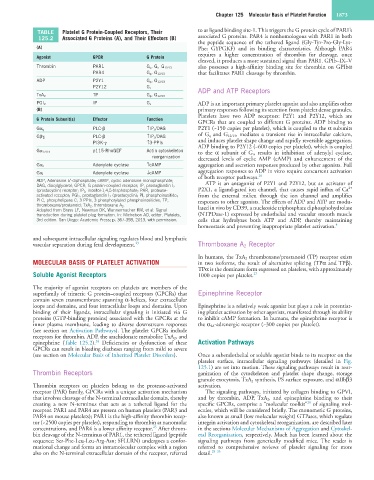
             TABLE   Platelet G Protein-Coupled Receptors, Their   to as ligand binding site-1. This triggers the G protein cycle of PAR1’s
              125.2  Associated G Proteins (A), and Their Effectors (B)  associated G proteins. PAR4 is nonhomologous with PAR1 in both
                                                                  the peptide sequence of the tethered ligand (Gly-Tyr-Pro-Gly-Lys-
             (A)                                                  Phe;  GYPGKF)  and  its  binding  characteristics.  Although  PAR4
                                                                  requires  a  higher  concentration  of  thrombin  for  cleavage,  once
             Agonist           GPCR              G Protein
                                                                  cleaved, it produces a more sustained signal than PAR1. GPIb–IX–V
             Thrombin          PAR1              G q , G i , G 12/13  also possesses a high-affinity binding site for  thrombin on GPIbα
                               PAR4              G q , G 12/13    that facilitates PAR1 cleavage by thrombin.
             ADP               P2Y1              G q , G 12/13
                               P2Y12             G i              ADP and ATP Receptors
                               TP
             TxA 2                               G q , G 12/13
                               IP
             PGI 2                               G s              ADP is an important primary platelet agonist and also amplifies other
             (B)                                                  primary responses following its secretion from platelet dense granules.
                                                                  Platelets  have  two  ADP  receptors:  P2Y1  and  P2Y12,  which  are
             G Protein Subunit(s)  Effector      Function
                                                                  GPCRs that are coupled to different G proteins. ADP binding to
                               PLC-β             ↑IP 3 /DAG       P2Y1 (~150 copies per platelet), which is coupled to the α subunits
             Gα q
                               PLC-β             ↑IP 3 /DAG       of G q and G 12/13 , mediates a transient rise in intracellular calcium,
             Gβγ i                                                and induces platelet shape change and rapidly reversible aggregation.
                               PI3K-γ            ↑3-PPIs
                                                                  ADP binding to P2Y12 (~600 copies per platelet), which is coupled
                               p115-RhoGEF       Actin cytoskeleton
             Gα 12/13                                             to  the  α  subunit  of  G i ,  results  in  inhibition  of  adenylyl  cyclase,
                                                   reorganization  decreased  levels  of  cyclic  AMP  (cAMP)  and  enhancement  of  the
                               Adenylate cyclase  ↑cAMP           aggregation and secretion responses produced by other agonists. Full
             Gα s
                               Adenylate cyclase  ↓cAMP           aggregation responses to ADP in vitro require concurrent activation
             Gα i                                                                     26
                                                                  of both receptor pathways.
             ADP, Adenosine 5′-diphosphate; cAMP, cyclic adenosine monophosphate;   ATP  is  an  antagonist  of  P2Y1  and  P2Y12,  but  an  activator  of
             DAG, diacylglycerol; GPCR; G protein-coupled receptor; IP, prostaglandin I 2                          2+
             (prostacyclin) receptor; IP 3 , inositol-1,4,5-trisphosphate; PAR, protease-  P2X1, a ligand-gated ion channel, that causes rapid influx of Ca
             activated receptor; PGI 2 , prostaglandin I 2  (prostacyclin); PI, phosphoinositide;   from  the  external  milieu  through  the  ion  channel  and  amplifies
             PLC, phospholipase C; 3-PPIs, 3-phosphorylated phosphoinositides; TP,   responses to other agonists. The effects of ADP and ATP are modu-
             thromboxane/prostanoid; TxA 2 , thromboxane A 2 .    lated in vivo by CD39, a nucleoside triphosphate diphosphohydrolase
             Adapted from Brass LF, Newman DK, Wannermacher KM, et al: Signal
             transduction during platelet plug formation. In: Michelson AD, editor. Platelets,   (NTPDase-1) expressed by endothelial and vascular smooth muscle
             3rd edition. San Diego: Academic Press; p. 367-398, 2013, with permission.  cells  that  hydrolyzes  both  ATP  and  ADP,  thereby  maintaining
                                                                  homeostasis and preventing inappropriate platelet activation. 4
            and subsequent intracellular signaling regulates blood and lymphatic
            vascular separation during fetal development. 23      Thromboxane A 2  Receptor
                                                                  In humans, the TxA 2  thromboxane/prostanoid (TP) receptor exists
            MOLECULAR BASIS OF PLATELET ACTIVATION                in two isoforms, the result of alternative splicing (TPα and TPβ).
                                                                  TPα is the dominant form expressed on platelets, with approximately
            Soluble Agonist Receptors                             1000 copies per platelet. 27
            The majority of agonist receptors on platelets are members of the
            superfamily of trimeric G protein–coupled receptors (GPCRs) that   Epinephrine Receptor
            contain seven transmembrane spanning α-helices, four extracellular
            loops and domains, and four intracellular loops and domains. Upon   Epinephrine is a relatively weak agonist but plays a role in potentiat-
            binding  of  their  ligands,  intracellular  signaling  is  initiated  via  G   ing platelet activation by other agonists, manifested through its ability
            proteins (GTP-binding proteins) associated with the GPCRs at the   to inhibit cAMP formation. In humans, the epinephrine receptor is
            inner  plasma  membrane,  leading  to  diverse  downstream  responses   the α 2A -adrenergic receptor (~300 copies per platelet).
            (see section on Activation Pathways). The platelet GPCRs include
            receptors for thrombin, ADP, the arachidonate metabolite TxA 2 , and
                                24
            epinephrine  (Table  125.2).   Deficiencies  or  dysfunction  of  these   Activation Pathways
            GPCRs can result in bleeding diatheses ranging from mild to severe
            (see section on Molecular Basis of Inherited Platelet Disorders).  Once a subendothelial or soluble agonist binds to its receptor on the
                                                                  platelet  surface,  intracellular  signaling  pathways  (detailed  in  Fig.
                                                                  125.1) are set into motion. These signaling pathways result in reor-
            Thrombin Receptors                                    ganization  of  the  cytoskeleton  and  platelet  shape  change,  storage
                                                                  granule exocytosis, TxA 2  synthesis, PS surface exposure, and αIIbβ3
            Thrombin  receptors  on  platelets  belong  to  the  protease-activated   activation.
            receptor (PAR) family, GPCRs with a unique activation mechanism   The signaling pathways, initiated by collagen binding to GPVI,
            that involves cleavage of the N-terminal extracellular domain, thereby   and  by  thrombin,  ADP,  TxA 2 ,  and  epinephrine  binding  to  their
                                                                                                      28
            creating  a  new  N-terminus  that  acts  as  a  tethered  ligand  for  the   specific GPCRs, comprise a “molecular toolkit”  of signaling mol-
            receptor. PAR1 and PAR4 are present on human platelets (PAR3 and   ecules, which will be considered briefly. The monomeric G proteins,
            PAR4 on mouse platelets); PAR1 is the high-affinity thrombin recep-  also known as small (low molecular weight) GTPases, which regulate
            tor (~2500 copies per platelet), responding to thrombin at nanomolar   integrin activation and cytoskeletal reorganization, are described later
                                                   25
            concentrations, and PAR4 is a lower affinity receptor.  After throm-  in the sections Molecular Mechanisms of Aggregation and Cytoskel-
            bin cleavage of the N-terminus of PAR1, the tethered ligand (peptide   etal Reorganization, respectively. Much has been learned about the
            sequence: Ser-Phe-Leu-Leu-Arg-Asn; SFLLRN) undergoes a confor-  signaling  pathways  from  genetically  modified  mice.  The  reader  is
            mational change and forms an intramolecular complex with a region   referred  to  comprehensive  reviews  of  platelet  signaling  for  more
            also on the N-terminal extracellular domain of the receptor, referred   detail. 28–35

