


Page 2166 - Hematology_ Basic Principles and Practice ( PDFDrive )
P. 2166
Chapter 128  Clinical Approach to the Patient With Bleeding or Bruising  1919


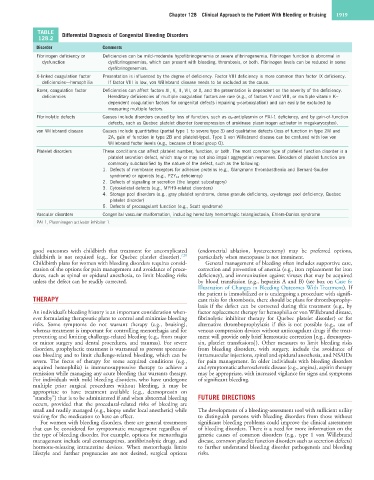
             TABLE   Differential Diagnosis of Congenital Bleeding Disorders
              128.2
             Disorder              Comments
             Fibrinogen deficiency or   Deficiencies can be mild-moderate hypofibrinogenemia or severe afibrinogenemia. Fibrinogen function is abnormal in
               dysfunction          dysfibrinogenemias, which can present with bleeding, thrombosis, or both. Fibrinogen levels can be reduced in some
                                    dysfibrinogenemias.
             X-linked coagulation factor   Presentation is influenced by the degree of deficiency. Factor VIII deficiency is more common than factor IX deficiency.
               deficiencies—hemophilia  If factor VIII is low, von Willebrand disease needs to be excluded as the cause.
             Rarer, coagulation factor   Deficiencies can affect factors XI, V, II, VII, or X, and the presentation is dependent on the severity of the deficiency.
               deficiencies         Hereditary deficiencies of multiple coagulation factors are rare (e.g., of factors V and VIII, or multiple vitamin K–
                                    dependent coagulation factors for congenital defects impairing γ-carboxylation) and can easily be excluded by
                                    measuring multiple factors.
             Fibrinolytic defects  Causes include disorders caused by loss of function, such as α 2 -antiplasmin or PAI-1 deficiency, and by gain-of-function
                                    defects, such as Quebec platelet disorder (overexpression of urokinase plasminogen activator in megakaryocytes).
             von Willebrand disease  Causes include quantitative (partial type 1 to severe type 3) and qualitative defects (loss of function in type 2M and
                                    2A, gain of function in type 2B and platelet-type). Type 1 von Willebrand disease can be confused with low von
                                    Willebrand factor levels (e.g., because of blood group O).
             Platelet disorders    These conditions can affect platelet number, function, or both. The most common type of platelet function disorder is a
                                    platelet secretion defect, which may or may not also impair aggregation responses. Disorders of platelet function are
                                    commonly subclassified by the nature of the defect, such as the following:
                                   1.  Defects of membrane receptors for adhesive proteins (e.g., Glanzmann thrombasthenia and Bernard-Soulier
                                     syndrome) or agonists (e.g., P2Y 12  deficiency)
                                   2.  Defects of signaling or secretion (the largest subcategory)
                                   3.  Cytoskeletal defects (e.g., MYH9-related disorders)
                                   4.  Storage pool disorders (e.g., gray platelet syndrome, dense granule deficiency, αγ-storage pool deficiency, Quebec
                                     platelet disorder)
                                   5.  Defects of procoagulant function (e.g., Scott syndrome)
             Vascular disorders    Congenital vascular malformation, including hereditary hemorrhagic telangiectasia, Ehlers-Danlos syndrome
             PAI-1, Plasminogen activator inhibitor 1.


            good  outcomes  with  childbirth  that  treatment  for  uncomplicated   (endometrial  ablation,  hysterectomy)  may  be  preferred  options,
            childbirth  is  not  required  (e.g.,  for  Quebec  platelet  disorder). 7,28    particularly when menopause is not imminent.
            Childbirth plans for women with bleeding disorders requires consid-  General management of bleeding often includes supportive care,
            eration of the options for pain management and avoidance of proce-  correction and prevention of anemia (e.g., iron replacement for iron
            dures, such as spinal or epidural anesthesia, to limit bleeding risks   deficiency), and immunization against viruses that may be acquired
            unless the defect can be readily corrected.           by blood transfusion (e.g., hepatitis A and B) (see box on Case 6:
                                                                  Illustration of Changes in Bleeding Outcomes With Treatment). If
                                                                  the patient is immobilized or is undergoing a procedure with signifi-
            THERAPY                                               cant risks for thrombosis, there should be plans for thromboprophy-
                                                                  laxis  if  the  defect  can  be  corrected  during  this  treatment  (e.g.,  by
            An individual’s bleeding history is an important consideration when-  factor replacement therapy for hemophilia or von Willebrand disease,
            ever formulating therapeutic plans to control and minimize bleeding   fibrinolytic  inhibitor  therapy  for  Quebec  platelet  disorder)  or  for
            risks.  Some  symptoms  do  not  warrant  therapy  (e.g.,  bruising),   alternative  thromboprophylaxis  if  this  is  not  possible  (e.g.,  use  of
            whereas treatment is important for controlling menorrhagia and for   venous compression devices without anticoagulant drugs if the treat-
            preventing and limiting challenge-related bleeding (e.g., from major   ment will provide only brief hemostatic correction [e.g., desmopres-
            or  minor  surgery  and  dental  procedures,  and  traumas).  For  severe   sin,  platelet  transfusions]).  Other  measures  to  limit  bleeding  risks
            disorders, prophylactic treatment is warranted to prevent spontane-  from  bleeding  disorders,  with  surgery,  include  the  avoidance  of
            ous bleeding and to limit challenge-related bleeding, which can be   intramuscular injections, spinal and epidural anesthesia, and NSAIDs
            severe.  The  focus  of  therapy  for  some  acquired  conditions  (e.g.,   for pain management. In older individuals with bleeding disorders
            acquired  hemophilia)  is  immunosuppressive  therapy  to  achieve  a   and symptomatic atherosclerotic disease (e.g., angina), aspirin therapy
            remission while managing any acute bleeding that warrants therapy.   may be appropriate, with increased vigilance for signs and symptoms
            For individuals with mild bleeding disorders, who have undergone   of significant bleeding.
            multiple  prior  surgical  procedures  without  bleeding,  it  may  be
            appropriate  to  have  treatment  available  (e.g.,  desmopressin  on
            “standby”) that is to be administered if and when abnormal bleeding   FUTURE DIRECTIONS
            occurs,  provided  that  the  procedural-related  risks  of  bleeding  are
            small and readily managed (e.g., biopsy under local anesthetic) while   The development of a bleeding-assessment tool with sufficient utility
            waiting for the medication to have an effect.         to distinguish persons with bleeding disorders from those without
              For women with bleeding disorders, there are general treatments   significant bleeding problems could improve the clinical assessment
            that can be considered for symptomatic management regardless of   of bleeding disorders. There is a need for more information on the
            the type of bleeding disorder. For example, options for menorrhagia   genetic  causes  of  common  disorders  (e.g.,  type  1  von  Willebrand
            management include oral contraceptives, antifibrinolytic drugs, and   disease, common platelet function disorders such as secretion defects)
            hormone-releasing  intrauterine  devices.  When  menorrhagia  limits   to further understand bleeding disorder pathogenesis and bleeding
            lifestyle  and  further  pregnancies  are  not  desired,  surgical  options   risks.

