


Page 2167 - Hematology_ Basic Principles and Practice ( PDFDrive )
P. 2167
1920   Part XII  Hemostasis and Thrombosis


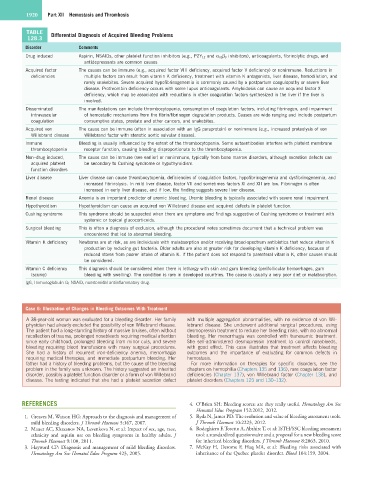
          TABLE   Differential Diagnosis of Acquired Bleeding Problems
          128.3
         Disorder          Comments
         Drug induced      Aspirin, NSAIDs, other platelet function inhibitors (e.g., P2Y 12  and α IIb β 3  inhibitors), anticoagulants, fibrinolytic drugs, and
                             antidepressants are common causes
         Acquired factor   The causes can be immune (e.g., acquired factor VIII deficiency, acquired factor V deficiency) or nonimmune. Reductions in
           deficiencies      multiple factors can result from vitamin K deficiency, treatment with vitamin K antagonists, liver disease, hemodilution, and
                             rarely snakebites. Severe acquired hypofibrinogenemia is commonly caused by a postpartum coagulopathy or severe liver
                             disease. Prothrombin deficiency occurs with some lupus anticoagulants. Amyloidosis can cause an acquired factor X
                             deficiency, which may be associated with reductions in other coagulation factors synthesized in the liver if the liver is
                             involved.
         Disseminated      The manifestations can include thrombocytopenia, consumption of coagulation factors, including fibrinogen, and impairment
           intravascular     of hemostatic mechanisms from the fibrin/fibrinogen degradation products. Causes are wide ranging and include postpartum
           coagulation       consumptive states, prostate and other cancers, and snakebites.
         Acquired von      The cause can be immune (often in association with an IgG paraprotein) or nonimmune (e.g., increased proteolysis of von
           Willebrand disease  Willebrand factor with stenotic aortic valvular disease).
         Immune            Bleeding is usually influenced by the extent of the thrombocytopenia. Some autoantibodies interfere with platelet membrane
           thrombocytopenia  receptor function, causing bleeding disproportionate to the thrombocytopenia.
         Non–drug induced,   The cause can be immune (see earlier) or nonimmune, typically from bone marrow disorders, although secretion defects can
           acquired platelet   be secondary to Cushing syndrome or hypothyroidism.
           function disorders
         Liver disease     Liver disease can cause thrombocytopenia, deficiencies of coagulation factors, hypofibrinogenemia and dysfibrinogenemia, and
                             increased fibrinolysis. In mild liver disease, factor VII and sometimes factors XI and XII are low. Fibrinogen is often
                             increased in early liver disease, and if low, the finding suggests severe liver disease.
         Renal disease     Anemia is an important predictor of uremic bleeding. Uremic bleeding is typically associated with severe renal impairment.
         Hypothyroidism    Hypothyroidism can cause an acquired von Willebrand disease and acquired defects in platelet function.
         Cushing syndrome  This syndrome should be suspected when there are symptoms and findings suggestive of Cushing syndrome or treatment with
                             systemic or topical glucocorticoids.
         Surgical bleeding  This is often a diagnosis of exclusion, although the procedural notes sometimes document that a technical problem was
                             encountered that led to abnormal bleeding.
         Vitamin K deficiency  Newborns are at risk, as are individuals with malabsorption and/or receiving broad-spectrum antibiotics that reduce vitamin K
                             production by reducing gut bacteria. Older adults are also at greater risk for developing vitamin K deficiency, because of
                             reduced stores from poorer intake of vitamin K. If the patient does not respond to parenteral vitamin K, other causes should
                             be considered.
         Vitamin C deficiency   This diagnosis should be considered when there is lethargy with skin and gum bleeding (perifollicular hemorrhages, gum
           (scurvy)          bleeding with swelling). The condition is rare in developed countries. The cause is usually a very poor diet or malabsorption.
         IgG, Immunoglobulin G; NSAID, nonsteroidal antiinflammatory drug.


         Case 6: Illustration of Changes in Bleeding Outcomes With Treatment
          A 38-year-old woman was evaluated for a bleeding disorder. Her family   with  multiple  aggregation  abnormalities,  with  no  evidence  of  von  Wil-
          physician had already excluded the possibility of von Willebrand disease.   lebrand  disease.  She  underwent  additional  surgical  procedures,  using
          The patient had a long-standing history of massive bruises, often without   desmopressin treatment to reduce her bleeding risks, with no abnormal
          recollection of trauma, prolonged nosebleeds requiring medical attention   bleeding.  Her  menorrhagia  was  controlled  with  tranexamic  treatment.
          since early childhood, prolonged bleeding from minor cuts, and severe   She  self-administered  desmopressin  treatment  to  control  nosebleeds,
          bleeding  requiring  blood  transfusions  with  many  surgical  procedures.   with  good  effect.  This  case  illustrates  that  treatment  affects  bleeding
          She  had  a  history  of  recurrent  iron-deficiency  anemia,  menorrhagia   outcomes  and  the  importance  of  evaluating  for  common  defects  in
          requiring  medical  therapies,  and  immediate  postpartum  bleeding.  Her   hemostasis.
          father had a history of bleeding problems, but the cause of the bleeding   For  more  information  on  therapies  for  specific  disorders,  see  the
          problem in the family was unknown. The history suggested an inherited   chapters on hemophilia (Chapters 135 and 136), rare coagulation factor
          disorder, possibly a platelet function disorder or a form of von Willebrand   deficiencies  (Chapter  137),  von  Willebrand  factor  (Chapter  138),  and
          disease. The testing indicated that she had a platelet secretion defect   platelet disorders (Chapters 125 and 130–132).


        REFERENCES                                             4.  O’Brien SH: Bleeding scores: are they really useful. Hematology Am Soc
                                                                 Hematol Educ Program 152:2012, 2012.
         1.  Greaves M, Watson HG: Approach to the diagnosis and management of   5.  Rydz N, James PD: The evolution and value of bleeding assessment tools.
           mild bleeding disorders. J Thromb Haemost 5:167, 2007.  J Thromb Haemost 10:2223, 2012.
         2.  Mauer AC, Khazanov NA, Levenkova N, et al: Impact of sex, age, race,   6.  Rodeghiero F, Tosetto A, Abshire T, et al: ISTH/SSC bleeding assessment
           ethnicity  and  aspirin  use  on  bleeding  symptoms  in  healthy  adults.  J   tool: a standardized questionnaire and a proposal for a new bleeding score
           Thromb Haemost 9:100, 2011.                           for inherited bleeding disorders. J Thromb Haemost 8:2063, 2010.
         3.  Hayward CP: Diagnosis and management of mild bleeding disorders.   7.  McKay  H,  Derome  F,  Haq  MA,  et al:  Bleeding  risks  associated  with
           Hematology Am Soc Hematol Educ Program 423, 2005.     inheritance of the Quebec platelet disorder. Blood 104:159, 2004.

