


Page 2206 - Hematology_ Basic Principles and Practice ( PDFDrive )
P. 2206
Chapter 131  Diseases of Platelet Number  1953


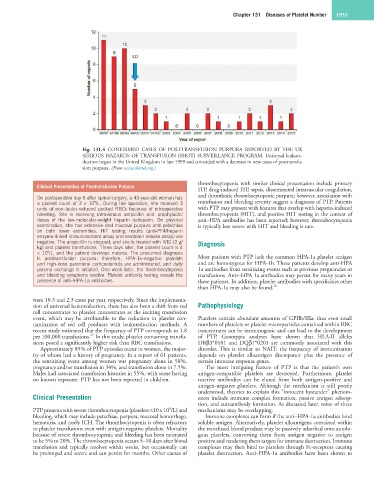
                            Fig.  131.4  CONFIRMED  CASES  OF  POSTTRANSFUSION  PURPURA  REPORTED  BY THE  UK
                            SERIOUS HAZARDS OF TRANSFUSION (SHOT) SURVEILLANCE PROGRAM. Universal leukore-
                            duction began in the United Kingdom in late 1999 and coincided with a decrease in new cases of posttransfu-
                            sion purpura. (From www.shotuk.org.)

                                                                  thrombocytopenia with similar clinical presentation include primary
             Clinical Presentation of Posttransfusion Purpura
                                                                  ITP, drug-induced ITP, sepsis, disseminated intravascular coagulation,
             On postoperative day 8 after spinal surgery, a 43-year-old woman has   and thrombotic thrombocytopenic purpura; however, association with
             a  platelet  count  of  3  ×  10 /L.  During  the  operation,  she  received  3   transfusion and bleeding severity suggest a diagnosis of PTP. Patients
                                9
             units  of  non–leuko-reduced  packed  RBCs  because  of  intraoperative   with PTP may present with features that overlap with heparin-induced
             bleeding.  She  is  receiving  intravenous  ampicillin  and  prophylactic   thrombocytopenia (HIT), and positive HIT testing in the context of
             doses  of  the  low-molecular-weight  heparin  dalteparin.  On  physical   anti–HPA antibodies has been reported; however, thrombocytopenia
             examination, she has extensive oral mucosal purpura and petechiae   is typically less severe with HIT and bleeding is rare.
             on  both  lower  extremities.  HIT  testing  results  (anti-PF4/heparin
             enzyme-linked immunosorbent assay and serotonin release assay) are
             negative. The ampicillin is stopped, and she is treated with IVIG (2 g/  Diagnosis
             kg) and platelet transfusions. Three days later, the platelet count is 4
                 9
             ×  10 /L,  and  the  patient  develops  melena.  The  presumed  diagnosis
             is  posttransfusion  purpura;  therefore,  HPA-1a–negative  platelets   Most patients with PTP lack the common HPA-1a platelet antigen
             and high-dose parenteral corticosteroids are administered, and daily   and are homozygous for HPA-1b. These patients develop anti-HPA
             plasma exchange is initiated. One week later, the thrombocytopenia   1a antibodies from sensitizing events such as previous pregnancies or
             and bleeding symptoms resolve. Platelet antibody testing reveals the   transfusions. Anti–HPA 1a antibodies may persist for many years in
             presence of anti–HPA-1a antibodies.                  these patients. In addition, platelet antibodies with specificities other
                                                                  than HPA-1a may also be found. 28
            were 10.3 and 2.3 cases per year, respectively. Since the implementa-
            tion of universal leukoreduction, there has also been a shift from red   Pathophysiology
            cell concentrates to platelet concentrates as the inciting transfusion
            event, which may be attributable to the reduction in platelet con-  Platelets contain abundant amounts of GPIIb/IIIa; thus even small
            tamination  of  red  cell  products  with  leukoreduction  methods.  A   numbers of platelets or platelet microparticles contained within RBC
            recent study estimated that the frequency of PTP corresponds to 1.8   concentrates can be immunogenic and can lead to the development
                               27
            per 100,000 transfusions.  In this study, platelet containing transfu-  of  PTP.  Genotypic  analyses  have  shown  that  HLA-II  alleles
            sions posed a significantly higher risk than RBC transfusions.  DRβ3*0101  and  DQβ1*0201  are  commonly  associated  with  this
              Approximately 85% of PTP episodes occur in women, the major-  disorder. This  is  similar  to  NAIT:  the  frequency  of  immunization
            ity of whom had a history of pregnancy. In a report of 61 patients,   depends  on  platelet  alloantigen  discrepancy  plus  the  presence  of
            the sensitizing event among women was pregnancy alone in 58%,   certain immune response genes.
            pregnancy and/or transfusion in 34%, and transfusion alone in 7.5%.   The  most  intriguing  feature  of  PTP  is  that  the  patient’s  own
            Males had associated transfusion histories in 55%, with some having   antigen-compatible  platelets  are  destroyed.  Furthermore,  platelet
            no known exposure. PTP has not been reported in children.  reactive  antibodies  can  be  eluted  from  both  antigen-positive  and
                                                                  antigen-negative  platelets.  Although  the  mechanism  is  still  poorly
                                                                  understood, theories to explain this “innocent bystander” phenom-
            Clinical Presentation                                 enon include immune complex formation, passive antigen adsorp-
                                                                  tion, and autoantibody formation. As discussed later, some of these
                                                        9
            PTP presents with severe thrombocytopenia (platelets <10 x 10 /L) and   mechanisms may be overlapping.
            bleeding, which may include petechiae, purpura, mucosal hemorrhage,   Immune complexes can form if the anti–HPA-1a antibodies bind
            hematuria, and rarely ICH. The thrombocytopenia is often refractory   soluble antigen. Alternatively, platelet alloantigens contained within
            to platelet transfusions even with antigen-negative platelets. Mortality   the transfused blood product may be passively adsorbed onto autolo-
            because of severe thrombocytopenia and bleeding has been estimated   gous  platelets,  converting  them  from  antigen  negative  to  antigen
            to be 5% to 20%. The thrombocytopenia occurs 5–10 days after blood   positive and rendering them targets for immune destruction. Immune
            transfusion and typically resolves within weeks, but occasionally can   complexes may then bind to platelets through Fc-receptors causing
            be prolonged and severe and can persist for months. Other causes of   platelet  destruction.  Anti–HPA-1a  antibodies  have  been  shown  to

