


Page 2209 - Hematology_ Basic Principles and Practice ( PDFDrive )
P. 2209
1956   Part XII  Hemostasis and Thrombosis


          TABLE   Mechanisms of Platelet Destruction or Consumption
          132.1
         Type of Thrombocytopenia                                   Specific Example(s)
         Immune Mediated
         Autoantibody-mediated platelet destruction by RES          Primary and secondary idiopathic (immune) ITP a
                                                                            a
                                                                       a
         Alloantibody-mediated platelet destruction by RES          NAIT,  PTP,  PAT; alloimmune platelet transfusion refractoriness a
         Drug-dependent, antibody-mediated platelet destruction by RES  Drug-induced immune ITP (e.g., vancomycin) (see Fig. 132.5)
         Platelet activation by binding of IgG Fc of drug-dependent IgG to platelet   HIT
           FcγIIa receptors
         Non–Immune Mediated
                                                                      a
         Platelet activation by thrombin or proinflammatory cytokines  DIC ; septicemia or systemic inflammatory response syndromes
         Platelet destruction via ingestion by macrophages (hemophagocytosis)  Infections, certain malignant lymphoproliferative disorders
         Platelet destruction through platelet interactions with altered vWF b  TTP,  HUS a
                                                                       a
         Platelet losses on artificial surfaces                     CPB,  use of intravascular catheters
                                                                       a
         Decreased platelet survival associated with cardiovascular diseases  Congenital and acquired heart disease, cardiomyopathy, PE
         a See Chapter 131 for a discussion of thrombocytopenia in these disorders.
         b Although platelet destruction is not directly caused by antibodies, immune mechanisms can explain altered vWF (e.g., autoimmune clearance of vWF-cleaving
         metalloprotease).
         CPB, Cardiopulmonary bypass surgery; DIC, disseminated intravascular coagulation; HIT, heparin-induced thrombocytopenia; HUS, hemolytic uremic syndrome;
         IgG, immunoglobulin G; ITP, idiopathic (immune) thrombocytopenic purpura; NAIT, neonatal alloimmune thrombocytopenia; PAT, passive alloimmune thrombocytopenia;
         PE, pulmonary embolism; PTP, posttransfusion purpura; RES, reticuloendothelial system; TTP, thrombotic thrombocytopenic purpura; vWF, von Willebrand factor.


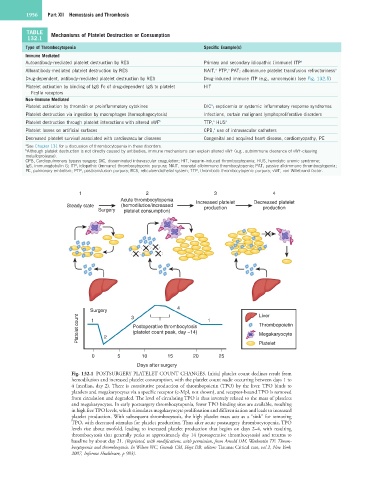
                           1                     2                     3                  4
                                        Acute thrombocytopenia   Increased platelet  Decreased platelet
                       Steady state      (hemodilution/increased    production         production
                                 Surgery  platelet consumption)


                               Surgery      3              4                          Liver
                           Platelet count  1  2  (platelet count peak, day ~14)  1    Thrombopoietin
                                             Postoperative thrombocytosis
                                                                                      Megakaryocyte


                               0       5       10       15      20       25           Platelet
                                              Days after surgery
                        Fig. 132.1  POSTSURGERY PLATELET COUNT CHANGES. Initial platelet count declines result from
                        hemodilution and increased platelet consumption, with the platelet count nadir occurring between days 1 to
                        4 (median, day 2). There is constitutive production of thrombopoietin (TPO) by the liver. TPO binds to
                        platelets and megakaryocytes via a specific receptor (c-Mpl, not shown), and receptor-bound TPO is removed
                        from circulation and degraded. The level of circulating TPO is thus inversely related to the mass of platelets
                        and megakaryocytes. In early postsurgery thrombocytopenia, fewer TPO binding sites are available, resulting
                        in high free TPO levels, which stimulates megakaryocyte proliferation and differentiation and leads to increased
                        platelet production. With subsequent thrombocytosis, the high platelet mass acts as a “sink” for removing
                        TPO, with decreased stimulus for platelet production. Thus after acute postsurgery thrombocytopenia, TPO
                        levels rise about twofold, leading to increased platelet production that begins on days 2–4, with resulting
                        thrombocytosis that generally peaks at approximately day 14 (postoperative thrombocytosis) and returns to
                        baseline by about day 21. (Reprinted, with modifications, with permission, from Arnold DM, Warkentin TE: Throm-
                        bocytopenia and thrombocytosis. In Wilson WC, Grande CM, Hoyt DB, editors: Trauma: Critical care, vol 2, New York,
                        2007, Informa Healthcare, p 983).

