


Page 2210 - Hematology_ Basic Principles and Practice ( PDFDrive )
P. 2210
Chapter 132  Thrombocytopenia Caused by Platelet Destruction, Hypersplenism, or Hemodilution  1957


            the  possibility  of  postoperative  thrombotic  thrombocytopenic   uremic syndrome (HUS); thrombocytopenia and microangiopathic
            purpura (TTP) should be considered. 6                 hemolysis that begin approximately 1 week after a prodromal diar-
              Mild to moderate platelet count decreases that occur soon after   rheal illness; and fungemia-associated thrombocytopenia (onset, 1–3
            transfusion of blood products are common and can be explained by   weeks after complex illness involving indwelling catheters and broad-
            hemodilution; however, a marked platelet count fall after transfusion   spectrum antibiotic usage). In contrast, thrombocytopenia of insidi-
            may be the result of passive alloimmune thrombocytopenia (PAT) or   ous  onset  that  progresses  over  several  years  suggests  chronic  liver
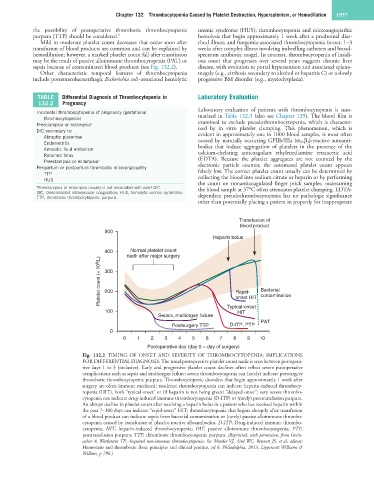
            sepsis because of contaminated blood products (see Fig. 132.2).  disease, with evolution to portal hypertension and associated spleno-
              Other  characteristic  temporal  features  of  thrombocytopenia   megaly (e.g., cirrhosis secondary to alcohol or hepatitis C) or a slowly
            include postenterohemorrhagic Escherichia coli–associated hemolytic   progressive BM disorder (e.g., myelodysplasia).

             TABLE   Differential Diagnosis of Thrombocytopenia in   Laboratory Evaluation
              132.2  Pregnancy
                                                                  Laboratory  evaluation  of  patients  with  thrombocytopenia  is  sum-
             Incidental thrombocytopenia of pregnancy (gestational   marized in Table 132.3 (also see Chapter 129). The blood film is
               thrombocytopenia)
             Preeclampsia or eclampsia a                          examined to exclude pseudothrombocytopenia, which is character-
                                                                  ized  by  in  vitro  platelet  clumping.  This  phenomenon,  which  is
             DIC secondary to:                                    evident in approximately one in 1000 blood samples, is most often
               Abruptio placentae                                 caused by naturally occurring GPIIb/IIIa (α IIbβ 3)-reactive autoanti-
               Endometritis                                       bodies  that  induce  aggregation  of  platelets  in  the  presence  of  the
               Amniotic fluid embolism                            calcium-chelating  anticoagulant  ethylenediamine  tetraacetic  acid
               Retained fetus                                     (EDTA).  Because  the  platelet  aggregates  are  not  counted  by  the
               Preeclampsia or eclampsia a
             Peripartum or postpartum thrombotic microangiopathy  electronic  particle  counter,  the  automated  platelet  count  appears
                                                                  falsely low. The correct platelet count usually can be determined by
               TTP                                                collecting the blood into sodium citrate or heparin or by performing
               HUS
                                                                  the count  on nonanticoagulated finger  prick samples; maintaining
             a Preeclampsia or eclampsia usually is not associated with overt DIC.  the blood sample at 37°C often attenuates platelet clumping. EDTA-
             DIC, Disseminated intravascular coagulation; HUS, hemolytic uremic syndrome;
             TTP, thrombotic thrombocytopenic purpura.            dependent pseudothrombocytopenia has no pathologic significance
                                                                  other than potentially placing a patient in jeopardy for inappropriate
                                                                               Transfusion of
                                                                               blood product
                                   500
                                                                       Heparin bolus
                                            Normal platelet count
                                   400    nadir after major surgery
                                  Platelet count (× 10 9 /L)  300             Rapid-  Bacterial


                                   200
                                                                                      contamination
                                                                              onset HIT
                                   100                                     Typical-onset
                                                                               HIT
                                                     Sepsis, multiorgan failure
                                                                                      PAT
                                                         Postsurgery TTP    D-ITP, PTP
                                     0
                                         0    1   2    3   4    5   6    7   8    9   10
                                                 Postoperative day (day 0 = day of surgery)
                            Fig.  132.2  TIMING  OF  ONSET  AND  SEVERITY  OF THROMBOCYTOPENIA:  IMPLICATIONS
                            FOR DIFFERENTIAL DIAGNOSIS. The usual postoperative platelet count nadir is seen between postopera-
                            tive days 1 to 3 (inclusive). Early and progressive platelet count declines often reflect severe postoperative
                            complications such as sepsis and multiorgan failure; severe thrombocytopenia can (rarely) indicate postsurgery
                            thrombotic thrombocytopenic purpura. Thrombocytopenic disorders that begin approximately 1 week after
                            surgery are often immune mediated: moderate thrombocytopenia can indicate heparin-induced thrombocy-
                            topenia (HIT), both “typical onset” or (if heparin is not being given) “delayed onset”; very severe thrombo-
                            cytopenia can indicate drug-induced immune thrombocytopenia (D-ITP) or (rarely) posttransfusion purpura.
                            An abrupt decline in platelet count after receiving a heparin bolus in a patient who has received heparin within
                            the past 7–100 days can indicate “rapid-onset” HIT; thrombocytopenia that begins abruptly after transfusion
                            of a blood product can indicate sepsis from bacterial contamination or (rarely) passive alloimmune thrombo-
                            cytopenia caused by transfusion of platelet-reactive alloantibodies. D-ITP, Drug-induced immune thrombo-
                            cytopenia;  HIT,  heparin-induced  thrombocytopenia;  PAT,  passive  alloimmune  thrombocytopenia;  PTP,
                            posttransfusion purpura; TTP, thrombotic thrombocytopenic purpura. (Reprinted, with permission, from Grein-
                            acher A, Warkentin TE: Acquired non-immune thrombocytopenia. In: Marder VJ, Aird WC, Bennett JS, et al, editors:
                            Hemostasis and thrombosis: Basic principles and clinical practice, ed 6, Philadelphia, 2013, Lippincott Williams &
                            Wilkins, p 796.)

