


Page 2211 - Hematology_ Basic Principles and Practice ( PDFDrive )
P. 2211
1958   Part XII  Hemostasis and Thrombosis


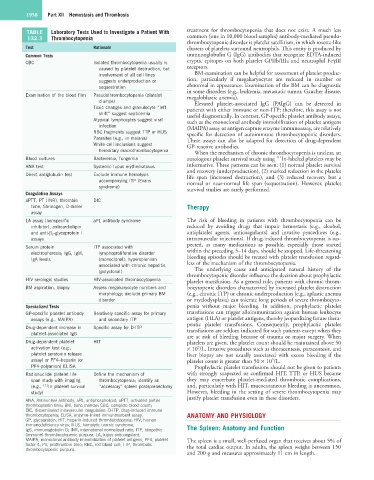
          TABLE   Laboratory Tests Used to Investigate a Patient With   treatment  for  thrombocytopenia  that  does  not  exist.  A  much  less
          132.3   Thrombocytopenia                            common (one in 10,000 blood samples) antibody-mediated pseudo-
                                                              thrombocytopenic disorder is platelet satellitism, in which rosette-like
         Test                   Rationale                     clusters of platelets surround neutrophils. This entity is produced by
         Common Tests                                         immunoglobulin G (IgG) antibodies that recognize EDTA-induced
         CBC                    Isolated thrombocytopenia usually is   cryptic epitopes on both platelet GPIIb/IIIa and neutrophil FcγIII
                                 caused by platelet destruction, but   receptors.
                                 involvement of all cell lines   BM examination can be helpful for assessment of platelet produc-
                                 suggests underproduction or   tion,  particularly  if  megakaryocytes  are  reduced  in  number  or
                                 sequestration                abnormal in appearance. Examination of the BM can be diagnostic
                                                              in some disorders (e.g., leukemia, metastatic tumor, Gaucher disease,
         Examination of the blood film  Pseudothrombocytopenia (platelet   megaloblastic anemia).
                                 clumps)                         Elevated  platelet-associated  IgG  (PAIgG)  can  be  detected  in
                                Toxic changes and granulocyte “left   patients with either immune or non-ITP; therefore, this assay is not
                                 shift” suggest septicemia    useful diagnostically. In contrast, GP-specific platelet antibody assays,
                                Atypical lymphocytes suggest viral   such as the monoclonal antibody immobilization of platelet antigens
                                 infection                    (MAIPA) assay or antigen capture enzyme immunoassay, are relatively
                                RBC fragments suggest TTP or HUS  specific  for  detection  of  autoimmune  thrombocytopenic  disorders.
                                Parasites (e.g., in malaria)  These  assays  can  also  be  adapted  for  detection  of  drug-dependent
                                White cell inclusions suggest   GP-reactive antibodies.
                                 hereditary macrothrombocytopenia  When the mechanism of chronic thrombocytopenia is unclear, an
                                                                                           111
         Blood cultures         Bacteremia, fungemia          autologous platelet survival study using  In-labeled platelets may be
         ANA test               Systemic lupus erythematosus  informative. Three patterns can be seen: (1) normal platelet survival
                                                              and recovery (underproduction), (2) marked reduction in the platelet
         Direct antiglobulin test  Exclude immune hemolysis   life  span  (increased  destruction),  and  (3)  reduced  recovery  but  a
                                 accompanying ITP (Evans      normal  or  near-normal  life  span  (sequestration).  However, platelet
                                 syndrome)                    survival studies are rarely performed.
         Coagulation Assays
         aPTT, PT (INR), thrombin   DIC
           time, fibrinogen, D-dimer                          Therapy
           assay
         LA assay (nonspecific   aPL antibody syndrome        The  risk  of  bleeding  in  patients  with  thrombocytopenia  can  be
           inhibitor), anticardiolipin                        reduced  by  avoiding  drugs  that  impair  hemostasis  (e.g.,  alcohol,
           and anti-β 2 -glycoprotein I                       antiplatelet  agents,  anticoagulants)  and  invasive  procedures  (e.g.,
           assays                                             intramuscular injections). If drug-induced thrombocytopenia is sus-
         Serum protein          ITP associated with           pected,  as  many  medications  as  possible,  especially  those  started
           electrophoresis; IgG, IgM,   lymphoproliferative disorder   within the preceding 5–14 days, should be stopped. Life-threatening
           IgA levels            (monoclonal); hypersplenism   bleeding episodes should be treated with platelet transfusion regard-
                                 associated with chronic hepatitis   less of the mechanism of the thrombocytopenia.
                                                                 The  underlying  cause  and  anticipated  natural  history  of  the
                                 (polyclonal)                 thrombocytopenic disorder influence the decision about prophylactic
         HIV serologic studies  HIV-associated thrombocytopenia  platelet transfusion. As a general rule, patients with chronic throm-
         BM aspiration, biopsy  Assess megakaryocyte numbers and   bocytopenic disorders characterized by increased platelet destruction
                                 morphology; exclude primary BM   (e.g., chronic ITP) or chronic underproduction (e.g., aplastic anemia
                                 disorder                     or myelodysplasia) can tolerate long periods of severe thrombocyto-
         Specialized Tests                                    penia  without  major  bleeding.  In  addition,  prophylactic  platelet
         GP-specific platelet antibody   Relatively specific assay for primary   transfusions can trigger alloimmunization against human leukocyte
           assays (e.g., MAIPA)  and secondary ITP            antigen (HLA) or platelet antigens, thereby jeopardizing future thera-
                                                              peutic  platelet  transfusions.  Consequently,  prophylactic  platelet
         Drug-dependent increase in   Specific assay for D-ITP  transfusions are seldom indicated for such patients except when they
           platelet-associated IgG
                                                              are at risk of bleeding because of trauma or major surgery. When
         Drug-dependent platelet   HIT                        platelets are given, the platelet count should be maintained above 50
           activation test (e.g.,                             × 10 /L. Invasive procedures such as thoracentesis, paracentesis, and
                                                                  9
           platelet serotonin release                         liver  biopsy  are  not  usually  associated  with  excess  bleeding  if  the
           assay) or PF4–heparin (or                          platelet count is greater than 50 × 10 /L.
                                                                                          9
           PF4-polyanion) ELISA                                  Prophylactic platelet transfusions should not be given to patients
         Radionuclide platelet life   Define the mechanism of   with  strongly  suspected  or  confirmed  HIT, TTP,  or  HUS  because
           span study with imaging   thrombocytopenia; identify an   they  may  exacerbate  platelet-mediated  thrombotic  complications,
           (e.g.,   111 In platelet survival   “accessory” spleen postsplenectomy  and, particularly with HIT, mucocutaneous bleeding is uncommon.
           study)                                             However,  bleeding  in  the  setting  of  severe  thrombocytopenia  may
                                                              justify platelet transfusion even in these disorders.
         ANA, Antinuclear antibody; aPL, antiphospholipid; aPTT, activated partial
         thromboplastin time; BM, bone marrow; CBC, complete blood count;
         DIC, disseminated intravascular coagulation; D-ITP, drug-induced immune
         thrombocytopenia; ELISA, enzyme-linked immunosorbent assay;    ANATOMY AND PHYSIOLOGY
         GP, glycoprotein; HIT, heparin-induced thrombocytopenia; HIV, human
         immunodeficiency virus; HUS, hemolytic uremic syndrome;
         IgG, immunoglobulin G; INR, international normalized ratio; ITP, idiopathic   The Spleen: Anatomy and Function
         (immune) thrombocytopenic purpura; LA, lupus anticoagulant;
         MAIPA, monoclonal antibody immobilization of platelet antigens; PF4, platelet   The spleen is a small, well-perfused organ that receives about 5% of
         factor 4; PT, prothrombin time; RBC, red blood cell; TTP, thrombotic   the total cardiac output. In adults, the spleen weighs between 150
         thrombocytopenic purpura.
                                                              and 200 g and measures approximately 11 cm in length.

