


Page 2216 - Hematology_ Basic Principles and Practice ( PDFDrive )
P. 2216
Chapter 132  Thrombocytopenia Caused by Platelet Destruction, Hypersplenism, or Hemodilution  1963


              Rarely, distinct drug-dependent IgG molecules destroy RBCs or   several that the patient is receiving) is most likely to explain a diag-
            WBCs  in  addition  to  platelets.  For  example,  both  platelet-  and   nosis of D-ITP. 10,12–14  The clinician should focus on drugs that have
            leukocyte-reactive  quinidine-dependent  IgG  molecules  have  been   been started 5–10 days before the onset of the platelet count decrease
            detected in a patient with quinidine-induced bicytopenia. Sometimes   (Fig. 132.5A). Also, with drugs such as quinine, in which there may
            the immune process is directed against a pluripotent hematopoietic   be intermittent exposure (e.g., consumption of gin and tonic), a very
            stem cell, resulting in pancytopenia accompanied by BM aplasia or   recent exposure (previous 1 or 2 days) usually explains the abrupt
            hypoplasia (e.g., gold-, carbamazepine-, or quinidine-induced pancy-  onset of symptomatic thrombocytopenia.
            topenia). A BM aspirate should be performed in patients with sus-  After the physician has identified one or more potential agents,
            pected  drug-induced  bicytopenia  or  pancytopenia  because  a   the next step is to determine whether these drugs have previously
            hypoplastic BM may be indicative of drug-induced aplastic anemia.  been implicated as causes of D-ITP. The box Search Strategies When
                                                                  Investigating Patient With Possible Drug-Induced Immune Throm-
                                                                  bocytopenic Purpura includes some strategies for identifying drugs
            Diagnosis                                             implicated in D-ITP.
                                                                    Demonstration of drug-dependent binding of IgG to platelets in
            A high index of clinical suspicion is required to make the diagnosis.   vitro  can  be  important  for  diagnosis  (see  Fig.  132.5B).  Labeled
            Moreover,  clinicians  need  to  evaluate  which  drug  (often  among   Ig-specific  probes  (e.g.,  phase  II  assays)  or  GP  capture  techniques
                                                                  (phase III assays) can be used (see Table 132.3). In other cases, D-ITP
                                                                  test results are negative, but the diagnosis still seems likely based on
                                                                  clinical features and supporting literature (see Fig. 132.6).
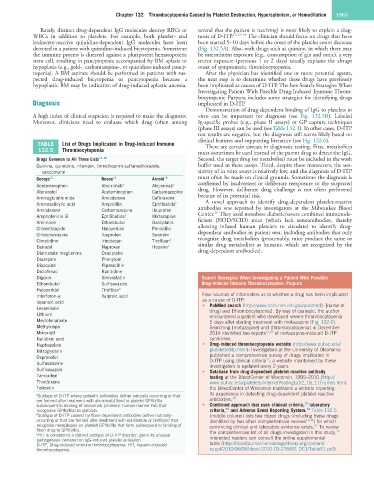
             TABLE   List of Drugs Implicated in Drug-Induced Immune   There are certain caveats in diagnostic testing. First, metabolites
              132.5  Thrombocytopenia                             must sometimes be used instead of the parent drug to detect the IgG.
             Drugs Common to All Three Lists 12–14                Second, the target drug (or metabolite) must be included in the wash
             Quinine, quinidine, rifampin, trimethoprim-sulfamethoxazole,   buffer used in these assays. Third, despite these maneuvers, the sen-
               vancomycin                                         sitivity of in vitro assays is relatively low, and the diagnosis of D-ITP
             George 12            Reese 13         Arnold 14      must often be made on clinical grounds. Sometimes the diagnosis is
             Acetaminophen        Abciximab a      Abciximab a    confirmed by inadvertent or deliberate reexposure to the suspected
             Alprenolol           Acetaminophen    Carbamazepine  drug.  However,  deliberate  drug  challenge  is  not  often  performed
             Aminoglutethimide    Amiodarone       Ceftriaxone    because of its potential risk.
             Aminosalicylic acid  Ampicillin       Eptifibatide b   A  novel  approach  to  identify  drug-dependent  platelet-reactive
             Amiodarone           Carbamazepine    Ibuprofen      antibodies  was  reported  by  investigators  at  the  Milwaukee  Blood
                                                                       20
             Amphotericin B       Eptifibatide b   Mirtazapine    Center.  They used nonobese diabetic/severe combined immunode-
             Amrinone             Ethambutol       Oxaliplatin    ficient  (NOD/SCID)  mice  (which  lack  xenoantibodies,  thereby
             Chlorothiazide       Haloperidol      Penicillin     allowing  infused  human  platelets  to  circulate)  to  identify  drug-
             Chlorpromazine       Ibuprofen        Suramin        dependent antibodies in patient sera, including antibodies that only
             Cimetidine           Irinotecan       Tirofiban b    recognize drug metabolites (presumably, mice produce the same or
             Danazol              Naproxen         Heparin c      similar  drug  metabolites  as  humans,  which  are  recognized  by  the
             Diatrizoate meglumine  Oxaliplatin                   drug-dependent antibodies).
             Diazepam             Phenytoin
             Diazoxide            Piperacillin
             Diclofenac           Ranitidine
             Digoxin              Simvastatin                      Search Strategies When Investigating a Patient With Possible
             Ethambutol           Sulfisoxazole                    Drug-Induced Immune Thrombocytopenic Purpura
             Haloperidol          Tirofiban b
             Interferon-α         Valproic acid                    Four sources of information as to whether a drug has been implicated
             Iopanoic acid                                         as a cause of D-ITP:
                                                                   •  PubMed search (http://www.ncbi.nlm.nih.gov/pubmed): [name of
             Levamisole                                               drug] and [thrombocytopenia]. By way of example, the author
             Lithium                                                  encountered a patient who developed severe thrombocytopenia
             Meclofenamate                                            5 days after starting treatment with mirtazapine (Fig. 132.6).
             Methyldopa                                               Searching [mirtazapine] and [thrombocytopenia] in December
             Minoxidil                                                2014 identified two reports 17,18  of mirtazapine-induced D-ITP
             Nalidixic acid                                           syndrome.
             Naphazoline                                           •  Drug-induced thrombocytopenia website (http://www.ouhsc.edu/
             Nitroglycerin                                            platelets/ditp.html): Investigators at the University of Oklahoma
             Oxprenolol                                               published a comprehensive survey of drugs implicated in
                                                                                        12
                                                                      D-ITP using clinical criteria ; a website maintained by these
             Sulfasalazine                                            investigators is updated every 2 years.
             Sulfisoxazole                                         •  Database from drug-dependent platelet-reactive antibody
             Tamoxifen                                                testing at the BloodCenter of Wisconsin, 1995–2010 (http://
             Thiothixene                                              www.ouhsc.edu/platelets/InternetPostingLab2_18_11Frames.htm):
             Tolmetin                                                 the BloodCenter of Wisconsin maintains a website reporting
             a Subtype of D-ITP where patient’s antibodies (either naturally occurring or that   its experience in detecting drug-dependent platelet-reactive
                                                                             19
             are formed after treatment with abciximab) bind to platelet GPIIb/IIIa   antibodies.    12
             subsequent to binding of abciximab (chimeric human-murine Fab that   •  Combined approach that uses clinical criteria,  laboratory
                                                                                                     13
                                                                           19
             recognizes GPIIb/IIIa) to platelets.                     criteria,  and Adverse Event Reporting System.  Table 132.5
             b Subtype of D-ITP caused by fiban-dependent antibodies (either naturally-  (middle column) lists two dozen drugs (including those drugs
             occurring or that are formed after treatment with eptifibatide or tirofiban) that   identified by two other comprehensive reviews 12,14 ) for which
             recognize neoepitopes on platelet GPIIb/IIIa that form subsequent to binding of   convincing clinical and laboratory evidence exists.  To review
                                                                                                        13
             fiban drug to GPIIb/IIIa.                                the comprehensive list of all drugs investigated in this study,
                                                                                                               13
             c HIT is considered a distinct subtype of D-ITP disorder, given its unusual
             pathogenesis centered on IgG-induced platelet activation.  interested readers can consult the online supplemental
             D-ITP, Drug-induced immune thrombocytopenia; HIT, heparin-induced   table (http://bloodjournal.hematologylibrary.org/content/
             thrombocytopenia.                                        suppl/2010/06/08/blood-2010-03-276691.DC1/TableS1.pdf).

