


Page 2329 - Hematology_ Basic Principles and Practice ( PDFDrive )
P. 2329
Chapter 139  Disseminated Intravascular Coagulation  2071


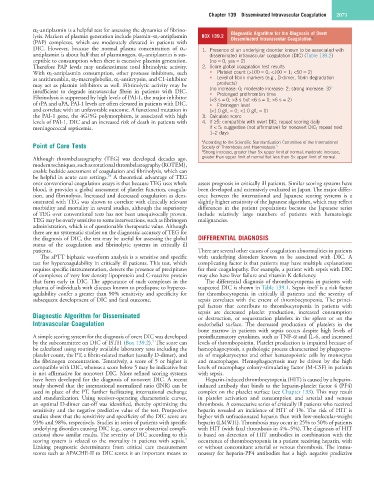
            α 2-antiplasmin is a helpful test for assessing the dynamics of fibrino-  Diagnostic Algorithm for the Diagnosis of Overt
            lysis. Markers of plasmin generation include plasmin–α 2-antiplasmin   BOX 139.2  Disseminated Intravascular Coagulation a
            (PAP)  complexes,  which  are  moderately  elevated  in  patients  with
            DIC.  However,  because  the  normal  plasma  concentration  of  α 2-  1.  Presence of an underlying disorder known to be associated with
            antiplasmin is about half that of plasminogen, α 2-antiplasmin is sus-  disseminated intravascular coagulation (DIC) (Table 139.2)
            ceptible to consumption when there is excessive plasmin generation.   (no = 0, yes = 2)
            Therefore  PAP  levels  may  underestimate  total  fibrinolytic  activity.   2.  Score global coagulation test results
            With  α 2-antiplasmin  consumption, other protease  inhibitors, such   •  Platelet count (>100 = 0; <100 = 1; <50 = 2)
            as antithrombin, α 2-macroglobulin, α 1-antitrypsin, and C1-inhibitor   •  Level of fibrin markers (e.g., D-dimer, fibrin degradation
            may act as plasmin inhibitors as well. Fibrinolytic activity may be   products)                  b
            insufficient  to  degrade  intravascular  fibrin  in  patients  with  DIC.   (no increase: 0; moderate increase: 2; strong increase: 3)
                                                                      •  Prolonged prothrombin time
            Fibrinolysis is suppressed by high levels of PAI-1, the major inhibitor   (<3 s = 0; >3 s but <6 s = 1; >6 s = 2)
            of tPA and uPA, PAI-1 levels are often elevated in patients with DIC,   •  Fibrinogen level
            and correlate with an unfavorable outcome. A functional mutation in   (>1.0 g/L = 0; <1.0 g/L = 1)
            the PAI-1 gene, the 4G/5G polymorphism, is associated with high   3.  Calculate score
            levels of PAI-1, DIC and an increased risk of death in patients with   4.  If ≥5: compatible with overt DIC; repeat scoring daily
            meningococcal septicemia.                                 If < 5: suggestive (not affirmative) for nonovert DIC; repeat next
                                                                      1–2 days
                                                                   a According to the Scientific Standardization Committee of the International
            Point of Care Tests                                    Society of Thrombosis and Haemostasis. 5
                                                                   b Strong increase, greater than 5× upper limit of normal; moderate increase,
            Although  thrombelastography  (TEG)  was  developed  decades  ago,   greater than upper limit of normal but less than 5× upper limit of normal.
            modern techniques, such as rotational thrombelastography (ROTEM),
            enable bedside assessment of coagulation and fibrinolysis, which can
                                    24
            be helpful in acute care settings.  A theoretical advantage of TEG
            over conventional coagulation assays is that because TEG uses whole   assess prognosis in critically ill patients. Similar scoring systems have
            blood, it provides a global assessment of platelet function, coagula-  been developed and extensively evaluated in Japan. The major differ-
            tion, and fibrinolysis. Increased and decreased coagulation as dem-  ence  between  the  international  and  Japanese  scoring  systems  is  a
            onstrated with TEG was shown to correlate with clinically relevant   slightly higher sensitivity of the Japanese algorithm, which may reflect
            morbidity and mortality in several studies, although the superiority   differences  in  the  patient  populations  because  the  Japanese  series
            of TEG over conventional tests has not been unequivocally proven.   include  relatively  large  numbers  of  patients  with  hematologic
            TEG may be overly sensitive to some interventions, such as fibrinogen   malignancies.
            administration, which is of questionable therapeutic value. Although
            there are no systematic studies on the diagnostic accuracy of TEG for
            the diagnosis of DIC, the test may be useful for assessing the global   DIFFERENTIAL DIAGNOSIS
            status  of  the  coagulation  and  fibrinolytic  systems  in  critically  ill
            patients.                                             There are several other causes of coagulation abnormalities in patients
              The aPTT biphasic waveform analysis is a sensitive and specific   with  underlying  disorders  known  to  be  associated  with  DIC.  A
            test for hypercoagulability in critically ill patients. This test, which   complicating factor is that patients may have multiple explanations
            requires specific instrumentation, detects the presence of precipitates   for their coagulopathy. For example, a patient with sepsis with DIC
            of complexes of very low density lipoprotein and C-reactive protein   may also have liver failure and vitamin K deficiency.
            that form early in DIC. The appearance of such complexes in the   The differential diagnosis of thrombocytopenia in patients with
            plasma of individuals with diseases known to predispose to hyperco-  suspected DIC is shown in Table 139.1. Sepsis itself is a risk factor
            agulability confer a greater than 90% sensitivity and specificity for   for  thrombocytopenia  in  critically  ill  patients  and  the  severity  of
            subsequent development of DIC and fatal outcome.      sepsis correlates with the extent of thrombocytopenia. The princi-
                                                                  pal  factors  that  contribute  to  thrombocytopenia  in  patients  with
            Diagnostic Algorithm for Disseminated                 sepsis  are  decreased  platelet  production,  increased  consumption
                                                                  or  destruction,  or  sequestration  platelets  in  the  spleen  or  on  the
            Intravascular Coagulation                             endothelial  surface.  The  decreased  production  of  platelets  in  the
                                                                  bone  marrow  in  patients  with  sepsis  occurs  despite  high  levels  of
            A simple scoring system for the diagnosis of overt DIC was developed   proinflammatory cytokines, such as TNF-α and IL-6, and increased
                                                   5
            by the subcommittee on DIC of ISTH (Box 139.2).  The score can   levels of thrombopoietin. Platelet production is impaired because of
            be calculated using routinely available laboratory tests including the   hemophagocytosis, a pathologic process characterized by phagocyto-
            platelet count, the PT, a fibrin-related marker (usually D-dimer), and   sis of megakaryocytes and other hematopoietic cells by monocytes
            the fibrinogen concentration. Tentatively, a score of 5 or higher is   and  macrophages.  Hemophagocytosis  may  be  driven  by  the  high
            compatible with DIC, whereas a score below 5 may be indicative but   levels of macrophage colony-stimulating factor (M-CSF) in patients
            is not affirmative for nonovert DIC. More refined scoring systems   with sepsis.
            have been developed for the diagnosis of nonovert DIC. A recent   Heparin-induced thrombocytopenia (HIT) is caused by a heparin-
            study showed that the international normalized ratio (INR) can be   induced antibody that binds to the heparin-platelet factor 4 (PF4)
            used in place of the PT, further facilitating international exchange   complex on the platelet surface (see Chapter 133). This may result
            and  standardization.  Using  receiver-operating  characteristic  curves,   in  platelet  activation  and  consumption  and  arterial  and  venous
            an optimal D-dimer cut-off was identified, thereby optimizing the   thrombosis. A consecutive series of critically ill patients who received
            sensitivity and the negative predictive value of the test. Prospective   heparin  revealed  an  incidence  of  HIT  of  1%. The  risk  of  HIT  is
            studies show that the sensitivity and specificity of the DIC score are   higher with unfractionated heparin than with low-molecular-weight
            93% and 98%, respectively. Studies in series of patients with specific   heparin (LMWH). Thrombosis may occur in 25% to 50% of patients
            underlying disorders causing DIC (e.g., cancer or obstetrical compli-  with HIT (with fatal thrombosis in 4%–5%). The diagnosis of HIT
            cations) show similar results. The severity of DIC according to this   is  based on  detection of  HIT  antibodies  in  combination with the
                                                              9
            scoring  system  is  related  to  the  mortality  in  patients  with  sepsis.    occurrence of thrombocytopenia in a patient receiving heparin, with
            Linking  prognostic  determinants  from  critical  care  measurement   or without concomitant arterial or venous thrombosis. The immu-
            scores such as APACHE-II to DIC scores is an important means to   noassay  for  heparin-PF4  antibodies  has  a  high  negative  predictive

