


Page 2330 - Hematology_ Basic Principles and Practice ( PDFDrive )
P. 2330
2072   Part XII  Hemostasis and Thrombosis


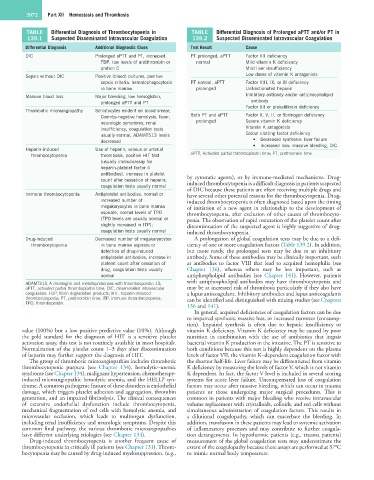
          TABLE   Differential Diagnosis of Thrombocytopenia in   TABLE   Differential Diagnosis of Prolonged aPTT and/or PT in
          139.1   Suspected Disseminated Intravascular Coagulation  139.2  Suspected Disseminated Intravascular Coagulation
         Differential Diagnosis  Additional Diagnostic Clues   Test Result       Cause
         DIC                    Prolonged aPTT and PT, increased   PT prolonged, aPTT   Factor VII deficiency
                                  FDP, low levels of antithrombin or   normal    Mild vitamin K deficiency
                                  protein C                                      Mild liver insufficiency
         Sepsis without DIC     Positive (blood) cultures, positive              Low doses of vitamin K antagonists
                                  sepsis criteria, hematophagocytosis   PT normal, aPTT   Factor VIII, IX, or XI deficiency
                                  in bone marrow                 prolonged       Unfractionated heparin
         Massive blood loss     Major bleeding, low hemoglobin,                  Inhibitory antibody and/or antiphospholipid
                                  prolonged aPTT and PT                            antibody
                                                                                 Factor XII or prekallikrein deficiency
         Thrombotic microangiopathy  Schistocytes evident on blood smear,
                                  Coombs-negative hemolysis, fever,   Both PT and aPTT   Factor X, V, II, or fibrinogen deficiency
                                  neurologic symptoms, renal     prolonged       Severe vitamin K deficiency
                                  insufficiency, coagulation tests               Vitamin K antagonists
                                  usually normal, ADAMTS13 levels                Global clotting factor deficiency
                                  decreased                                         •  Decreased synthesis: liver failure
                                                                                    •  Increased loss: massive bleeding, DIC
         Heparin-induced        Use of heparin, venous or arterial
           thrombocytopenia       thrombosis, positive HIT test   aPTT, Activated partial thromboplastin time; PT, prothrombin time.
                                  (usually immunoassay for
                                  heparin-platelet factor 4
                                  antibodies), increase in platelet   by cytostatic agents), or by immune-mediated mechanisms. Drug-
                                  count after cessation of heparin;   induced thrombocytopenia is a difficult diagnosis in patients suspected
                                  coagulation tests usually normal
                                                              of DIC because these patients are often receiving multiple drugs and
         Immune thrombocytopenia  Antiplatelet antibodies, normal or   have several other potential reasons for the thrombocytopenia. Drug-
                                  increased number of         induced thrombocytopenia is often diagnosed based upon the timing
                                  megakaryocytes in bone marrow   of initiation of a new agent in relationship to the development of
                                  aspirate, normal levels of TPO   thrombocytopenia, after exclusion of other causes of thrombocyto-
                                  (TPO levels are usually normal or   penia. The observation of rapid restoration of the platelet count after
                                  slightly increased in ITP);   discontinuation of the suspected agent is highly suggestive of drug-
                                  coagulation tests usually normal  induced thrombocytopenia.
         Drug-induced           Decreased number of megakaryocytes   A prolongation of global coagulation tests may be due to a defi-
           thrombocytopenia       in bone marrow aspirate or   ciency of one or more coagulation factors (Table 139.2). In addition,
                                  detection of drug-induced   but  more  rarely,  the  prolonged  tests  may  be  due  to  an  inhibitory
                                  antiplatelet antibodies, increase in   antibody. Some of these antibodies may be clinically important, such
                                  platelet count after cessation of   as  antibodies  to  factor  VIII  that  lead  to  acquired  hemophilia  (see
                                  drug; coagulation tests usually   Chapter  136),  whereas  others  may  be  less  important,  such  as
                                  normal                      antiphospholipid  antibodies  (see  Chapter  141).  However,  patients
         ADAMTS13, A disintegrin and metalloproteinase with thrombospondin 13;   with antiphospholipid antibodies may have thrombocytopenia and
         aPTT, activated partial thromboplastin time; DIC, disseminated intravascular   may be at increased risk of thrombosis particularly if they also have
         coagulation; FDP, fibrin degradation products; HIT, heparin-induced   a lupus anticoagulant. Inhibitory antibodies and lupus anticoagulants
         thrombocytopenia; PT, prothrombin time; ITP, immune thrombocytopenia;    can be identified and distinguished with mixing studies (see Chapters
         TPO, thrombopoietin.
                                                              136 and 141).
                                                                 In general, acquired deficiencies of coagulation factors can be due
                                                              to impaired synthesis, massive loss, or increased turnover (consump-
                                                              tion).  Impaired  synthesis  is  often  due  to  hepatic  insufficiency  or
        value (100%) but a low positive predictive value (10%). Although   vitamin K deficiency. Vitamin K deficiency may be caused by poor
        the  gold  standard  for  the  diagnosis  of  HIT  is  a  sensitive  platelet   nutrition  in  combination  with  the  use  of  antibiotics  that  impair
        activation assay, this test is not routinely available in most hospitals.   bacterial vitamin K production in the intestine. The PT is sensitive to
        Normalization of the platelet count 1–3 days after discontinuation   both conditions because this test is highly dependent on the plasma
        of heparin may further support the diagnosis of HIT.  levels of factor VII, the vitamin K–dependent coagulation factor with
           The group of thrombotic microangiopathies includes thrombotic   the shortest half-life. Liver failure may be differentiated from vitamin
        thrombocytopenic  purpura  (see  Chapter  134),  hemolytic–uremic   K deficiency by measuring the levels of factor V, which is not vitamin
        syndrome (see Chapter 134), malignant hypertension, chemotherapy-  K dependent. In fact, the factor V level is included in several scoring
        induced microangiopathic hemolytic anemia, and the HELLP syn-  systems  for  acute  liver  failure.  Uncompensated  loss  of  coagulation
        drome. A common pathogenic feature of these disorders is endothelial   factors may occur after massive bleeding, which can occur in trauma
        damage, which triggers platelet adhesion and aggregation, thrombin   patients  or  those  undergoing  major  surgical  procedures.  This  is
        generation, and an impaired fibrinolysis. The clinical consequences   common in patients with major bleeding who receive intravascular
        of  extensive  endothelial  dysfunction  include  thrombocytopenia,   volume replacement with crystalloids, colloids, and red cells without
        mechanical fragmentation of red cells with hemolytic anemia, and   simultaneous  administration  of  coagulation  factors. This results in
        microvasular  occlusion,  which  leads  to  multiorgan  dysfunction,   a  dilutional  coagulopathy,  which  can  exacerbate  the  bleeding.  In
        including renal insufficiency and neurologic symptoms. Despite this   addition, transfusion in these patients may lead to systemic activation
        common  final  pathway,  the  various  thrombotic  microangiopathies   of  inflammatory  processes  and  may  contribute  to  further  coagula-
        have different underlying etiologies (see Chapter 134).  tion derangements. In hypothermic patients (e.g., trauma patients)
           Drug-induced  thrombocytopenia  is  another  frequent  cause  of   measurement of the global coagulation tests may underestimate the
        thrombocytopenia in critically ill patients (see Chapter 131). Throm-  extent of the coagulopathy because these assays are performed at 37°C
        bocytopenia may be caused by drug-induced myelosuppression, (e.g.,   to mimic normal body temperature.

