


Page 2326 - Hematology_ Basic Principles and Practice ( PDFDrive )
P. 2326
2068   Part XII  Hemostasis and Thrombosis


                                                              may  also  complicate  other  types  of  sepsis-induced  DIC  and  may
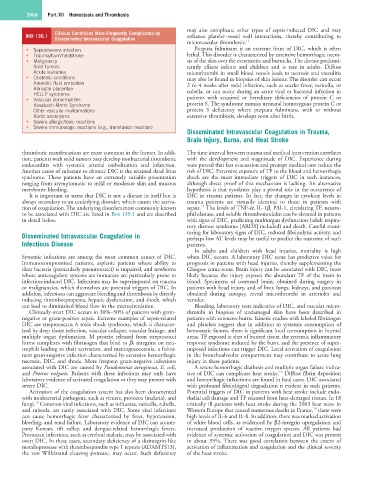
                   Clinical Conditions Most Frequently Complicated by
         BOX 139.1  Disseminated Intravascular Coagulation    enhance  platelet–vessel  wall  interactions,  thereby  contributing  to
                                                              microvascular thrombosis. 14
          •  Sepsis/severe infection                             Purpura  fulminans  is  an  extreme  form  of  DIC,  which  is  often
          •  Trauma/burn/heatstroke                           lethal. This disorder is characterized by extensive hemorrhagic necro-
          •  Malignancy                                       sis of the skin over the extremities and buttocks. The disease predomi-
            Solid tumors                                      nantly  affects  infants  and  children  and  is  rare  in  adults.  Diffuse
            Acute leukemia                                    microthrombi in small blood vessels leads to necrosis and vasculitis
          •  Obstetric conditions                             may also be found in biopsies of skin lesions. The disorder can occur
            Amniotic fluid embolism                           2 to 4 weeks after mild infection, such as scarlet fever, varicella, or
            Abruptio placentae                                rubella, or can occur during an acute viral or bacterial infection in
            HELLP syndrome
          •  Vascular abnormalities                           patients  with  acquired  or  hereditary  deficiencies  of  protein  C  or
            Kasabach-Merrit Syndrome                          protein S. The syndrome mimics neonatal homozygous protein C or
            Other vascular malformations                      protein  S  deficiency  where  purpura  fulminans,  with  or  without
            Aortic aneurysms                                  extensive thrombosis, develops soon after birth.
          •  Severe allergic/toxic reactions
          •  Severe immunologic reactions (e.g., transfusion reaction)
                                                              Disseminated Intravascular Coagulation in Trauma,
                                                              Brain Injury, Burns, and Heat Stroke
        thrombotic manifestations are more common in the former. In addi-  The time interval between trauma and medical intervention correlates
        tion, patients with solid tumors may develop nonbacterial thrombotic   with  the  development  and  magnitude  of  DIC.  Experience  during
        endocarditis  with  systemic  arterial  embolization  and  infarction.   wars proved that fast evacuation and prompt medical care reduce the
        Another cause of subacute to chronic DIC is the retained dead fetus   risk of DIC. Extensive exposure of TF to the blood and hemorrhagic
        syndrome. These  patients  have  an  extremely  variable  presentation   shock  are  the  most  immediate  triggers  of  DIC  in  such  instances,
        ranging from asymptomatic to mild or moderate skin and mucous   although direct proof of this mechanism is lacking. An alternative
        membrane bleeding.                                    hypothesis is that cytokines play a pivotal role in the occurrence of
           It is important to stress that DIC is not a disease in itself but is   DIC in trauma patients. In fact, the changes in cytokine levels in
        always secondary to an underlying disorder, which causes the activa-  trauma  patients  are  virtually  identical  to  those  in  patients  with
                                                                   15
        tion of coagulation. The underlying disorders most commonly known   sepsis.  The levels of TNF-α, IL-1β, PAI-1, circulating TF, neutro-
        to be associated with DIC are listed in Box 139.1 and are described   phil elastase, and soluble thrombomodulin can be elevated in patients
        in detail below.                                      with signs of DIC, predicting multiorgan dysfunction (adult respira-
                                                              tory distress syndrome [ARDS] included) and death. Careful moni-
        Disseminated Intravascular Coagulation in             toring for laboratory signs of DIC, reduced fibrinolytic activity, and
                                                              perhaps low AT levels may be useful to predict the outcome of such
        Infectious Disease                                    patients.
                                                                 In  adults  and  children  with  head  injuries,  mortality  is  high
        Systemic  infections  are  among  the  most  common  causes  of  DIC.   when DIC occurs. A laboratory DIC score has predictive value for
        Immunocompromised  patients,  asplenic  patients  whose  ability  to   prognosis in patients with head injuries, thereby supplementing the
        clear bacteria (particularly pneumococci) is impaired, and newborns   Glasgow coma score. Brain injury can be associated with DIC, most
        whose anticoagulant systems are immature are particularly prone to   likely because the injury exposes the abundant TF of the brain to
        infection-induced DIC. Infections may be superimposed on trauma   blood.  Specimens  of  contused  brain,  obtained  during  surgery  in
        or malignancies, which themselves are potential triggers of DIC. In   patients with head injury, and of liver, lungs, kidneys, and pancreas
        addition, infections can aggravate bleeding and thrombosis by directly   obtained  during  autopsy,  reveal  microthrombi  in  arterioles  and
        inducing thrombocytopenia, hepatic dysfunction, and shock, which   venules.
        can lead to diminished blood flow in the microcirculation.  Bleeding, laboratory tests indicative of DIC, and vascular micro-
           Clinically overt DIC occurs in 30%–50% of patients with gram-  thrombi  in  biopsies  of  undamaged  skin  have  been  described  in
        negative or gram-positive sepsis. Extreme examples of sepsis-related   patients with extensive burns. Kinetic studies with labeled fibrinogen
        DIC are streptococcus A toxic shock syndrome, which is character-  and  platelets  suggest  that  in  addition  to  systemic  consumption  of
        ized by deep tissue infection, vascular collapse, vascular leakage, and   hemostatic factors, there is significant local consumption in burned
        multiple  organ  dysfunction.  M  protein  released  from  streptococci   areas. TF exposed at sites of burned tissue, the systemic inflammatory
        forms complexes with fibrinogen that bind to β 2  integrins on neu-  response syndrome induced by the burn, and the presence of super-
        trophils leading to their activation, and meningococcemia, a fulmi-  imposed infections can trigger DIC. Local activation of coagulation
        nant gram-negative infection characterized by extensive hemorrhagic   in the bronchoalveolar compartment may contribute to acute lung
        necrosis, DIC, and shock. More frequent gram-negative infections   injury in these patients.
        associated with DIC are caused by Pseudomonas aeruginosa, E. coli,   A severe hemorrhagic diathesis and multiple organ failure indica-
                                                                                            16
        and  Proteus  vulgaris.  Patients  with  these  infections  may  only  have   tive of DIC can complicate heat stroke.  Diffuse fibrin deposition
        laboratory evidence of activated coagulation or they may present with   and hemorrhagic infarctions are found in fatal cases. DIC associated
        severe DIC.                                           with profound fibrin(ogen) degradation is evident in such patients.
           Activation of the coagulation system has also been documented   Potential triggers of DIC in patients with heat stroke include endo-
        with nonbacterial pathogens, such as viruses, protozoa (malaria), and   thelial cell damage and TF released from heat-damaged tissues. In 18
             13
        fungi.  Common viral infections, such as influenza, varicella, rubella,   critically ill patients with heat stroke during the 2003 heat wave in
                                                                                                       16
        and rubeola, are rarely associated with DIC. Some viral infections   Western Europe that caused numerous deaths in France,  there were
        can  cause  hemorrhagic  fever  characterized  by  fever,  hypotension,   high levels of IL-6 and IL-8. In addition, there was marked activation
        bleeding, and renal failure. Laboratory evidence of DIC can accom-  of white blood cells, as evidenced by β2-integrin upregulation and
        pany  Korean,  rift  valley,  and  dengue-related  hemorrhagic  fevers.   increased  production  of  reactive  oxygen  species.  All  patients  had
        Protozoan infections, such as cerebral malaria, may be associated with   evidence of systemic activation of coagulation and DIC was present
        overt DIC. In these cases, secondary deficiency of a disintegrin-like   in  about  35%. There  was  good  correlation  between  the  extent  of
        metalloprotease with thrombospondin type 1 repeats (ADAMTS13),   activation of inflammation and coagulation and the clinical severity
        the  von  Willebrand  cleaving  protease,  may  occur.  Such  deficiency   of the heat stroke.

