


Page 2324 - Hematology_ Basic Principles and Practice ( PDFDrive )
P. 2324
2066   Part XII  Hemostasis and Thrombosis


                                                                Protein C

                        Thrombomodulin +
                                thrombin


                              Endothelial                       Activated
                                protein C                       protein C
                                receptor
                                                               –
                                                                     Factor Va
                                                                     Factor VIIIa
                               Endothelial                                        Blocking
                             cell apoptosis                                       NFκB
                                                                                  translocation
                                                            –
                                                                     Tissue factor  –

                                                                                  Decreased
                                                    TFPI                      –   TNF-α and
                                                                                  IL production
                                                                                  in monocytes

                                                            –
                                                                     Thrombin
                                                                     Factor Xa
                         Glycosaminoglycans                                   –   Antiinflammatory
                                                                                  cytokines (IL-10)
                                                   Antithrombin

                                                                                  Increased TNF-α

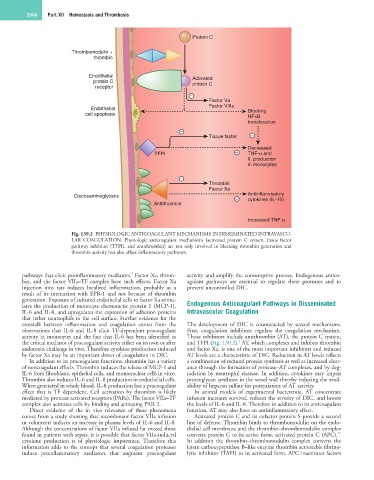
                        Fig. 139.2  PHYSIOLOGIC ANTICOAGULANT MECHANISMS IN DISSEMINATED INTRAVASCU-
                        LAR  COAGULATION.  Physiologic  anticoagulant  mechanisms  (activated  protein  C  system,  tissue  factor
                        pathway inhibitor (TFPI), and antithrombin) are not only involved in blocking thrombin generation and
                        thrombin activity but also affect inflammatory pathways.


                                            7
        pathways that elicit proinflammatory mediators.  Factor Xa, throm-  activity and amplify the consumptive process. Endogenous antico-
        bin, and the factor VIIa–TF complex have such effects. Factor Xa   agulant  pathways  are  essential  to  regulate  these  proteases  and  to
        injection  into  rats  induces  localized  inflammation,  probably  as  a   prevent uncontrolled DIC.
        result  of  its  interaction  with  EPR-1  and  not  because  of  thrombin
        generation. Exposure of cultured endothelial cells to factor Xa stimu-
        lates the production of monocyte chemotactic protein 1 (MCP-1),   Endogenous Anticoagulant Pathways in Disseminated
        IL-6 and IL-8, and upregulates the expression of adhesion proteins   Intravascular Coagulation
        that tether neutrophils to the cell surface. Further evidence for the
        crosstalk  between  inflammation  and  coagulation  comes  from  the   The  development  of  DIC  is  counteracted  by  several  mechanisms.
        observations  that  IL-6  and  IL-8  elicit TF-dependent  procoagulant   First,  coagulation  inhibitors  regulate  the  coagulation  mechanism.
        activity in monocytes and the fact that IL-6 has been identified as   Those inhibitors include antithrombin (AT), the protein C system,
                                                                               7
        the critical mediator of procoagulant activity either on its own or after   and TFPI (Fig. 139.2).  AT, which complexes and inhibits thrombin
        endotoxin challenge in vivo. Therefore cytokine production induced   and factor Xa, is one of the most important inhibitors and reduced
        by factor Xa may be an important driver of coagulation in DIC.  AT levels are a characteristic of DIC. Reduction in AT levels reflects
           In addition to its procoagulant functions, thrombin has a variety   a combination of reduced protein synthesis as well as increased clear-
        of noncoagulant effects. Thrombin induces the release of MCP-1 and   ance through the formation of protease–AT complexes, and by deg-
        IL-6 from fibroblasts, epithelial cells, and mononuclear cells in vitro.   radation by neutrophil elastase. In addition, cytokines may impair
        Thrombin also induces IL-6 and IL-8 production in endothelial cells.   proteoglycan synthesis in the vessel wall thereby reducing the avail-
        When generated in whole blood, IL-8 production has a procoagulant   ability of heparan sulfate for potentiation of AT activity.
        effect  that  is TF  dependent.  Cell  activation  by  thrombin  is  likely   In  animal  models  of  experimental  bacteremia,  AT  concentrate
        mediated by protease activated receptors (PARs). The factor VIIa–TF   infusion increases survival, reduces the severity of DIC, and lowers
        complex also activates cells by binding and activating PAR 2.  the levels of IL-6 and IL-8. Therefore in addition to its anticoagulant
           Direct  evidence  of  the  in  vivo  relevance  of  these  phenomena   function, AT may also have an antiinflammatory effect.
        comes from a study showing that recombinant factor VIIa infusion   Activated protein C and its cofactor protein S provide a second
        in volunteers induces an increase in plasma levels of IL-6 and IL-8.   line of defense. Thrombin binds to thrombomodulin on the endo-
        Although the concentrations of factor VIIa infused far exceed those   thelial cell membrane and the thrombin–thrombomodulin complex
                                                                                                               12
        found in patients with sepsis, it is possible that factor VIIa-induced   converts protein C to its active form, activated protein C (APC).
        cytokine  production  is  of  physiologic  importance.  Therefore  this   In  addition  the  thrombin–thrombomodulin  complex  converts  the
        information adds to the concept that several coagulation proteases   latent carboxypeptidase B–like enzyme thrombin activatable fibrino-
        induce  proinflammatory  mediators  that  augment  procoagulant   lytic inhibitor (TAFI) to its activated form. APC inactivates factors

