


Page 2372 - Hematology_ Basic Principles and Practice ( PDFDrive )
P. 2372
2114   Part XII  Hemostasis and Thrombosis


          A                                B                                  C


         D                                    E                               F

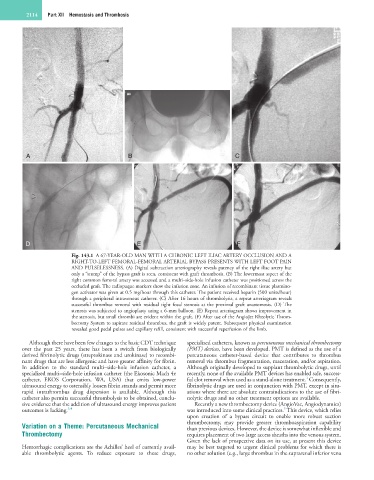
                        Fig. 143.1  A 67-YEAR-OLD MAN WITH A CHRONIC LEFT ILIAC ARTERY OCCLUSION AND A
                        RIGHT-TO-LEFT FEMORAL-FEMORAL ARTERIAL BYPASS PRESENTS WITH LEFT FOOT PAIN
                        AND PULSELESSNESS. (A) Digital subtraction arteriography reveals patency of the right iliac artery but
                        only a “stump” of the bypass graft is seen, consistent with graft thrombosis. (B) The lowermost aspect of the
                        right common femoral artery was accessed and a multi–side-hole infusion catheter was positioned across the
                        occluded graft. The radiopaque markers show the infusion zone. An infusion of recombinant tissue plasmino-
                        gen activator was given at 0.5 mg/hour through this catheter. The patient received heparin (500 units/hour)
                        through a peripheral intravenous catheter. (C) After 16 hours of thrombolysis, a repeat arteriogram reveals
                        successful thrombus removal with residual tight focal stenosis at the proximal graft anastomosis. (D) The
                        stenosis was subjected to angioplasty using a 6-mm balloon. (E) Repeat arteriogram shows improvement in
                        the stenosis, but small thrombi are evident within the graft. (F) After use of the AngioJet Rheolytic Throm-
                        bectomy System to aspirate residual thrombus, the graft is widely patent. Subsequent physical examination
                        revealed good pedal pulses and capillary refill, consistent with successful reperfusion of the limb.

           Although there have been few changes to the basic CDT technique   specialized catheters, known as percutaneous mechanical thrombectomy
        over  the  past  25  years,  there  has  been  a  switch  from  biologically   (PMT) devices, have been developed. PMT is defined as the use of a
        derived fibrinolytic drugs (streptokinase and urokinase) to recombi-  percutaneous  catheter-based  device  that  contributes  to  thrombus
        nant drugs that are less allergenic and have greater affinity for fibrin.   removal via thrombus fragmentation, maceration, and/or aspiration.
        In  addition  to  the  standard  multi–side-hole  infusion  catheter,  a   Although originally developed to supplant thrombolytic drugs, until
        specialized multi–side-hole infusion catheter (the Ekosonic Mach 4e   recently, none of the available PMT devices has enabled safe, success-
                                                                                                     1
        catheter,  EKOS  Corporation,  WA,  USA)  that  emits  low-power   ful clot removal when used as a stand-alone treatment.  Consequently,
        ultrasound energy to ostensibly loosen fibrin strands and permit more   fibrinolytic drugs are used in conjunction with PMT, except in situ-
        rapid  intrathrombus  drug  dispersion  is  available.  Although  this   ations where there are absolute contraindications to the use of fibri-
        catheter also permits successful thrombolysis to be obtained, conclu-  nolytic drugs and no other treatment options are available.
        sive evidence that the addition of ultrasound energy improves patient   Recently a new thrombectomy device (AngioVac, Angiodynamics)
                                                                                              5
        outcomes is lacking. 3,4                              was introduced into some clinical practices.  This device, which relies
                                                              upon  creation  of  a  bypass  circuit  to  enable  more  robust  suction
        Variation on a Theme: Percutaneous Mechanical         thrombectomy,  may  provide  greater  thromboaspiration  capability
                                                              than previous devices. However, the device is somewhat inflexible and
        Thrombectomy                                          requires placement of two large access sheaths into the venous system.
                                                              Given the lack of prospective data on its use, at present this device
        Hemorrhagic complications are the Achilles’ heel of currently avail-  may be best targeted to urgent clinical problems for which there is
        able  thrombolytic  agents.  To  reduce  exposure  to  these  drugs,   no other solution (e.g., large thrombus in the suprarenal inferior vena

